
What Is Identity Governance and Administration?
Identity Governance and Administration (IGA) is a security framework that automates and manages user identities and access rights across an organization's IT systems. It combines identity administration (provisioning, credentials) with access governance (policy enforcement, audits) to ensure the right users have appropriate access.
IGA helps achieve compliance with regulations, such as GDPR, HIPAA, and SOX, and strengthens security by reducing excessive permissions. By centralizing identity management, IGA provides a structured approach to handling user identities, roles, and entitlements.
Core components of IGA include:
Identity lifecycle management: Automates onboarding, offboarding, and role changes, managing the user's access from creation to deletion.
Access certification/attestation: Allows managers to periodically review and certify that employee access privileges are still necessary.
Policy enforcement: Defines and enforces policies such as Separation of Duties (SoD) to prevent risks like fraud.
Role management: Assigns access based on defined roles within the organization.
Separation of Duties (SoD): Enforces a security principle to prevent one user from completing sensitive or conflicting tasks alone, reducing fraud risk.
Access requests and self-service: Allows users to request access to resources through a centralized portal and automates approval workflows.
Provisioning and deprovisioning: Automates granting, updating, and removing user access across connected systems with validation to ensure correct enforcement.
Audit evidence and reporting: Collects and stores detailed records of identity and access activities to support compliance reporting and audit readiness.
Benefits of IGA
IGA delivers practical value by improving how identities and access are managed across systems. It reduces manual work, enforces consistent policies, and gives teams better visibility into who has access to what.
Enhanced security: IGA limits access based on roles and policies. This reduces unauthorized access and insider threats. It also helps detect and remove excessive privileges.
Compliance adherence: IGA supports regulatory requirements by enforcing access controls and maintaining audit trails. It simplifies reporting for standards such as SOX, SOC 2, ISO 27001, HIPAA, PCI-DSS, NYDFS, NIS2, GDPR.
Operational efficiency: Automation replaces manual provisioning and deprovisioning tasks. This speeds up onboarding and reduces errors in access management.
Risk mitigation: Regular access reviews and policy checks help identify risky permissions. This lowers the chance of breaches and misuse of data.
Centralized visibility: IGA provides a single view of identities, roles, and entitlements. This makes it easier to monitor and manage access across systems.
Lifecycle automation: User access is managed from creation to removal. Changes in roles or status trigger automatic updates to permissions.
Audit readiness: Built-in logging and reporting make audits faster and more accurate. Teams can quickly show who had access and why.
Cost control: Reducing manual work lowers administrative costs. Removing unused accounts and licenses also cuts waste.
Scalability: IGA systems can handle growing numbers of users and applications. This supports expansion without losing control over access.
Core Components of IGA
Let’s review the essential components of modern IGA systems.
1. Identity Lifecycle Management
Identity lifecycle management includes the processes and technologies used to create, modify, and deactivate user accounts throughout their time with the organization. It starts when a new user joins, as an employee, contractor, or partner, and continues as their roles and responsibilities change, ending when they leave or no longer require access. The goal is to ensure that users always have appropriate access based on their current status.
Automating identity lifecycle management reduces the risk of orphaned accounts and unauthorized access. Workflows can trigger provisioning and deprovisioning actions automatically based on HR or directory changes, ensuring timely updates across connected systems. Effective lifecycle management supports security, operational efficiency, and regulatory compliance by preventing lingering access and enforcing consistent policies.
2. Access Certification / Attestation
Access certification, also known as attestation, is the process of regularly reviewing and validating user access rights to ensure they remain appropriate. Organizations require managers or data owners to confirm that users’ entitlements are still necessary for their roles. This process helps identify and remove excessive, outdated, or unauthorized access.
Automated access certification campaigns can be scheduled at regular intervals or triggered by events such as a role change. IGA solutions support the review process by providing reviewers with clear information about user access and enabling approvals or revocations. This supports compliance with regulations and demonstrates due diligence in protecting sensitive information.
3. Policy Enforcement
Policy enforcement in IGA refers to the automated application of access control policies and business rules across systems and resources. These policies define who can access what, under which conditions, and what actions are allowed. IGA solutions monitor user access rights to detect and remediate policy violations.
Centralized enforcement helps prevent unauthorized access, segregation of duties violations, and privilege abuse. Automated policy enforcement also supports compliance by ensuring that access controls are applied and documented.
4. Role Management
Role management is the process of defining, assigning, and maintaining roles within an organization to standardize access control. Roles are collections of permissions that reflect job functions or responsibilities, making it easier to grant and manage access at scale. Effective role management reduces the need for individual entitlement assignments.
IGA solutions enable organizations to create role hierarchies, model business functions, and automate role-based provisioning. This approach improves access accuracy and reduces over-provisioning or privilege creep. Regular role reviews ensure that access remains aligned with business needs and organizational changes.
5. Separation of Duties (SoD)
Separation of Duties (SoD) is a security principle that prevents a single user from having enough access to complete sensitive or conflicting tasks alone. The goal is to reduce the risk of fraud, misuse, and human error by distributing responsibilities across multiple users or roles. In IGA, SoD policies define combinations of permissions that should not exist together.
For example, the same person should not be able to both create a vendor and approve payments to that vendor. IGA systems detect these conflicts during provisioning, role assignment, or access reviews. When violations are identified, workflows can block the request, trigger alerts, or require additional approvals. Continuous SoD monitoring helps organizations enforce internal controls and maintain compliance with financial and security regulations.
6. Access Requests and Self-Service
Access request and self-service capabilities allow users to request access to applications, systems, or roles without relying entirely on IT administrators. Users can browse available resources through a centralized portal, submit requests, and track approval status. This simplifies access management and reduces delays in granting permissions.
IGA platforms automate approval workflows based on predefined policies, business rules, or managerial oversight. Requests can be routed to managers, application owners, or security teams for validation before access is granted. Self-service features improve user experience while maintaining control and accountability. They also reduce help desk workloads by automating common tasks such as password resets and access changes.
7. Provisioning and Deprovisioning
Provisioning and deprovisioning refer to the automated process of granting, updating, and removing user access across connected systems. Provisioning occurs when users are assigned access based on their role, department, or approved requests. Deprovisioning removes access when users leave the organization or no longer require certain permissions.
Closed-loop provisioning adds validation and feedback mechanisms to ensure that requested changes are fully completed and correctly enforced across all systems. The IGA platform confirms whether accounts were successfully created, modified, or removed and can detect failures or inconsistencies. This reduces the risk of orphaned accounts, excessive privileges, and manual errors.
Automated provisioning and deprovisioning improve operational efficiency and strengthen security by ensuring access changes happen quickly and consistently. Integration with HR systems, directories, and cloud applications enables organizations to maintain accurate identity data and enforce access policies throughout the user lifecycle.
8. Audit Evidence and Reporting
Audit evidence and reporting provide organizations with detailed records of identity and access activities across systems. IGA solutions collect and store data such as access requests, approvals, role assignments, policy violations, and certification results. These records create a verifiable history of who had access to specific resources and why that access was granted.
Centralized reporting helps security and compliance teams generate reports for internal reviews and external audits. Reports can show user entitlements, privileged access, access changes, and policy enforcement status. Many IGA platforms also support scheduled reporting and real-time dashboards to improve visibility into access governance activities.
Maintaining accurate audit evidence supports compliance with regulations and security frameworks such as GDPR, HIPAA, SOX, and ISO 27001. Automated logging reduces manual documentation efforts and helps organizations demonstrate that access controls are consistently enforced. This improves audit readiness and shortens the time required to respond to compliance requests.
How IGA Supports Compliance Programs
IGA helps organizations meet regulatory requirements by enforcing consistent access controls and maintaining audit trails. It provides the structure and evidence needed to demonstrate that only authorized users can access sensitive systems and data.
Here’s a look at how IGA supports compliance:
Automated policy enforcement: IGA ensures that access permissions and authorizations remain aligned with regulatory requirements by applying and monitoring policies consistently across systems.
Comprehensive audit trails: All access-related activities are recorded and stored, providing verifiable evidence for use in compliance audits and regulatory reviews.
Regular access certifications: Periodic reviews of user access rights help confirm that entitlements remain appropriate for each user's current role and responsibilities.
Compliance dashboards: Real-time visibility into the compliance status of user accounts allows security and compliance teams to identify and address issues proactively.
Here are a few examples of compliance standards and the role IGA plays in each:
GDPR (General Data Protection Regulation): IGA limits access to personal data based on roles and business needs. It tracks who accessed data and when. Automated deprovisioning helps enforce least privilege.
HIPAA (Health Insurance Portability and Accountability Act): IGA ensures that only authorized personnel can access protected health information (PHI). Access reviews and logs help demonstrate compliance with security and privacy rules.
SOX (Sarbanes-Oxley Act): IGA enforces segregation of duties in financial systems. It provides audit trails and certification processes that verify access to financial data is reviewed regularly.
PCI DSS (Payment Card Industry Data Security Standard): IGA restricts access to cardholder data environments. It supports access controls, user activity tracking, and periodic access reviews required by PCI standards.
ISO/IEC 27001: IGA aligns with access control requirements by enforcing policies and managing identity lifecycles. Reporting and monitoring features help demonstrate adherence to security controls.
NIST (National Institute of Standards and Technology) frameworks
IGA supports identity and access management controls defined by NIST. It enables monitoring, policy enforcement, and risk-based access decisions.SOC 2 (System and Organization Controls 2): IGA helps organizations enforce logical access controls required under the Security Trust Services Criteria. Access reviews, provisioning workflows, and audit trails provide evidence that access is granted, monitored, and revoked according to policy.
NYDFS Cybersecurity Regulation (23 NYCRR 500): IGA supports requirements for access privilege management, periodic access reviews, and user lifecycle controls. Automated provisioning, deprovisioning, and certification processes help financial institutions demonstrate that access to information systems is appropriately restricted and regularly validated.
NIS2 (Network and Information Security Directive 2): IGA helps organizations implement identity and access controls required to reduce cybersecurity risk. It supports least-privilege access, accountability, continuous monitoring, and governance processes that help organizations protect critical systems and demonstrate compliance with security obligations.
The IGA Process: How Identity Governance and Administration Works
Step 1: Identity Data Aggregation
IGA begins by collecting identity data from authoritative systems such as HR platforms, directories, and contractor databases. In most organizations, the human resources information system (HRIS) acts as the primary source of truth for employee identity information. This includes attributes such as name, department, manager, job title, employment status, and location.
The IGA platform imports and normalizes this data to create a centralized identity record for each user. Integrations with systems such as Active Directory, cloud platforms, and business applications allow the platform to maintain a consistent view of identities across the environment.
Using the HRIS as the authoritative source ensures that identity changes are reflected accurately and quickly. Events such as hiring, transfers, promotions, or terminations trigger updates that drive downstream access management processes.
Step 2: Access Mapping and Identity Correlation
After identity data is collected, the IGA system maps user accounts and permissions across connected applications and infrastructure. Identity correlation links multiple accounts belonging to the same individual into a single identity profile.
For example, one employee may have accounts in Active Directory, Microsoft 365, Salesforce, and several internal systems. The IGA platform correlates these accounts using identifiers such as email address, employee ID, or username patterns.
This process creates a complete view of a user’s access across the organization. Accurate correlation is important for access reviews, policy enforcement, risk analysis, and lifecycle automation.
Step 3: Role Mining and Discovery
Role mining analyzes existing access patterns to identify common permission groupings among users with similar job functions. The goal is to create standardized roles that simplify access management and reduce manual entitlement assignments.
IGA platforms examine data such as department, location, job title, and application access to discover candidate roles. For example, employees in the finance department may consistently require access to the same accounting systems and reporting tools.
Role discovery helps organizations move from direct entitlement assignments to structured role-based access control (RBAC). This improves consistency, reduces excessive permissions, and makes provisioning easier to manage at scale.
Step 4: Policy Definition
Once identities and roles are established, organizations define access governance policies within the IGA platform. These policies determine how access is granted, reviewed, monitored, and revoked.
Policies may include least privilege requirements, segregation of duties rules, approval workflows, password standards, or conditional access requirements. Organizations can also define risk-based policies for privileged accounts or sensitive applications.
Centralized policy definition ensures that access controls are applied consistently across systems. Automated enforcement reduces reliance on manual oversight and helps prevent policy violations.
Step 5: Access Request and Approval
Users can request access to systems, applications, or roles through a centralized self-service portal. Requests are evaluated against organizational policies and routed through approval workflows before access is granted.
Approvals may involve managers, application owners, compliance teams, or security personnel depending on the sensitivity of the requested access. The IGA platform records all request and approval activity for auditing purposes.
Automated workflows reduce delays and improve consistency in access management. Users gain faster access to the resources they need while organizations maintain control and accountability.
Step 6: Automated Provisioning and Deprovisioning
After approval, the IGA platform automatically provisions or updates user access across connected systems. This may include creating accounts, assigning roles, adding group memberships, or configuring permissions.
When a user changes roles or leaves the organization, the platform automatically modifies or removes access based on lifecycle events from the HRIS or identity source. Deprovisioning ensures that obsolete accounts and permissions are removed promptly.
Automation reduces administrative effort and lowers the risk of human error. It also improves security by ensuring that access changes occur consistently and without delay.
Step 7: Review, Certification, and Remediation
IGA platforms regularly initiate access reviews and certification campaigns to validate that users still require their assigned permissions. Managers, application owners, or compliance teams review access rights and approve or revoke them as needed.
The system highlights excessive permissions, inactive accounts, policy violations, or segregation of duties conflicts. When issues are identified, remediation workflows can automatically remove access or trigger additional review steps.
Regular certification supports least privilege principles and helps organizations maintain compliance with regulatory requirements. It also improves visibility into access risks across the environment.
Step 8: Ongoing Reconciliation and Drift Detection
IGA continuously reconciles identity and access data between the governance platform and connected systems. This process detects differences between expected access states and actual permissions in target systems.
Drift can occur when administrators make direct changes outside approved workflows or when systems fail to synchronize correctly. The IGA platform identifies these inconsistencies and can trigger alerts, remediation actions, or policy enforcement steps.
Continuous reconciliation helps maintain accurate access records and prevents unauthorized or excessive privileges from persisting undetected. This strengthens governance and improves long-term access control integrity.
Common Identity Governance and Administration Use Cases
The common use cases for IGA center on managing the full identity lifecycle, ensuring proper governance for all user types, and maintaining compliance and audit readiness. By automating these critical functions, IGA reduces manual effort, improves security posture, and ensures that access is appropriate, timely, and consistently enforced across all connected systems.
Employee onboarding: IGA automates access provisioning for new hires, integrating with HR systems to create accounts and assign access based on predefined roles, departments, or location, ensuring a consistent and controlled start.
Employee role changes: When an employee transfers, IGA automatically updates their permissions, adding required access and removing permissions no longer needed, based on role-based rules and HR system triggers.
Offboarding and access removal: IGA ensures immediate access revocation across all connected systems when an employee leaves, preventing security risks from orphaned accounts and archiving access history for audits.
Access certification campaigns: The platform manages periodic reviews where managers validate that user access rights remain appropriate for their roles, tracking decisions (approve/revoke) and automatically enforcing changes.
Third-party and guest access governance: IGA governs external users (contractors, vendors) by enforcing limited, time-bound access through specific policies and expiration rules, often requiring internal sponsorship and review.
Mergers, acquisitions, and restructuring: IGA facilitates organizational changes by consolidating identity data, mapping roles, and enforcing consistent access policies across multiple environments to maintain security and operational continuity.
Audit response and evidence collection: IGA simplifies audit preparation by maintaining centralized, searchable records of access requests, approvals, and policy violations, which reduces manual effort and shortens response times.
The Challenge of Governing Human, Non-Human, and AI Identities
Modern organizations no longer manage only employee identities. They must also govern contractors, partners, service accounts, APIs, cloud workloads, robotic process automation (RPA) bots, and AI agents. In many environments, non-human identities now outnumber human users and often hold broad permissions to perform automated tasks. Unlike employees, these identities may not follow traditional joiner, mover, and leaver processes, making them harder to inventory, review, and secure.
AI agents introduce an additional layer of complexity because they can act autonomously, interact with multiple systems, and dynamically request or use access to complete tasks. Access may be temporary, delegated, or created on demand rather than assigned permanently. As a result, organizations need governance models that can manage human, machine, and AI identities together, applying consistent ownership, policy enforcement, monitoring, and lifecycle controls across all identity types.
Why Traditional IGA Is Breaking
Built for On-Prem AD and SAP, Not Modern SaaS and Cloud
Traditional IGA platforms were designed around centralized enterprise environments dominated by systems such as Active Directory, LDAP, and SAP. These environments changed slowly, used predictable role structures, and relied heavily on internal networks.
Modern organizations now operate across hundreds of SaaS applications, multi-cloud platforms, APIs, and remote work environments. Access is no longer limited to a small set of centrally managed systems. Users often authenticate directly with cloud services outside traditional directory boundaries.
Many legacy IGA platforms struggle to provide deep integration, real-time visibility, and granular governance across modern cloud ecosystems. Their architecture and workflows were not designed for highly distributed and rapidly changing environments.
SaaS Sprawl and Fine-Grained Entitlements
Organizations now use large numbers of SaaS applications, each with its own permission model, APIs, and administrative structure. A single user may have access to dozens or hundreds of cloud services, creating major visibility and governance challenges.
Traditional IGA systems were designed around coarse-grained access models such as application-level roles or directory groups. Modern SaaS platforms often expose highly granular entitlements, including feature-level permissions, workspace access, API scopes, and delegated administration rights.
Managing these fine-grained permissions manually becomes difficult at scale. Legacy IGA tools may lack detailed entitlement visibility or require extensive customization to govern modern SaaS access effectively. This creates blind spots that increase the risk of over-provisioning and privilege creep.
The Non-Human Identity Explosion
Machine and service identities now outnumber human users in many environments. Organizations manage service accounts, containers, APIs, robotic process automation (RPA) bots, CI/CD pipelines, cloud workloads, and machine-to-machine credentials across distributed systems.
Traditional IGA platforms primarily focused on employee lifecycle management and human access governance. Non-human identities often operate outside these workflows, making them difficult to inventory, monitor, and govern consistently.
Many machine identities also have privileged or persistent access that remains active for long periods. Without centralized governance, organizations face increased risks from unmanaged credentials, excessive privileges, and orphaned service accounts.
Agentic Identities and Ephemeral Access
Modern systems increasingly use short-lived and autonomous identities created dynamically by cloud platforms, automation tools, and AI agents. These identities may exist for only minutes or hours while performing specific tasks or workflows.
Traditional IGA processes rely on static identities, manual approvals, and scheduled review cycles. These approaches are too slow for environments where access is created and revoked continuously in real time.
Agentic AI systems introduce additional complexity because they can initiate actions, request access, and interact with enterprise systems autonomously. Organizations need governance models that support temporary, contextual, and continuously evaluated access instead of long-lived static permissions.
Multi-Year Deployments and Brittle Connectors
Legacy IGA implementations are often large and complex projects that require extensive customization, connector development, and integration work. Deployments can take months or years before delivering full value.
Many traditional connectors depend on fragile integrations, custom scripts, or outdated APIs that break when applications change. Maintaining these integrations becomes increasingly difficult as organizations adopt new SaaS platforms and cloud services.
The operational overhead of maintaining legacy IGA environments slows adaptation and increases costs. Modern organizations increasingly expect faster deployment models, API-driven integration, and flexible governance architectures that can evolve with changing technology environments.
How AI Improves IGA
Role Mining and Outlier Detection
AI improves role mining by analyzing identity, access, entitlement, usage, and organizational data to identify common access patterns across users with similar responsibilities. Instead of relying only on manually defined roles, AI can detect which permissions are typically required by users in the same department, job function, location, or peer group.
This helps organizations create more accurate roles and reduce over-provisioning. AI can also identify outliers, such as users who have access that is unusual compared to their peers or inconsistent with their current role. These exceptions may indicate privilege creep, misconfiguration, or unnecessary access that should be reviewed.
By combining role context with access behavior and risk signals, AI helps teams understand what appropriate access should look like. This makes role design more accurate, supports least privilege, and reduces the amount of manual analysis required to maintain clean access models.
Peer-Group Analytics for Review Recommendations
Peer-group analytics use AI to compare a user’s access with similar users in the organization. This gives reviewers more context during access certification campaigns and helps them distinguish normal access from unusual or risky permissions.
Instead of reviewing long lists of entitlements without guidance, managers can focus on access that stands out. AI can highlight permissions that are rarely used, inconsistent with a user’s peer group, tied to sensitive systems, or associated with elevated risk. It can also recommend approval for access that is commonly used by comparable users and aligns with the person’s role.
This reduces review fatigue and helps prevent rubber-stamped approvals. Reviewers can make faster and more confident decisions because they see the business context behind each entitlement, including usage patterns, peer comparisons, and risk indicators.
Access Request Approval Recommendations
AI improves access request workflows by helping approvers evaluate whether requested access is appropriate. When a user requests access to an application, role, or entitlement, AI can analyze the request against identity attributes, peer access, usage patterns, business context, and policy requirements.
Based on this analysis, AI can recommend whether the request should be approved, denied, modified, or escalated for additional review. For example, if the requested access is common for the user’s role and low risk, the system may recommend approval. If the request involves privileged access, sensitive data, or access that is unusual for the user’s peer group, it may recommend further review or a more limited alternative.
These recommendations help organizations remove guesswork from access decisions. They also support least privilege by guiding approvers toward the minimum access needed for the user’s job, rather than granting broad permissions by default.
Anomaly Detection on Approvals
AI can monitor approval activity to detect patterns that may indicate risk, abuse, or process failure. This includes unusual approval volumes, repeated approvals for high-risk access, approvals made without sufficient justification, or access decisions that conflict with normal peer-group or role-based patterns.
Anomaly detection helps identity teams move beyond periodic governance and toward continuous monitoring. Instead of waiting for the next certification campaign, AI can surface suspicious access decisions as they happen. These alerts can trigger additional review, remediation workflows, or policy enforcement actions.
This is especially useful in environments where access changes frequently and manual oversight cannot keep pace. By identifying unusual approval behavior early, AI helps reduce excessive permissions, policy drift, and the risk of inappropriate access remaining in place.
Auto-Classification of Entitlements
AI can automatically classify entitlements by analyzing what each permission allows, which systems it affects, how it is used, and whether it grants access to sensitive data or privileged functions. This helps organizations understand the real business meaning and risk level of permissions that may otherwise be difficult to interpret.
Auto-classification is valuable because entitlement names are often technical, inconsistent, or application-specific. AI can group permissions into categories such as standard access, privileged access, sensitive data access, unused access, high-risk access, or redundant access.
This makes governance more accurate and actionable. During access reviews, teams can prioritize high-risk or sensitive entitlements instead of treating all permissions equally. During remediation, they can identify excessive access more easily and recommend safer alternatives. Over time, entitlement classification helps reduce permission sprawl and supports more effective least-privilege enforcement.
IGA vs. Related Identity Security Tools
The following table summarizes the differences between IGA and related identity security solutions: AM, PAM, CIEM, and ISPM. Below we explore the differences in more detail.
Category | Primary Focus | Main Functions | Typical Scope | Example Capabilities |
IGA | Governing who should have access | Provisioning, access reviews, role management, policy enforcement | Organization-wide identities and entitlements | Joiner-mover-leaver workflows, certifications, segregation of duties |
Access Management (AM) | Controlling login and access sessions | Authentication, SSO, MFA, session control | User authentication and application access | Single sign-on, adaptive MFA, session timeout |
PAM | Securing privileged accounts | Credential vaulting, session brokering, privileged monitoring | Administrative and high-risk accounts | Just-in-time admin access, privileged session recording |
CIEM | Managing cloud permissions risk | Cloud entitlement analysis and remediation | Cloud infrastructure and cloud-native identities | Detecting excessive AWS or Azure permissions |
ISPM | Monitoring identity security posture | Continuous identity risk assessment | Identity infrastructure and configurations | Detecting orphaned accounts or weak authentication settings |
IGA vs. Access Management
Access management (AM) controls how users authenticate and gain entry to systems at the point of access. It handles mechanisms such as single sign-on (SSO), multi-factor authentication (MFA), and session management to verify that the right user is accessing the right resource at the right time.
Identity governance and administration (IGA) determines what access users should have and governs how that access is assigned, reviewed, and revoked across the identity lifecycle. It manages provisioning, access certifications, role assignments, and policy enforcement to ensure that users hold only the permissions appropriate for their role and responsibilities.
Key differences:
Focus: IGA governs who has access and why; AM controls how users prove their identity and gain entry.
Function: IGA manages provisioning, access reviews, and policy enforcement; AM handles authentication, SSO, and session control.
Timing: IGA operates across the identity lifecycle; AM acts at the moment of access.
Overlap: IGA defines access policies; AM enforces them at the authentication layer.
IGA vs. PAM
Privileged access management (PAM) secures, controls, and monitors accounts with elevated permissions, such as system administrators, database operators, and IT staff with root or superuser access. PAM tools vault credentials, enforce just-in-time access, and record privileged sessions to reduce the risk of misuse or compromise.
IGA governs access broadly across all user types, systems, and applications. It manages the full identity lifecycle, enforces role-based access policies, and runs access certification campaigns to ensure that permissions remain appropriate across the organization.
Key differences:
Scope: IGA covers all user identities and entitlements; PAM focuses on privileged and administrative accounts.
Function: IGA manages lifecycle, roles, and access reviews; PAM vaults credentials, brokers sessions, and records privileged activity.
Risk target: IGA reduces excessive permissions across the organization; PAM limits exposure from high-risk administrative access.
Complementarity: IGA can identify which accounts require privileged access; PAM governs how that access is used.
IGA vs. CIEM
Cloud infrastructure entitlement management (CIEM) manages excessive permissions in cloud environments. It focuses on cloud-native identities such as service accounts and roles across platforms like AWS, Azure, and Google Cloud. CIEM provides continuous visibility into what permissions exist in cloud environments, identifies over-provisioned roles, and surfaces risks such as unused entitlements or misconfigured policies at scale and in real time.
IGA provides governance across on-premises and cloud systems, including human and non-human identities. It ensures that access is provisioned appropriately, reviewed regularly, and revoked when no longer needed, through structured workflows that apply consistently across the environment.
Key differences:
Environment: CIEM is cloud-native and focused on IaaS and PaaS platforms; IGA spans on-premises, cloud, and SaaS environments.
Identity types: CIEM emphasizes machine, service, and cloud-native identities; IGA governs both human and non-human identities.
Function: CIEM detects and analyzes entitlement risk in cloud platforms; IGA manages lifecycle, provisioning, and access reviews.
Depth: CIEM provides granular visibility into cloud permissions; IGA provides broader governance workflows across the organization.
IGA vs. ISPM
Identity security posture management (ISPM) continuously assesses and monitors the overall security state of an organization's identity infrastructure. It identifies risks such as misconfigured accounts, orphaned identities, excessive permissions, weak authentication settings, and gaps in identity controls across the environment, providing a continuous, organization-wide view of identity risk rather than managing specific access decisions.
IGA governs access through structured workflows including provisioning, access reviews, role management, and policy enforcement. It produces the access records, audit trails, and certified entitlements that give organizations a documented history of who had access and why.
Key differences:
Purpose: IGA governs access through lifecycle and policy workflows; ISPM assesses and monitors the security posture of the identity environment.
Approach: IGA is process-driven, managing provisioning and certifications; ISPM is risk-driven, continuously evaluating identity configurations and exposures.
Output: IGA produces access decisions, audit trails, and certified entitlements; ISPM produces risk scores, posture assessments, and remediation recommendations.
Relationship: IGA generates the identity and access data that ISPM analyzes; ISPM identifies gaps that IGA processes can address.
What to Look for in an Identity Governance and Administration Solution
Native and Deep Application Integrations
A strong IGA solution should connect natively with the systems where identities and entitlements actually live. This includes HR platforms, directories, SaaS applications, cloud environments, collaboration tools, financial systems, and custom or homegrown applications. The deeper the integration, the more accurately the platform can discover accounts, understand permissions, enforce changes, and maintain reliable access records.
Look for integrations that go beyond basic account visibility. The solution should understand application-specific roles, groups, permissions, and entitlement structures. It should also support provisioning, deprovisioning, certification, and policy enforcement across connected systems. Deep integrations reduce blind spots, limit manual reconciliation, and help organizations govern access consistently across both modern and legacy environments.
Identity Correlation Across Systems
Identity correlation is essential for building a complete view of each user’s access. A good IGA platform should be able to link accounts from different systems back to the same person, even when usernames, email formats, or account structures differ across applications.
This capability helps security and compliance teams understand the full scope of access tied to an employee, contractor, vendor, service account, or other identity type. Accurate correlation supports better access reviews, cleaner lifecycle management, stronger policy enforcement, and faster detection of orphaned or duplicate accounts. Without reliable correlation, organizations may miss risky access that is spread across disconnected systems.
Automated Lifecycle Workflows
IGA solutions should automate the full identity lifecycle, from onboarding to role changes to offboarding. When a user joins the organization, changes departments, receives a promotion, or leaves, the platform should trigger the appropriate access changes based on identity attributes, policies, and approvals.
Effective lifecycle automation reduces manual IT work and ensures access is updated quickly and consistently. New users receive the access they need faster, while outdated permissions are removed when they are no longer required. This supports least privilege, reduces orphaned accounts, and lowers the risk of access remaining active after a user changes roles or exits the organization.
Role and Policy Management
Role and policy management help organizations standardize access decisions and enforce consistent governance rules. An IGA solution should support role definition, role mining, role assignment, and ongoing role maintenance so that access can be aligned with job function, department, location, seniority, and business need.
The platform should also allow teams to define and enforce access policies such as least privilege, segregation of duties, privileged access rules, approval requirements, and exceptions. Strong policy management reduces over-provisioning and helps prevent conflicting access combinations. Over time, role and policy controls make access easier to manage at scale and help keep permissions aligned with business change.
Access Reviews and Certifications
Access reviews and certifications are core IGA capabilities. The solution should make it easy for managers, application owners, and compliance teams to review user access and decide whether permissions should be approved, modified, or revoked.
A strong platform should provide reviewers with enough context to make informed decisions. This may include user role, department, manager, peer group comparisons, entitlement details, usage history, risk level, and previous review decisions. Context-rich reviews reduce rubber-stamping and help reviewers focus on access that is unusual, excessive, unused, or sensitive. Automated remediation should also be available so revoked access can be removed quickly after a review decision.
Reporting and Audit Capabilities
Reporting and audit capabilities should give organizations a clear, searchable record of identity and access activity. The IGA platform should track access requests, approvals, provisioning actions, certification decisions, policy violations, remediation steps, and administrative changes.
These records help security and compliance teams demonstrate that access controls are being enforced. Reports should support common audit needs, such as showing who had access to sensitive systems, why access was granted, who approved it, when it was reviewed, and whether policy violations were resolved. Strong reporting reduces manual audit preparation and helps organizations respond faster to internal reviews, external auditors, and regulatory requirements.
Risk Analytics and Intelligence
Modern IGA solutions should help teams prioritize access risk instead of treating every identity and entitlement the same. Risk analytics can identify excessive permissions, unused access, privileged accounts, policy violations, orphaned accounts, anomalous access patterns, and permissions that are unusual compared with similar users.
Intelligence-driven recommendations help teams make better access decisions during requests, reviews, and remediation. For example, the platform may flag high-risk entitlements, suggest least-privilege alternatives, or recommend additional approval for sensitive access. This helps organizations move from static governance to more adaptive, risk-aware identity security.
Time-to-Value and Agentless Discovery
Time-to-value is an important factor when evaluating an IGA solution. Traditional deployments can require long implementation cycles, heavy customization, and extensive connector work before teams see meaningful results. A modern solution should provide fast discovery, quick integration, and practical governance outcomes early in the deployment.
Agentless discovery can help by identifying identities, accounts, entitlements, and access relationships without requiring software agents across every system. This makes it easier to gain visibility into the environment, prioritize high-risk areas, and begin access reviews or remediation sooner. Faster deployment reduces operational burden and helps security teams address identity risk without waiting months or years for a full implementation.
Identity Governance and Administration Metrics and KPIs
Organizations use IGA metrics and key performance indicators (KPIs) to measure the effectiveness of access governance processes, identify operational gaps, and track security improvements over time. These metrics help security, compliance, and IT teams understand whether access controls are working as intended and whether governance processes are efficient and scalable.
Common IGA metrics include:
Time-to-provision and deprovision SLA hit rate: Measures how consistently the organization meets service-level targets for granting or removing access. Delays in provisioning affect productivity, while delayed deprovisioning increases security risk.
Percentage of access granted via roles vs. direct grants: Tracks how much access is assigned through standardized roles instead of manual entitlement assignments. Higher role-based access adoption usually indicates stronger governance and reduced administrative complexity.
Orphan account count: Identifies accounts that remain active without a valid owner or associated identity. Orphan accounts are a common source of unauthorized access risk.
Certification completion and revocation rates: Measures how many access reviews are completed on time and how often access is revoked during certifications. High revocation rates may indicate excessive provisioning or weak role design.
Provisioning error rate: Tracks failed or incomplete provisioning and deprovisioning actions across connected systems. High error rates may indicate integration problems or workflow issues.
Average access request approval time: Measures how long it takes for access requests to move through approval workflows. Long approval times can slow operations and reduce user productivity.
Segregation of duties (SoD) violation count: Monitors the number of conflicting access combinations detected across the environment. This metric helps organizations assess policy enforcement effectiveness.
Dormant or inactive account percentage: Tracks accounts that remain unused for extended periods while still retaining access. Dormant accounts increase attack surface and should be reviewed regularly.
Excessive privilege rate: Measures how many users have permissions beyond what is required for their role. This helps evaluate least privilege enforcement.
Automated vs. manual access changes: Shows the percentage of access modifications handled through automation instead of manual administration. Higher automation levels generally improve consistency and reduce operational overhead.
Identity Governance and Administration Best Practices
Start With Least Privilege as the Operating Model
Least privilege should be the foundation of every IGA program. Users, contractors, service accounts, and applications should receive only the access required to perform their approved responsibilities, and that access should be removed when it is no longer needed.
Organizations should avoid granting broad default access or relying on permanent exceptions. Instead, access should be based on business need, role, risk level, and context. Sensitive permissions should require stronger approval, tighter monitoring, and more frequent review.
Least privilege also requires continuous maintenance. Job responsibilities change, applications evolve, and permissions accumulate over time. Regular access reviews, usage analysis, role refinement, and automated deprovisioning help prevent privilege creep and keep access aligned with current business requirements.
Automate Joiner, Mover, and Leaver Workflows
Joiner, mover, and leaver workflows should be automated wherever possible. When employees join, change roles, transfer departments, or leave the organization, access changes should be triggered by authoritative identity sources such as HR systems, directories, or workforce management platforms.
Automation helps ensure that users receive the right access quickly when they start a role and lose outdated access when their responsibilities change. This reduces manual IT work, improves user productivity, and lowers the chance of inconsistent or delayed access changes.
Leaver automation is especially important because inactive accounts and delayed deprovisioning create significant security risk. IGA workflows should remove or disable access promptly across applications, cloud environments, directories, privileged accounts, and connected systems when a user exits the organization.
Use Business Context to Improve Access Decisions
Access decisions are more effective when reviewers and approvers understand the business context behind each permission. IGA processes should use attributes such as job title, department, manager, location, employment type, application ownership, entitlement sensitivity, and usage history to guide access decisions.
Business context helps teams distinguish between access that is appropriate and access that is unusual or excessive. For example, a finance user may need access to financial systems, while the same entitlement may be risky for a user in another department. Context allows governance teams to apply policies more accurately instead of treating all access the same.
This context should be visible during access requests, approvals, certifications, and remediation workflows. When reviewers can see why access exists, how often it is used, and whether similar users have the same permissions, they are more likely to make informed decisions.
Reduce Rubber-Stamped Approvals
Access reviews lose value when managers and application owners approve permissions without meaningful evaluation. Rubber-stamped approvals often happen when reviewers receive too many items, lack enough context, or do not understand the risk associated with each entitlement.
IGA programs should make reviews focused, risk-based, and easy to understand. Reviewers should be shown high-risk, unused, unusual, privileged, or policy-violating access first. Low-risk access can be grouped, automated, or reviewed less frequently depending on the organization’s policy and regulatory requirements.
Review campaigns should also include clear ownership, deadlines, escalation paths, and remediation tracking. Decisions should be auditable, and revoked access should be removed automatically where possible. The goal is to turn access reviews from a checkbox exercise into a practical control that reduces identity risk.
Govern Human, Non-Human, and AI Identities Together
Modern identity governance must include more than employees and contractors. Organizations should also govern service accounts, machine identities, cloud roles, API credentials, bots, workloads, and AI agents. These identities often have powerful access and may not follow traditional employee lifecycle processes.
Non-human and AI identities should have clear ownership, documented purpose, assigned risk levels, and defined expiration or review requirements. Their permissions should be reviewed regularly, especially when they have privileged access, persistent credentials, or access to sensitive systems and data.
As AI agents and automation tools become more common, organizations need governance models that can handle temporary, delegated, and autonomous access. IGA programs should support contextual policies, time-bound permissions, continuous monitoring, and rapid revocation so that both human and machine access remains controlled across the environment.
Discover Before You Govern
Organizations should start by building a clear inventory of identities, accounts, entitlements, applications, and access relationships before trying to enforce broad governance policies. Without accurate discovery, security teams may miss orphaned accounts, unmanaged service accounts, excessive permissions, shadow applications, or access that was granted outside approved workflows.
Discovery should cover both users and the systems they touch, including directories, SaaS applications, cloud environments, privileged accounts, APIs, and custom applications. It should also identify who owns each account, what permissions exist, how those permissions are used, and whether access aligns with the person’s role or business need.
This visibility gives IGA programs a stronger foundation. Teams can prioritize the highest-risk systems first, clean up stale or excessive access, map entitlements to business owners, and design policies based on real access patterns instead of assumptions. Discovery also helps organizations show faster value by identifying risk before long-term role modeling or certification programs are fully mature.
Use HRIS as the Source of Truth
The HRIS should serve as the authoritative source for core workforce identity data. Attributes such as employment status, department, job title, manager, location, start date, and termination date should drive identity lifecycle decisions across connected systems.
Using HR data as the foundation helps ensure that access changes are tied to real business events. When someone joins, transfers, changes managers, moves departments, or leaves the organization, those changes can automatically trigger provisioning, access updates, approvals, or deprovisioning workflows.
This reduces reliance on manual tickets and informal notifications, which are often delayed or incomplete. It also improves auditability because access decisions can be traced back to verified workforce records. For the best results, organizations should keep HRIS data clean, define ownership for key identity attributes, and ensure that downstream systems receive updates quickly and consistently.
Close the Loop Between Governance Decisions
IGA programs should not stop at approving, rejecting, or revoking access in a review screen. Every governance decision should be carried through to the target system and verified after the change is made. This is what turns access governance from a reporting exercise into an enforceable control.
Closed-loop governance means that access requests, review decisions, policy violations, and remediation actions are connected to provisioning and deprovisioning workflows. If a manager revokes access during a certification campaign, the system should remove that access, confirm the change, record the outcome, and flag any failure or drift.
This feedback loop helps prevent access from remaining active after it has been rejected or revoked. It also improves audit readiness because teams can prove not only that a decision was made, but that it was enforced. Continuous reconciliation should compare expected access with actual permissions so organizations can detect direct administrative changes, failed updates, or unauthorized access drift.
Govern Human and Non-Human Identities Together
IGA programs should govern all identity types through a unified model, not just employees and contractors. Service accounts, API keys, bots, cloud workloads, automation scripts, machine identities, and AI agents can all hold sensitive access and may create risk if they are unmanaged.
Each non-human or AI identity should have a clear owner, purpose, scope, access policy, and review cadence. These identities should not rely on shared credentials or broad persistent permissions. Where possible, they should use scoped access, short-lived credentials, strong authentication, and least-privilege permissions tied to a specific task or workflow.
Provisioning AI identities introduces additional governance challenges because they may request, assign, or modify access through automated workflows. Organizations should define what these identities are allowed to provision, which systems they can interact with, when human approval is required, and how their actions are logged. Bringing human, machine, and AI identities into the same governance framework helps reduce blind spots, strengthen accountability, and maintain consistent access controls across the full environment.
AI-Driven Identity Governance with Opti
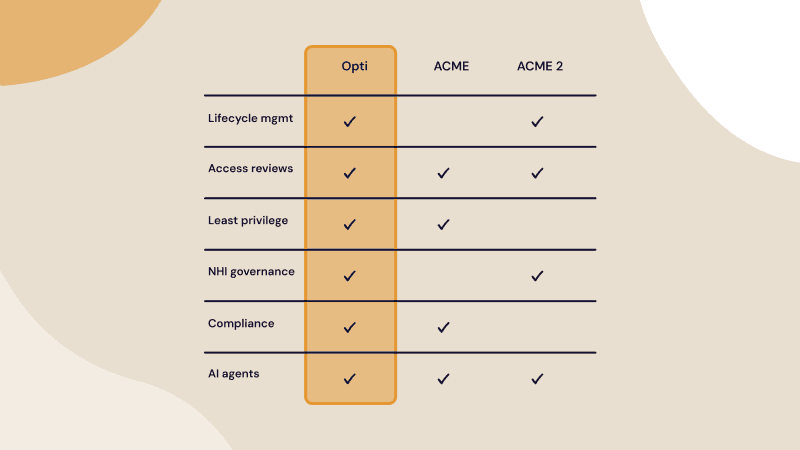
Opti is an AI-native identity security platform that turns identity governance from a periodic, manual process into a continuous operation across all identity types. Purpose-built AI models power three core capabilities: risk visibility and remediation, automated user access reviews, and intelligent access administration. Unlike legacy IGA platforms that require multi-year deployments and brittle connector configurations, Opti deploys in hours, works across cloud and on-prem environments, and covers human, non-human, and agentic identities from a single platform.
Key capabilities of Opti include:
Continuous risk visibility and remediation: excessive permissions, orphaned accounts, and policy violations are surfaced and fixed, not just flagged
Automated access reviews: high-risk access prioritized, low-risk deprioritized or auto-handled, with reviewer context built in so certifications stop being rubber stamps
Intelligent access administration: joiner, mover, and leaver workflows automated with closed-loop provisioning and deprovisioning verified across target systems
Coverage for human, non-human, and agentic identities from a single governance layer
Natural language governance policies: teams define rules in plain English, Opti translates them into live actionable logic
Agentless discovery and fast deployment: visibility across systems without agents on every endpoint, live in hours not months