What is a Non-Human Identity?
A non-human identity (NHI) typically refers to a digital credential used by software, such as applications, APIs, bots, AI agents, and devices, to automatically authenticate and access systems. In cybersecurity, NHIs heavily outnumber human users in most IT environments and are highly targeted by attackers if unmonitored.
Unlike human identities, which are tied to individuals, NHIs are tied to technical components and are managed programmatically. NHIs play a key role in enabling automation, integration, and secure communication between systems in modern IT environments.
These identities can take many forms, such as service accounts, API keys, tokens, and certificates. Their primary function is to authenticate and authorize non-human actors within an organization’s infrastructure. As organizations adopt cloud, DevOps, and automation, NHIs have become fundamental to operational workflows. Managing NHIs securely is critical, as they often have access to sensitive data and essential services, making them attractive targets for attackers if not properly controlled.
This is part of a series of articles about identity and access management
Why Non-Human Identities Are Growing
Non-human identities are growing because modern systems depend on automation, cloud services, and machine-to-machine communication. Each new service, workflow, and integration often requires its own identity to authenticate and access resources.
Cloud environments create more NHIs because workloads, containers, serverless functions, and managed services need identities to communicate securely.
DevOps pipelines rely on NHIs to build, test, deploy, and monitor applications without manual user actions.
APIs and integrations increase the number of NHIs because systems need keys, tokens, and certificates to exchange data.
Microservices architectures create many service-to-service connections, and each connection may require a separate identity.
Automation tools use NHIs to run scheduled tasks, manage infrastructure, rotate secrets, and perform routine operations.
IoT and edge devices add more NHIs because each device may need its own identity to connect, send data, or receive commands.
Security requirements also drive NHI growth, as organizations separate identities by workload, environment, or permission level to reduce risk.
Human Identity vs. Non-Human Identity vs. Machine Identity
Human identities represent individual users who access systems, applications, and data using credentials like usernames and passwords. These identities are typically managed through directory services and subject to user-centric policies, such as multifactor authentication and regular access reviews.
Non-human identities represent software entities, applications, scripts, or automated processes that require access to digital resources. While both types of identities need secure management, their usage patterns and risk profiles differ significantly.
Machine identities are a subset of non-human identities, referring to digital certificates, cryptographic keys, and similar credentials used by devices and servers for mutual authentication. While all machine identities are non-human, not all NHIs are machine identities; NHIs also include service accounts, tokens, and API keys.
Aspect | Human Identity | Non-Human Identity | Machine Identity |
Represents | Individual user | Application, service, script, or automated process | Device, server, or workload using cryptographic credentials |
Primary credentials | Username, password, MFA | Service accounts, API keys, OAuth tokens, secrets | Certificates, private keys, PKI credentials |
Primary purpose | User access to systems and data | Automated access between applications and services | Mutual authentication and encrypted machine-to-machine communication |
Relationship | Separate identity type | Broad category | Subset of non-human identities |
Related content: Learn how an identity fabric unifies human, non-human, and machine identities.
Common Types of Non-Human Identities
1. Service Accounts
Service accounts are special-purpose accounts used by applications, services, or automated tasks to interact with systems and resources. Unlike user accounts, service accounts are not assigned to individual people but are created for specific functions, such as running a database service or managing scheduled jobs. They often require elevated privileges to perform their tasks, which makes their security and management critical to overall system integrity.
Proper handling of service accounts involves strict access controls, regular credential rotation, and clear documentation of their purpose and permissions. Service accounts can be local to a system, domain-wide, or exist in the cloud, depending on the environment. Mismanagement or over-permissioning of service accounts can result in unauthorized access or privilege escalation, making them a frequent target for attackers.
2. API Keys
API keys are unique identifiers used to authenticate applications or services when accessing APIs. They are commonly issued by platforms to developers or automated systems, enabling secure communication between different software components. API keys are often embedded in application code or configuration files, providing a way to validate requests and enforce usage quotas.
API keys can pose security risks if not managed properly. If exposed or leaked, they can be used by unauthorized parties to access sensitive data or perform actions within systems. Best practices include restricting API key permissions, rotating them regularly, and storing them securely using secrets management tools. Monitoring usage and promptly revoking compromised keys are also necessary for maintaining security.
3. OAuth Tokens
OAuth tokens are credentials issued by an authorization server as part of the OAuth protocol, which is widely used for delegated access to resources. These tokens allow applications or services to access APIs on behalf of users or themselves, without sharing passwords. OAuth tokens are typically short-lived and can be scoped to limit access to specific resources or actions, providing fine-grained control over permissions.
OAuth tokens are standard in modern web and cloud applications, enabling secure integrations and third-party access. Improper management of OAuth tokens, such as storing them insecurely or failing to revoke them after use, can lead to unauthorized access. Organizations should implement token management practices, including secure storage, timely expiration, and regular audits, to reduce risk.
4. Workload Identities
Workload identities are digital identities assigned to software workloads, such as containers, virtual machines, or serverless functions. These identities enable workloads to authenticate to other services and resources without hardcoding credentials. Cloud providers offer native solutions for workload identity, such as AWS IAM roles, Azure Managed Identities, and Google Cloud service accounts, which simplify credential management and improve security.
Workload identities help enforce least privilege by granting only the permissions necessary for the workload’s function. They also enable authentication across dynamic and ephemeral environments. Managing workload identities at scale requires automation, policy enforcement, and continuous monitoring to prevent privilege creep and unauthorized access.
5. Machine Certificates
Machine certificates are digital certificates issued to devices, servers, or applications for mutual authentication and secure communication. These certificates use public key infrastructure (PKI) to establish trust between machines, encrypt traffic, and prevent man-in-the-middle attacks. Machine certificates are widely used in VPNs, SSL/TLS connections, and internal network authentication.
Managing machine certificates involves tracking their issuance, renewal, and revocation across the organization. Expired or compromised certificates can disrupt services or expose systems to risk, making certificate lifecycle management necessary. Automated certificate management solutions help maintain visibility, enforce policies, and reduce the risk of outages or security incidents caused by mismanaged certificates.
6. CI/CD and DevOps Identities
CI/CD and DevOps pipelines rely on non-human identities to automate code builds, tests, deployments, and integrations. These identities can take the form of service accounts, API tokens, or SSH keys, granting automated tools the permissions required to interact with source code repositories, cloud environments, and deployment targets. The speed and scale of modern DevOps practices often lead to the rapid creation and use of these identities.
Securing CI/CD and DevOps identities requires controls, including least privilege access, credential rotation, and detailed auditing. Unauthorized access to these identities can compromise the software delivery pipeline, enabling attackers to inject malicious code or disrupt operations. Integrating identity management into DevOps workflows helps maintain the integrity and security of automated processes.
7. AI Agents and Bots
AI agents and bots are automated software entities that perform tasks such as data analysis, customer support, or system monitoring. These non-human identities require secure authentication and authorization to access data, APIs, and other resources. As AI-driven automation increases, managing the identities of these agents becomes a core part of organizational security.
AI agents and bots often operate at scale and with varying privilege levels, depending on their roles. Without proper controls, they can become vectors for abuse or data leakage. Best practices include assigning unique identities to each agent or bot, enforcing strict access controls, and monitoring their activity to detect anomalies or misuse.
Non-Human Identity Lifecycle Management
Non-human identity lifecycle management covers the creation, use, maintenance, and retirement of identities used by applications, services, and automated workloads. Every NHI should have a defined owner, a documented purpose, and only the permissions required to perform its function. Creating identities through automated workflows helps enforce consistent naming, approval, and access policies while reducing configuration errors.
As environments change, NHIs should be reviewed regularly to remove unused identities and reduce excessive permissions. Credentials such as API keys, tokens, and certificates should be rotated automatically whenever possible, with expiration dates and renewal processes built into operations. Continuous monitoring helps detect unusual behavior, such as identities accessing unexpected resources or operating outside normal schedules.
The final stage of the lifecycle is decommissioning. When an application, workload, or service is retired, its associated identities, credentials, and permissions should be revoked promptly. Leaving unused service accounts, tokens, or certificates active creates unnecessary attack paths. A complete lifecycle management process improves security, supports compliance requirements, and keeps the number of active non-human identities under control.
Non-Human Identity Governance
Non-human identity governance defines and enforces policies for how NHIs are created, used, monitored, and retired. Its purpose is to ensure every identity has a known owner, a documented business purpose, and only the permissions required for its role. A governance program also provides visibility into where NHIs exist, what they can access, and whether that access remains appropriate as infrastructure and business needs evolve.
Maintain a complete inventory: Keep an up-to-date inventory of all non-human identities and document their ownership, business purpose, permissions, and lifecycle status to ensure visibility and accountability.
Assign ownership and enforce least privilege: Assign a clear owner to every NHI, review permissions regularly, and ensure each identity has only the access required for its intended role.
Standardize identity management: Define and enforce standards for credential rotation, certificate renewal, secret storage, and identity naming. Automated policy enforcement helps ensure new identities comply with these standards while reducing manual errors.
Continuously monitor and audit: Track authentication activity, identify unused or orphaned identities, detect excessive privileges, and investigate unusual behavior. Regular access reviews and policy updates help organizations adapt to infrastructure changes while reducing the risk of credential misuse, unauthorized access, and compliance violations.
Support regulatory compliance: Apply governance controls that support compliance with SOX, SOC 2, ISO 27001, HIPAA, PCI-DSS, NYDFS, NIS2, and GDPR. Auditors increasingly expect non-human identities to follow the same ownership, lifecycle management, access control, and evidence requirements as human identities.
Non-Human Identity Best Practices
1. Maintain a Complete NHI Inventory
Maintain a centralized inventory of every non-human identity across on-premises, cloud, and SaaS environments. The inventory should record the identity type, owner, purpose, associated application or workload, permissions, credentials, authentication method, and lifecycle status. Keeping this information current helps security teams understand where NHIs exist and what they can access.
Automated discovery is important because new service accounts, tokens, and workload identities are created frequently by cloud platforms, DevOps pipelines, and automation tools. Manual tracking becomes inaccurate in large environments. Regular reconciliation can identify orphaned, unused, duplicate, or unmanaged identities that increase security risk. A complete inventory supports governance, auditing, incident response, and access reviews.
2. Assign Clear Ownership
Every non-human identity should have a designated owner who is responsible for its security and ongoing management. The owner should understand why the identity exists, approve permission changes, review access regularly, and ensure credentials are rotated or revoked when necessary. Ownership should be documented so security and operations teams know who to contact when questions or incidents arise.
Ownership should be tied to a team or business function rather than an individual whenever possible. This prevents identities from becoming unmanaged when employees change roles or leave the organization. Organizations should also review ownership periodically to verify it remains accurate as applications are updated, migrated, or retired.
3. Enforce Least Privilege
Grant each non-human identity only the permissions required to perform its intended task. Avoid assigning broad administrative privileges unless they are necessary, and separate identities by application, environment, or workload to reduce the impact of a compromise. Different workloads should generally use different identities instead of sharing a single high-privilege account.
Permissions should be reviewed regularly as applications evolve and infrastructure changes. Temporary permissions should be removed when they are no longer needed, and excessive privileges should be reduced when possible. Role-based access controls, policy-based authorization, and just-in-time access can help enforce least privilege across large environments.
4. Rotate Credentials Automatically
API keys, passwords, certificates, and other credentials should be rotated automatically whenever supported by the platform. Automated rotation reduces the risk associated with long-lived secrets and reduces the operational burden of manual updates.
Credential rotation should be combined with secure storage in a secrets management solution and supported by expiration policies. Applications should retrieve credentials dynamically rather than storing them in code, configuration files, or scripts. Organizations should also have processes for revoking and replacing credentials if they are exposed, suspected of being compromised, or no longer required.
5. Monitor Runtime Behavior
Runtime monitoring provides the operational context needed to determine whether a non-human identity is being used as expected. Security teams should continuously monitor authentication events, resource access, privilege use, geographic location, execution environment, and behavioral patterns to detect compromised identities, credential misuse, or unauthorized activity. Alerts should focus on deviations from established baselines, such as access to new systems, unusual execution times, unexpected privilege escalation, or abnormal request volumes.
Usage telemetry should be the primary input for monitoring and access reviews. Last-used timestamps and access frequency are the most reliable indicators of whether an NHI is still active or over-permissioned. Access lists alone only show what an identity can access, not what it actually uses. By analyzing real usage over time, organizations can identify dormant identities for removal, eliminate unused permissions, and reduce excessive access without disrupting legitimate workloads. Continuous telemetry also provides evidence for governance, compliance, and risk-based access decisions.
6. Include NHIs in Access Reviews
Non-human identities should be reviewed on the same schedule as human accounts. Every review should verify that each NHI has a valid owner, a documented business purpose, and only the permissions required for its current function. Identities without a known owner, clear justification, or recent legitimate activity should be investigated and, when appropriate, disabled or removed. Reviews should also validate that credentials remain in use, have not expired, and comply with organizational security policies.
Access reviews should be driven by actual usage telemetry rather than permission inventories alone. Peer-group analytics can compare similar workloads, applications, or service accounts to identify NHIs with permissions that are significantly broader than comparable identities.
Anomaly detection on authentication and resource access patterns can highlight unexpected behavior, while automatic classification of high-risk entitlements helps prioritize reviews of identities with administrative privileges, sensitive data access, or cross-environment permissions. These capabilities enable organizations to focus remediation efforts on the NHIs that present the greatest operational and security risk.
Non-Human Identity Metrics and KPIs
Tracking non-human identity metrics helps organizations measure the effectiveness of their identity governance program, identify security gaps, and demonstrate progress over time. The most useful KPIs focus on ownership, access, credential hygiene, lifecycle management, and operational efficiency rather than simply counting identities.
Total NHI count vs. human identity count: Measures the number of non-human identities compared to human users. This KPI helps organizations understand the scale of machine access and monitor growth as cloud adoption, automation, and AI workloads increase.
Percentage of NHIs with a known owner: Tracks the percentage of identities that have a documented owner responsible for approving access, reviewing permissions, and managing the identity throughout its lifecycle. A high percentage indicates stronger governance and accountability.
Percentage of NHIs with scoped least-privilege permissions: Measures how many NHIs have permissions limited to only the resources and actions required for their intended function. This KPI helps identify over-permissioned identities and track least-privilege adoption.
Number of credentials not rotated in 90+ days: Tracks API keys, passwords, certificates, tokens, or other credentials that have exceeded the organization's rotation policy. Monitoring this metric helps reduce the risk associated with long-lived credentials.
Percentage of NHIs included in access reviews: Measures the proportion of non-human identities reviewed during scheduled access certification campaigns. This KPI helps ensure machine identities receive the same governance oversight as human accounts.
Mean time to deprovision inactive NHIS: Measures the average time required to disable or remove an identity after it becomes inactive or is no longer needed. Lower times reduce the risk of dormant identities being exploited by attackers.
AI-Native Identity Security with Opti
Managing non-human identities requires more than discovery and governance. Security teams also need continuous visibility into identity risk, automated remediation, and scalable access administration across every identity type.
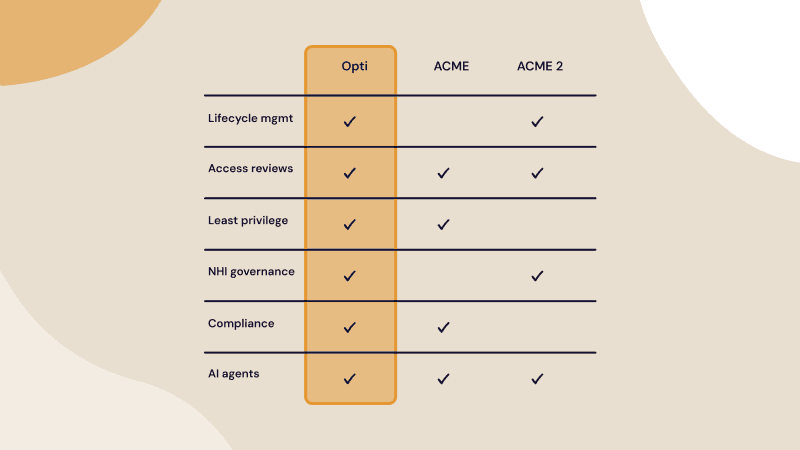
Opti is an AI-native identity security platform that unifies identity risk visibility, automated access reviews, and intelligent access administration for human identities, non-human identities (NHIs), and AI agents. Using AI to analyze identity relationships, entitlements, and real-world usage, Opti identifies excessive access, recommends least-privilege permissions, automates remediation workflows, and simplifies access certification with explainable, risk-based decisions. The platform helps organizations reduce identity risk while maintaining governance and operational efficiency across modern hybrid environments.
Learn how Opti helps secure human, non-human, and agentic identities with AI-native identity security: Book a demo.