What is Non-Human Identity Security?
Non-Human Identity (NHI) security involves protecting, managing, and governing digital credentials used by machines, APIs, service accounts, and AI agents. Because NHIs massively outnumber human identities and bypass human-focused controls like MFA, they are a primary attack vector for lateral movement and data exfiltration.
Why NHIs are a security gap:
Over-permissioning: Developers frequently create automated service accounts with full administrative rights for convenience, leaving wide-open "blast radiuses" if compromised.
No MFA: Machines cannot complete traditional multi-factor authentication, meaning compromised API keys or tokens grant immediate, persistent access.
Forgotten lifecycles: Stale, unrotated tokens or secrets created by third-party integrations (e.g., OAuth apps) persist indefinitely, acting as backdoors.
Secret leakage: API keys, tokens, passwords, and certificates are frequently exposed through source code, repositories, configuration files, logs, and CI/CD pipelines.
Core strategies for securing NHIs:
Discovery and inventory: Continuously discover and inventory all non-human identities across cloud, on-premises, SaaS, Kubernetes, CI/CD, and AI environments.
Identity classification: Classify NHIs by type, purpose, privilege level, business criticality, and risk to apply appropriate security controls.
Ownership mapping: Assign a responsible owner to every NHI to ensure accountability for lifecycle management, permissions, and credential rotation.
Permission and entitlement analysis: Continuously evaluate permissions, identify excessive or unused access, and enforce least privilege across automated identities.
Credential and secret governance: Securely store, rotate, monitor, and revoke credentials while eliminating hardcoded secrets and favoring short-lived authentication mechanisms.
This is part of a series of articles about identity and access management
4 Reasons NHIs Are a Major Security Gap
1. Over-Permissioning
Over-permissioning occurs when NHIs are granted more access than necessary to perform their functions. This often happens because administrators or developers assign broad privileges for convenience or to avoid troubleshooting permission errors, rather than following the principle of least privilege. As a result, NHIs may have unrestricted access to sensitive data, critical systems, or cloud resources, increasing the risk that a compromised NHI can cause widespread damage.
The problem is compounded by the fact that NHIs often operate without human supervision, making excessive permissions less likely to be detected or challenged. Attackers who compromise over-permissioned NHIs can exploit these privileges to move laterally within the environment, escalate access, or execute malicious actions such as data exfiltration or service disruption. Addressing over-permissioning requires entitlement reviews and automated enforcement of least privilege policies.
2. No MFA
Unlike human users, NHIs typically do not use multi-factor authentication (MFA) to access systems and services. Implementing MFA for NHIs is technically challenging because these identities are often used by scripts, applications, or automated processes that cannot interact with a second authentication factor in real time. As a result, NHIs are usually protected only by static credentials such as passwords, API keys, or certificates, making them easier targets for attackers.
The absence of MFA for NHIs weakens an organization’s security posture. If an attacker gains access to an NHI’s credentials, they can operate with the full privileges of that identity without facing the additional barrier that MFA provides. While some modern solutions enable programmatic or adaptive authentication for NHIs, adoption remains low, leaving a critical gap that organizations must address through other controls.
3. Forgotten Lifecycles
NHIs are often created to support specific projects, integrations, or applications but are rarely decommissioned when no longer needed. This leads to forgotten or orphaned NHIs that persist in the environment long after their original purpose has expired. Because these identities are not tied to an individual, there is often no clear owner responsible for management or removal, making them targets for attackers.
Forgotten NHIs can retain access to critical systems and data, even as the underlying business context or application changes. Attackers who discover these lingering identities can use them to bypass more closely monitored user accounts. Effective NHI lifecycle management requires automated processes for detecting unused identities, reassigning ownership, and ensuring timely deprovisioning to reduce the attack surface and limit abuse.
4. Secret Leakage
Secret leakage refers to the accidental or intentional exposure of credentials, API keys, tokens, or certificates used by NHIs. This can occur through code repositories, configuration files, logging systems, or public forums where secrets are committed or shared. Once exposed, these secrets can be harvested by attackers to gain unauthorized access to systems and data.
Secret leakage is common due to poor credential management practices, such as embedding secrets directly in source code or failing to rotate them regularly. Organizations should implement secret management solutions, such as vaults and automated scanning tools, to detect and remediate leaked secrets quickly. Failure to address secret leakage can result in security breaches, as attackers use exposed credentials to compromise assets.
Common Non-Human Identity Security Risks
Long-Lived Credentials
Long-lived credentials are passwords, API keys, certificates, or tokens that remain valid for months or even years. They are commonly used by service accounts, applications, and automated workloads because they reduce operational overhead. However, static credentials are difficult to manage consistently and often remain active long after they should have been replaced. Their extended lifespan makes them a frequent target for attackers.
Impact
Compromised long-lived credentials provide persistent access to systems, allowing attackers to remain undetected, move laterally, and access sensitive resources without repeatedly authenticating.
Mitigations
Replace static credentials with short-lived or ephemeral credentials whenever possible.
Automate credential rotation for passwords, API keys, certificates, and tokens.
Store credentials in centralized secret management platforms instead of application code.
Monitor credential usage and revoke unused or compromised secrets immediately.
Regularly audit credential age and remove credentials that are no longer required.
Orphaned or Stale Identities
Orphaned or stale non-human identities (NHIs) remain active after the application, workload, or process they supported has been retired. These identities often have no assigned owner and receive little or no security oversight. In dynamic cloud and DevOps environments, abandoned identities accumulate quickly unless lifecycle management is automated. Over time, they significantly expand the attack surface.
Impact
Attackers can exploit forgotten identities to gain access to systems without triggering the scrutiny applied to active accounts, making them effective entry points for persistence and privilege abuse.
Mitigations
Continuously discover and inventory all NHIs across the environment.
Assign a business or technical owner to every identity.
Automate deprovisioning when applications or workloads are retired.
Review inactive identities regularly and remove those no longer needed.
Include NHIs in identity governance and lifecycle management processes.
Excessive Privileges
Non-human identities frequently receive broader permissions than necessary because developers prioritize functionality over access control. Over time, permission changes, application updates, and infrastructure growth can lead to privilege creep. Since NHIs often operate continuously and automatically, excessive permissions may go unnoticed for long periods. Applying least privilege is essential to reducing this risk.
Impact
A compromised NHI with excessive permissions can access sensitive data, modify critical systems, disrupt services, and move laterally across cloud and on-premises environments.
Mitigations
Grant NHIs only the permissions required for their specific function.
Perform regular entitlement and access reviews.
Remove unused permissions to prevent privilege creep.
Use automated tools to analyze actual permission usage.
Continuously monitor privileged NHIs for abnormal activity.
Hardcoded Secrets
Hardcoded secrets are authentication credentials embedded directly into source code, configuration files, scripts, or container images. Although convenient during development, they become difficult to rotate and are easily exposed through version control systems, shared repositories, or software distribution. Automated scanning tools routinely search public and private repositories for exposed secrets. Once discovered, these credentials can be exploited immediately.
Impact
Exposed secrets allow attackers to authenticate as trusted applications or services, potentially leading to unauthorized access, data theft, and cloud resource compromise.
Mitigations
Remove secrets from source code and configuration files.
Store credentials in secure secret management or vault solutions.
Retrieve secrets dynamically at runtime.
Scan repositories and CI/CD pipelines for exposed credentials.
Rotate leaked or hardcoded credentials immediately after discovery.
AI Agent Overreach
AI agents act as non-human identities when they invoke APIs, execute workflows, retrieve data, and interact with enterprise applications. To perform these tasks, organizations often grant agents access to multiple systems and services. Without carefully defined permissions and governance, AI agents can accumulate broad privileges that exceed their intended role. As organizations adopt agentic AI, managing these identities becomes increasingly important.
Impact
An overprivileged AI agent can access or modify unauthorized resources. If compromised through vulnerable integrations, stolen credentials, or prompt injection attacks, it may perform harmful actions across multiple connected systems.
Mitigations
Apply least privilege to every AI agent and connected tool.
Isolate agent identities from human and application accounts.
Require approval for high-risk or sensitive operations.
Continuously monitor agent activity for anomalous behavior.
Review and reduce agent permissions as business requirements change.
Limit cross-system integrations to only the services an agent requires.
Related content: Explore the top IAM security risks and essential security capabilities.
How Non-Human Identity Security Works
Let’s review the key components of NHI security solutions.
Discovery and Inventory
The first step in NHIS is discovering every non-human identity across the environment and maintaining a complete inventory. This includes service accounts, application identities, cloud workloads, containers, APIs, IoT devices, CI/CD pipelines, and AI agents. Because NHIs are created automatically across multiple platforms, many organizations lack visibility into how many identities exist.
Discovery tools continuously scan cloud environments, identity providers, operating systems, Kubernetes clusters, and application platforms to identify NHIs. The resulting inventory records key information such as the identity's type, location, associated application, credentials, permissions, owner, and last activity. Maintaining an accurate inventory provides the foundation for other NHIS controls.
Identity Classification
Once discovered, NHIs are classified according to their purpose, environment, and risk level. Classification helps organizations distinguish between identities used by applications, infrastructure, automation tools, cloud services, third-party integrations, IoT devices, and AI agents. Each category has different security requirements and governance policies.
Classification also considers factors such as whether an identity is privileged, internet-facing, temporary, or production-critical. By grouping identities based on business function and risk, security teams can prioritize remediation efforts, apply appropriate policies, and focus monitoring on the NHIs that present the greatest potential impact if compromised.
Ownership Mapping
Every NHI should have a defined owner responsible for its lifecycle and security. Ownership mapping connects each identity to an application owner, development team, business unit, or system administrator. Without ownership, NHIs are more likely to become orphaned, over-permissioned, or forgotten.
Ownership information supports accountability throughout the identity's lifecycle. Owners are responsible for approving access, reviewing permissions, rotating credentials, and ensuring the identity is removed when no longer required. Automated ownership tracking also helps identify identities without an assigned owner so they can be investigated and remediated.
Permission and Entitlement Analysis
Permission and entitlement analysis evaluates what each NHI can access and whether those permissions are appropriate. Security tools compare assigned permissions with actual usage to identify excessive privileges, unused entitlements, and opportunities to reduce access without disrupting operations. This supports least privilege across automated identities.
Continuous analysis is important because cloud environments and applications change frequently. As new resources are added or workloads evolve, permissions can expand beyond what is necessary. Regular entitlement reviews and automated policy enforcement help prevent privilege creep while reducing the impact of a compromised NHI.
Credential and Secret Governance
NHIs rely on credentials such as API keys, passwords, certificates, tokens, and cryptographic secrets to authenticate with other systems. Credential and secret governance ensures these authentication materials are generated, stored, rotated, monitored, and revoked when no longer needed. The objective is to minimize the risk of credential theft or misuse.
Modern NHIS solutions integrate with secret management platforms and certificate management systems to automate credential lifecycle management. They also detect hardcoded secrets, monitor for leaked credentials, enforce rotation schedules, and favor short-lived credentials when possible. These controls reduce the likelihood that stolen or exposed secrets are used to gain persistent unauthorized access.
Non-Human Identity Security vs. Machine Identity Management
Machine identity management focuses on managing the identities of machines, workloads, services, and devices. It often centers on certificates, keys, and authentication between systems. Its main goal is to ensure that machines can prove their identity securely and that their credentials are issued, renewed, and revoked correctly.
Non-human identity security is broader. It includes machine identities, but also covers service accounts, API keys, application identities, bots, automation scripts, CI/CD identities, cloud roles, and AI agents. NHIS looks beyond authentication and credential management to include discovery, ownership, permissions, activity monitoring, lifecycle governance, and risk reduction.
The difference is scope. Machine identity management answers the question: “Can this machine authenticate securely?” NHIS answers a wider question: “Should this non-human identity exist, who owns it, what can it access, how is it being used, and does it create risk?” Both are related, but NHIS provides a more complete security model for modern automated environments.
Related content: See why an identity fabric matters and how to make it work.
Non-Human Identity Security Best Practices and Strategies
1. Maintain a Complete NHI Inventory
Organizations cannot secure NHIs that they do not know exist. Maintaining a complete inventory requires continuous discovery across cloud platforms, identity providers, Kubernetes clusters, CI/CD systems, SaaS applications, and on-premises environments. The inventory should include details such as identity type, owner, permissions, credentials, associated applications, and last activity.
Because NHIs are created and removed frequently through automation, the inventory must be updated continuously rather than through periodic audits. A centralized inventory provides the visibility needed for lifecycle management, permission reviews, compliance reporting, and incident response.
2. Enforce Least Privilege
Every NHI should receive only the permissions required to perform its function. Broad or default permissions increase the impact of a compromised identity and make lateral movement easier for attackers. Least privilege limits the resources an attacker can access if credentials are stolen.
Organizations should review actual permission usage regularly and remove unused entitlements. Automated policy enforcement and entitlement analysis can help detect privilege creep and align permissions with operational requirements without disrupting workloads.
3. Eliminate Hardcoded Secrets
Secrets should never be embedded directly into application code, scripts, configuration files, or container images. Hardcoded credentials are difficult to rotate, often remain in version control systems, and are a common source of credential exposure during software development.
Instead, applications should retrieve secrets at runtime from secret management platforms. Automated scanning tools should inspect repositories and build pipelines for exposed credentials, allowing organizations to detect and remediate leaked secrets before they are exploited.
4. Rotate Credentials Automatically
Manual credential rotation is difficult to perform consistently, especially in environments with thousands of NHIs. Automated rotation reduces the time a stolen credential remains valid and removes the operational burden of updating secrets across multiple systems.
Credential rotation should apply to passwords, API keys, certificates, access tokens, and other authentication secrets. Automation should verify that applications adopt new credentials and revoke old ones without interrupting operations.
5. Use Short-Lived Credentials
When possible, organizations should replace long-lived credentials with temporary credentials that expire automatically after a short period. Examples include short-lived cloud tokens, ephemeral certificates, and workload identity tokens issued on demand.
Short-lived credentials reduce the value of stolen secrets because they become unusable after expiration. Combined with automated issuance and renewal, they provide stronger security while reducing the need to manage static credentials.
6. Review OAuth and SaaS Permissions
Many NHIs access cloud and SaaS applications through OAuth integrations or service accounts that accumulate permissions over time. These integrations often receive broad access during deployment and are rarely reviewed afterward, creating security exposure.
Organizations should audit OAuth grants, application integrations, and SaaS permissions regularly to ensure they remain appropriate. Unused integrations should be removed, and excessive scopes should be reduced to limit the impact of a compromised application or service account.
7. Monitor NHI Behavior Continuously
Continuous monitoring helps organizations detect when an NHI begins behaving differently from its normal operating pattern. Because service accounts, APIs, workloads, and AI agents typically perform predictable tasks, changes in the systems they access, the frequency of requests, the volume of data transferred, or the commands they execute can indicate credential theft, misuse, or compromise. Behavioral monitoring should establish baselines for each identity and generate alerts when activity deviates from expected patterns.
AI-driven analytics strengthen this process by comparing each NHI with similar identities to identify outlier permissions and unusual behavior. Peer-group analytics can flag service accounts or AI agents with significantly broader entitlements than comparable workloads, while anomaly detection models identify unexpected API usage, access times, resource consumption, or data access patterns. AI can also automatically classify high-risk NHI entitlements based on factors such as privilege level, exposure to sensitive resources, and observed usage, allowing security teams to prioritize remediation and revoke or reduce risky permissions before they are exploited.
8. Include NHIs in Governance Processes
Non-human identities should be governed using the same identity governance and administration (IGA) processes applied to human users. This includes assigning a business owner, documenting the identity's purpose, reviewing permissions regularly, enforcing approval workflows for privileged access, and deprovisioning identities that are no longer required. Integrating NHIs into governance processes improves accountability, reduces orphaned identities, and helps ensure that automated access remains aligned with business needs.
NHI governance is increasingly required to support compliance with regulations and frameworks such as SOX, SOC 2, ISO 27001, HIPAA, PCI DSS, the NYDFS Cybersecurity Regulation, NIS2, and GDPR. Auditors increasingly expect organizations to provide the same evidence of ownership, access reviews, entitlement approvals, and lifecycle management for NHIs as they do for human users.
AI Native Identity Security with Opti
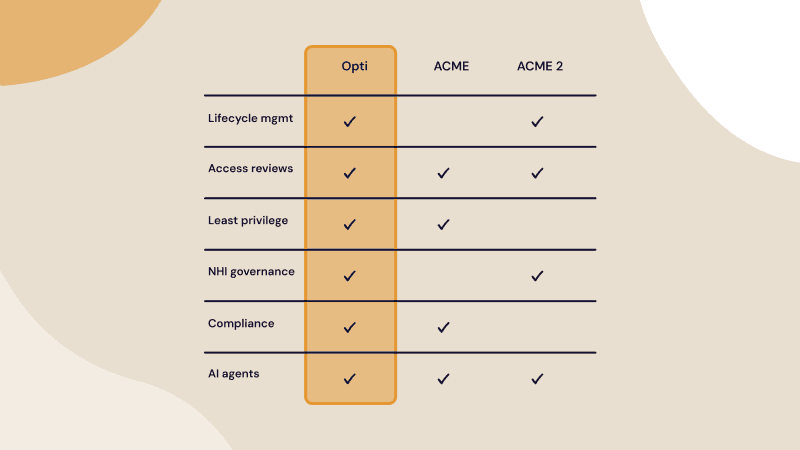
Opti is an AI-native identity security platform built for identity governance and administration (IGA). It provides continuous visibility into identity risk, automatically detects excessive access, orphaned accounts, policy violations, and entitlement drift, and recommends or executes remediation to maintain least privilege.
Opti streamlines access reviews by prioritizing high-risk exceptions, enriching certifications with business context and usage insights, and keeping organizations continuously audit-ready. It also delivers intelligent access administration by automating provisioning, entitlement changes, approvals, and lifecycle governance across human identities, non-human identities (NHIs), and AI agents.
Rather than managing privileged credentials or secrets, Opti focuses on governing who and what should have access, ensuring the right level of access is continuously maintained as identities, roles, and environments evolve.
Book a demo to see how Opti helps reduce identity risk while simplifying governance and compliance.