
What Is an Identity Governance and Administration (IGA) Solution?
Modern Identity Governance and Administration (IGA) solutions, such as Opti, Omada, and One Identity, manage user identities and access rights, using AI to automate provisioning, auditing, and compliance to enforce security policies such as least privilege and separation of duties. They address risks from improper access and orphan accounts, combining identity data to streamline user lifecycle management.
The primary goal of an IGA solution is to ensure that the right individuals have the appropriate access to technology resources for the right reasons, and only for as long as needed. IGA platforms integrate with various applications and directories, supporting the entire user lifecycle from onboarding to offboarding. By providing a unified view of identity and access data, IGA solutions help organizations improve security posture and streamline auditing and compliance.
Core features of IGA solutions include:
Lifecycle management: Automating user onboarding, role changes, and offboarding.
Access request and approval: Portals for requesting access, with automated workflows.
Access certification and auditing: Regular reviews to ensure compliance and prevent "privilege creep".
Separation of duties (SoD): Preventing conflicts of interest by restricting conflicting permissions.
Connectors: Integrating with applications (SAP, AD, Salesforce) to govern access.
Closed-loop provisioning and deprovisioning: Ensures access changes are fully executed, verified, and continuously monitored.
AI-driven identity analytics: Uses machine learning and behavioral analysis to detect unusual access patterns, excessive permissions, and potential insider threats.
Workflow automation: Manages processes such as access requests, approvals, provisioning, and certifications, reducing manual intervention.
Coverage for human, non-human, and agentic identities: Manages identities for employees, service accounts, APIs, bots, and AI agents, applying governance controls across all identity types.
HRIS integration as source of truth for lifecycle events: Uses HR systems like Workday and SAP SuccessFactors as authoritative sources to trigger identity events.
Drift detection and ongoing reconciliation: Continuously compares entitlement data against defined policies to identify and correct unintended permission changes.
Agentless discovery and time-to-value: Identifies accounts and permissions across systems without deploying software agents, simplifying deployment.
IGA Solutions at a Glance
The table below summarizes the key differences between the platforms covered in this article. We explore each of them in more detail in the sections that follow.
Category | Solution | Best For | Key Strengths | Things to Consider |
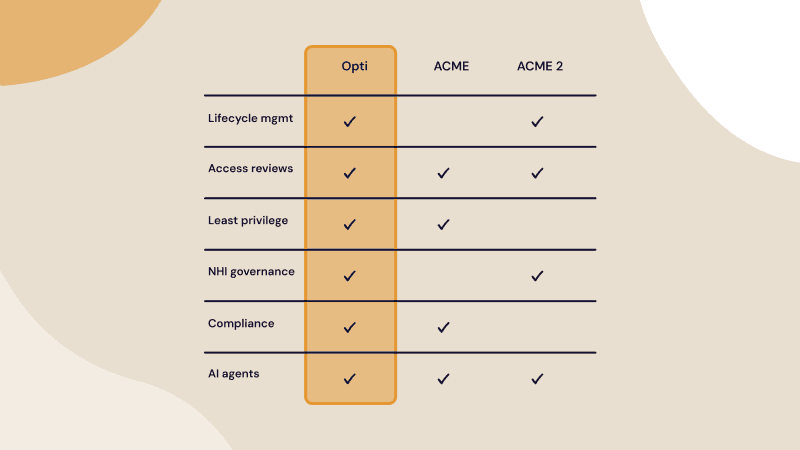
Modern / AI-Native IGA | Opti | AI-driven continuous identity governance with rapid deployment | Continuous AI-assisted access reviews, closed-loop remediation, coverage for human, non-human, and agentic identities | Focused on IGA; organizations needing privileged access management (PAM) require a separate PAM solution |
Modern / AI-Native IGA | Omada Identity | Automating enterprise identity governance across hybrid environments | AI-driven lifecycle automation, continuous monitoring, broad compliance capabilities | Initial deployment is complex; SaaS version lacks some on-premises features; extensive customization increases complexity |
Modern / AI-Native IGA | One Identity | Identity governance combined with privileged account governance | Strong lifecycle management, access certification, privileged account governance | Legacy system integrations can be challenging; interface has a learning curve; customization can be difficult |
Enterprise IGA Platforms | Microsoft Entra ID Governance | Organizations standardized on Microsoft Entra ID and Microsoft 365 | Deep Microsoft ecosystem integration, lifecycle workflows, entitlement management, AI-assisted access reviews | Advanced configuration and licensing are complex; premium capabilities increase cost |
Enterprise IGA Platforms | SailPoint Identity Security Cloud | Large enterprises requiring mature identity governance across complex environments | AI-driven access recommendations, broad connector ecosystem, continuous compliance capabilities | Extensive functionality creates complexity; advanced configuration often relies on APIs; some newer modules are still maturing |
Enterprise IGA Platforms | Saviynt IGA | Cloud-first identity governance for large enterprises | Cloud-native architecture, AI-powered access decisions, enterprise-wide visibility, automated lifecycle management | Steep learning curve, configuration complexity, and limited documentation reported by users |
Benefits of Modern IGA
Modern IGA solutions go beyond basic access control. They combine automation, visibility, and integration to address security and operational challenges in complex environments. The following benefits highlight why organizations adopt modern IGA platforms:
Increased security: IGA enforces least-privilege access and reduces the risk of unauthorized access. Automated provisioning and deprovisioning ensure users only have access they need, when they need it.
Compliance enablement: Built-in audit trails, access certifications, and reporting help meet regulatory requirements. IGA simplifies demonstrating compliance with standards like SOX, SOC 2, ISO 27001, HIPAA, PCI-DSS, NYDFS, NIS2, GDPR.
Operational efficiency: Automation reduces manual tasks such as onboarding, offboarding, and access reviews. This lowers administrative overhead and speeds up access requests.
SaaS-native architecture: Many modern IGA solutions are delivered as SaaS. This allows faster deployment, easier updates, and better scalability without heavy infrastructure management.
Audit evidence and reporting: Modern IGA platforms generate detailed audit evidence for access changes, approvals, and policy violations. Built-in reporting helps security and compliance teams quickly produce documentation for audits, investigations, and regulatory reviews.
Improved visibility: Centralized dashboards provide a clear view of identities, roles, and access rights. Security teams can quickly detect anomalies and over-provisioned accounts.
Better user experience: Self-service access requests and approvals reduce friction for end users. This improves productivity while maintaining control.
Scalability: IGA systems can handle growth in users, applications, and data. This is critical for organizations adopting cloud and hybrid environments.
Risk reduction: Continuous monitoring and policy enforcement help identify and mitigate access risks early. This reduces the attack surface and potential damage from breaches.
Integration across systems: Modern IGA platforms integrate with cloud services, on-prem systems, and third-party apps. This ensures consistent access control across the entire IT ecosystem.
Key Features of IGA Solutions
Modern IGA solutions include the following key features and capabilities.
Lifecycle Management
Lifecycle management handles the entire journey of a user’s identity within the organization. This process covers onboarding new employees, managing changes in roles or responsibilities, and offboarding users when they leave. Automated lifecycle management ensures that access rights are updated to reflect organizational changes, reducing the risk of orphaned accounts and unnecessary privileges.
Lifecycle management also supports business agility by simplifying access provisioning and deprovisioning as employees move across departments or projects. It helps maintain compliance by ensuring that users only have access necessary for their roles and that these permissions are revoked in a timely manner when they are no longer needed. This improves security and reduces administrative overhead for IT teams.
Access Request and Approval
Access request and approval workflows allow users to request access to applications, systems, or data, with automated routing for managerial or compliance approval. This reduces delays and ensures that access is granted based on established policies and business needs. Automated notifications and reminders help prevent bottlenecks.
Configured access request systems can enforce least-privilege principles, ensuring that users only receive the minimum access required to perform their tasks. These workflows create an audit trail of who requested, approved, and granted access, which supports compliance and forensic investigations. By reducing manual intervention, organizations can minimize errors and unauthorized access.
Access Certification and Auditing
Access certification and auditing help maintain compliance and reduce security risks. IGA solutions enable organizations to conduct periodic reviews of user access rights, ensuring that only authorized individuals retain access to sensitive systems and data. These reviews can be automated, with managers prompted to certify or revoke access based on current business requirements.
Auditing capabilities provide visibility into access events and changes, supporting internal governance and regulatory requirements. Audit logs and reports can be generated on demand, making it easier to identify policy violations or suspicious activity. Certification and auditing support accountability and security.
Separation of Duties (SoD)
Separation of duties (SoD) prevents conflicts of interest by ensuring that no single individual has excessive privileges. IGA solutions enforce SoD policies by detecting and preventing toxic combinations of access rights, such as granting a user both the ability to initiate and approve financial transactions.
Automated SoD checks reduce administrative burden and help maintain compliance with regulations that require such controls. When a policy violation is detected, the IGA platform can trigger alerts, require remediation, or block the access request. This approach reduces the risk of fraud and strengthens governance.
Connectors
Connectors link the IGA solution to external systems, applications, and directories. These connectors enable the platform to manage identities and access across cloud services, on-premises applications, and legacy systems. Broad connector libraries simplify integration.
Effective connectors support bidirectional synchronization of identity data, ensuring consistency and accuracy across connected systems. This supports automated provisioning, deprovisioning, and access reviews. Organizations can use prebuilt and custom connectors to maintain centralized identity governance.
Closed-Loop Provisioning and Deprovisioning
Closed-loop provisioning and deprovisioning ensures that access changes are fully executed, verified, and continuously monitored across connected systems. When a user joins, changes roles, or leaves the organization, the IGA platform not only initiates access changes but also confirms that those changes were successfully completed in target applications.
This closed-loop approach reduces the risk of orphaned accounts, failed provisioning tasks, and inconsistent permissions across environments. Verification and reconciliation processes help identify systems where access was not properly removed or updated. Automated remediation workflows can then correct these issues, improving security and compliance while reducing manual effort.
AI-Driven Identity Analytics
AI-driven identity analytics uses machine learning and behavioral analysis to detect unusual access patterns, excessive permissions, and potential insider threats. By analyzing identity data across systems, IGA platforms can identify anomalies such as privilege escalation, dormant accounts, or users with access outside their normal role.
These analytics help organizations move from reactive governance to proactive risk management. AI can also support auto-classification of entitlements, role mining, and access recommendations by identifying common entitlement patterns across departments or job functions. This improves decision-making during provisioning, certification, and policy enforcement while reducing review fatigue for managers and auditors.
Workflow Automation
Workflow automation in IGA solutions manages processes such as access requests, approvals, provisioning, and certifications. Automated workflows reduce manual intervention and help ensure that policies are applied consistently.
Customizable workflows allow organizations to tailor processes to their requirements and support compliance with internal policies and regulations. Automation also creates an audit trail of actions taken, supporting governance and accountability.
Coverage for Human, Non-Human, and Agentic Identities
Modern IGA solutions increasingly govern more than employee accounts. They also manage non-human identities such as service accounts, APIs, bots, workloads, and machine identities used in cloud and automation environments. Some platforms also extend governance to agentic AI systems that interact autonomously with applications and data.
Managing these identities is critical because non-human accounts often have elevated or persistent privileges. IGA platforms help organizations inventory these identities, apply least-privilege policies, rotate credentials, and monitor activity. Unified governance across human and non-human identities improves visibility and reduces unmanaged access risks.
HRIS Integration as Source of Truth for Lifecycle Events
Human resources information system (HRIS) integration allows IGA platforms to use systems such as Workday and SAP SuccessFactors as authoritative sources for identity lifecycle events. Changes in employment status, department, title, or location automatically trigger provisioning or deprovisioning workflows within the IGA platform.
Using HR systems as a source of truth improves accuracy and reduces delays in access management. New hires can receive required access on day one, while terminated users can have access revoked immediately. This integration strengthens security and ensures that identity data remains aligned with organizational structure and business processes.
Drift Detection and Ongoing Reconciliation
Drift detection and reconciliation identify differences between intended access policies and actual permissions in connected systems. Over time, manual changes, failed workflows, or unmanaged accounts can create access drift, where users accumulate privileges outside approved governance controls.
IGA platforms continuously compare entitlement data against defined policies and role models to detect these inconsistencies. Automated reconciliation workflows can flag violations, revoke unauthorized access, or trigger review processes. Continuous monitoring helps maintain policy compliance and reduces long-term privilege creep.
Agentless Discovery and Time-to-Value
Agentless discovery allows IGA platforms to identify identities, accounts, permissions, and systems without deploying software agents on every endpoint or application. This simplifies deployment and reduces operational complexity, especially in large or distributed environments.
By minimizing infrastructure requirements, agentless architectures improve time-to-value and allow organizations to onboard systems more quickly. Security and identity teams can gain visibility into unmanaged accounts and access risks faster, accelerating governance initiatives and reducing implementation overhead.
Why Traditional IGA Solutions Are Failing
Built for On-Prem Active Directory and SAP, not Modern SaaS and Cloud
Many traditional IGA platforms were designed when enterprise environments were centered around on-premises systems such as Active Directory, LDAP, Oracle, and SAP. Their architectures assumed stable infrastructure, predictable network boundaries, and long-lived employee accounts. Modern organizations now operate across hundreds of SaaS applications, multi-cloud platforms, remote work environments, and decentralized identity providers.
This shift exposes limitations in legacy IGA designs. Older systems often struggle to govern cloud-native applications, dynamic entitlements, and API-driven infrastructure. Integrating modern SaaS platforms frequently requires custom development or fragile connector configurations. As organizations adopt hybrid and cloud-first strategies, traditional IGA solutions become difficult to scale and maintain, slowing identity governance initiatives and increasing operational complexity.
SaaS Sprawl and Fine-Grained Entitlements
Organizations now use hundreds or thousands of SaaS applications, each with its own permission model, APIs, and administrative roles. Traditional IGA solutions were designed around coarse-grained access models, where users received broad application-level access rather than highly granular entitlements. Modern SaaS platforms introduce nested permissions, shared workspaces, dynamic groups, and resource-specific access that older IGA systems cannot easily model or govern.
This creates visibility and governance gaps. Security teams may know a user has access to an application but lack insight into the specific data, repositories, or administrative functions available within that platform. Managing fine-grained entitlements manually becomes unsustainable at scale. Without modern entitlement management capabilities, organizations face increased risks from excessive permissions, privilege creep, and shadow access.
The Non-Human Identity Explosion
Non-human identities now outnumber human users in many enterprise environments. Service accounts, APIs, containers, robotic process automation (RPA) bots, workloads, cloud functions, and machine identities all require authentication and access permissions. Traditional IGA platforms were primarily built to manage employee identities and often lack visibility into these machine-driven accounts.
Non-human identities frequently operate with elevated privileges and persistent credentials, making them attractive attack targets. Many are created outside centralized governance processes and remain unmanaged for long periods. Legacy IGA systems typically struggle to inventory, classify, and lifecycle-manage these identities consistently across cloud and DevOps environments. As machine identities continue to grow, governance gaps create significant security and compliance risks.
Agentic Identities and Ephemeral Access
Modern environments increasingly rely on autonomous systems and short-lived access models. AI agents, automation platforms, serverless workloads, and just-in-time privilege systems create identities and permissions dynamically based on real-time tasks and workflows. Traditional IGA solutions were not designed to manage identities that may exist for only minutes or hours.
Legacy governance models depend on static roles, scheduled certifications, and long approval cycles. These approaches do not align with ephemeral access patterns or agentic systems that continuously interact with applications and data autonomously. Organizations need governance platforms capable of evaluating risk and enforcing policies in near real time. Without this capability, temporary access can become persistent, unmanaged, or invisible to security teams.
Multi-Year Deployments and Brittle Connectors
Traditional IGA implementations are often known for long deployment timelines, heavy customization, and complex integration projects. Large-scale deployments can take months or years due to connector development, role engineering, workflow configuration, and infrastructure requirements. These lengthy implementations delay value realization and increase project risk.
Connectors in legacy IGA systems are also frequently brittle and difficult to maintain. SaaS applications evolve rapidly, with APIs and permission structures changing often. Older connectors may break when applications update their interfaces or authentication methods, requiring ongoing maintenance and manual remediation. This creates operational overhead and reduces confidence in governance accuracy.
Evolution of IGA: How Modern IGA Solutions Overcome These Challenges
Modern IGA solutions are designed for cloud-first, API-driven, and highly distributed environments. Unlike legacy platforms that depend on static roles, heavy customization, and periodic governance processes, modern platforms focus on automation, scalability, continuous monitoring, and broader identity coverage. They address traditional IGA challenges by providing:
SaaS-native and cloud-first architecture: Modern IGA platforms are built for SaaS applications, cloud infrastructure, and hybrid environments. API-first integrations, SaaS delivery models, and prebuilt connectors reduce deployment complexity and simplify ongoing maintenance compared to legacy on-prem-focused systems.
AI-driven and continuous governance: Modern platforms use AI and machine learning to automate access recommendations, detect anomalies, identify excessive permissions, and improve certification processes. Continuous monitoring replaces periodic governance cycles by detecting access drift and policy violations in near real time.
Governance for human, non-human, and agentic identities: Modern IGA solutions govern employees, contractors, service accounts, APIs, bots, workloads, and AI agents through a unified platform. This improves visibility into machine identities and reduces risks from unmanaged privileged access.
Fine-grained entitlement visibility and risk-based access: Modern platforms provide visibility into detailed permissions inside SaaS applications rather than only tracking application-level access. They also support adaptive, risk-based governance that evaluates context such as user behavior, device posture, and resource sensitivity when making access decisions.
Faster deployment and closed-loop automation: SaaS delivery, agentless discovery, low-code workflows, and automated reconciliation reduce implementation timelines and operational overhead. Closed-loop provisioning verifies that access changes were completed successfully and continuously reconciles permissions across connected systems.
Notable IGA Solutions
Modern / AI-Native IGA Solutions
1. Opti

Opti is an AI-native identity security platform that turns access reviews from a periodic, manual process into a continuous operation. Purpose-built AI models surface high-risk access first, auto-handle low-risk decisions, and give reviewers the usage context they need to certify with confidence, not guesswork. Opti covers human, non-human, and agentic identities from a single platform and deploys in hours, not months.
Opti’s key features include:
Risk-scored access reviews: high-risk access flagged and prioritized, low-risk deprioritized or auto-handled
Reviewer context built in: last-used telemetry, peer comparisons, and behavioral signals surface automatically so reviewers stop guessing
Closed-loop remediation: revocations are executed and verified, not just ticketed
Comprehensive coverage: human, non-human, and agentic identities
Continuous access intelligence: governance doesn't stop between campaigns
Audit trail that maintains itself: documentation is automatic, not a pre-audit scramble
Limitation: Opti is purpose-built for identity governance; organizations looking for a combined access review and PAM platform in a single tool will need to pair it with a dedicated PAM solution.
Learn more about Opti
2. Omada Identity

Omada Identity is an IGA solution that uses AI and automation to manage identity governance at scale while reducing operational complexity. It centralizes identity workflows and applies machine learning to improve access decisions. The platform provides visibility into access and compliance across cloud, on-premises, and hybrid systems. It supports scalability and deployment aligned with business operations.
Features:
AI-driven automation: Uses AI and machine learning to automate access requests, approvals, and role assignments.
Continuous monitoring and risk detection: Monitors identity activity to identify unusual behavior or vulnerabilities.
Automated compliance enforcement: Applies policies automatically and maintains visibility into user access for audits.
Centralized cloud management portal: Provides a single interface to manage provisioning, access governance, and compliance.
Real-time analytics and insights: Dashboards highlight access patterns, risks, and anomalies.
Limitations (as reported by users on PeerSpot]:
Complex initial setup: Implementation requires answering many organizational and workflow questions, making setup time-consuming.
Feature gaps in SaaS version: Some capabilities available on-premises are missing in the SaaS offering.
Flexibility adds complexity: Extensive customization options can make the platform harder to manage.
Costly upgrades for fixes: Resolving issues often requires upgrades that can be expensive.
Insufficient documentation: Troubleshooting can be difficult without external consultant support.
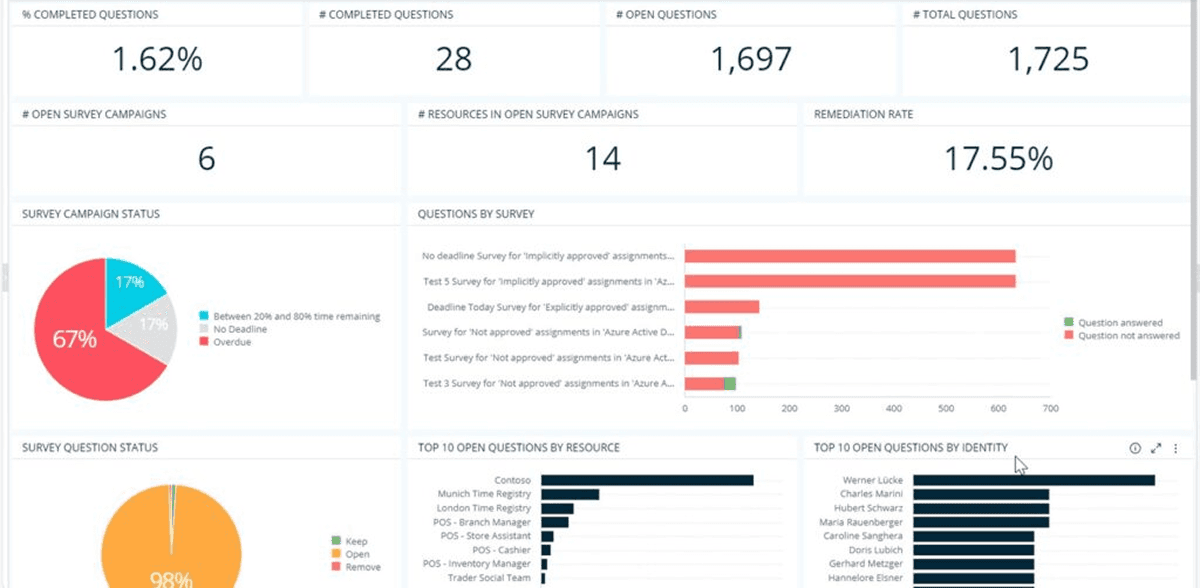
Source: Omada
3. One Identity

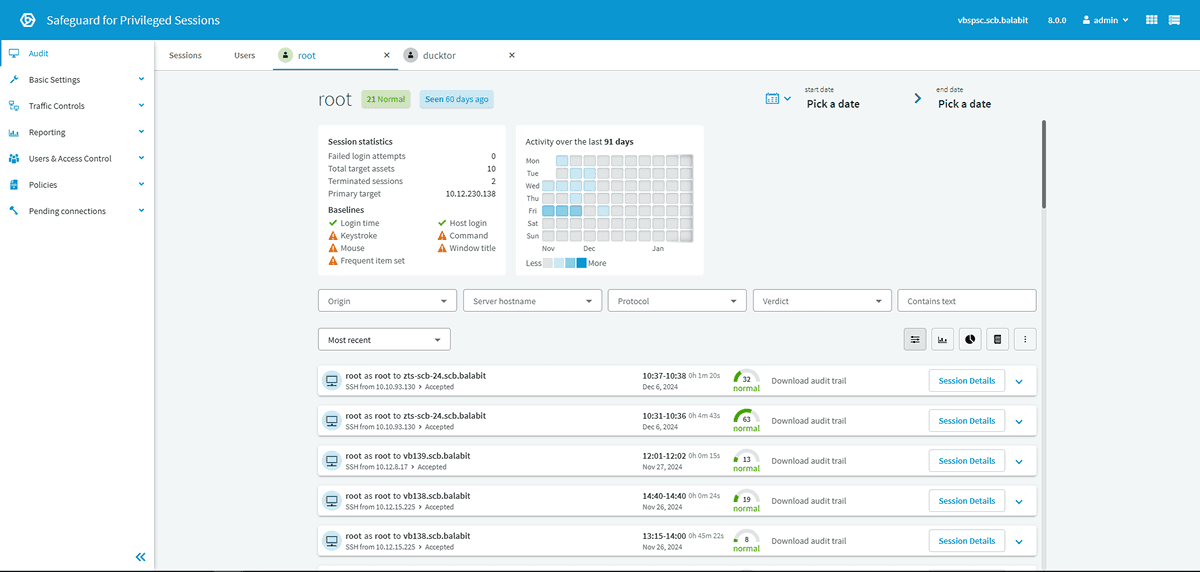
One Identity is an IGA solution that provides governance across identities, data, and privileged access. It centralizes control over user identities and permissions across on-premises, cloud, and hybrid environments, ensuring that access aligns with defined policies. The platform emphasizes visibility and compliance with reporting and certification processes. It combines lifecycle management, access governance, and privileged account control.
Features:
Identity lifecycle management: Automates onboarding, role changes, and offboarding for employees and contractors.
Access certification and attestation: Supports periodic review of user access to ensure it remains appropriate.
Privileged account governance: Applies governance controls to administrator and high-risk accounts.
Access request and approval workflows: Enables users to request access through predefined workflows.
Auditing and reporting: Provides reports showing who has access to resources and when it was granted.
Limitations (as reported by users on G2]:
Integration issues with legacy systems: Problems with OpenLDAP integration impact functionality such as email and SSO.
Complex user interface for beginners: The interface can feel complicated and requires time to learn.
Limited documentation quality: Some modules lack detailed documentation, making implementation harder.
Synchronization challenges: Users report issues with directory sync, requiring manual intervention.
Customization difficulties: Web portal customization is not straightforward and can be restrictive.
Source: One Identity
Enterprise IGA Platforms
4. Microsoft Entra ID Governance

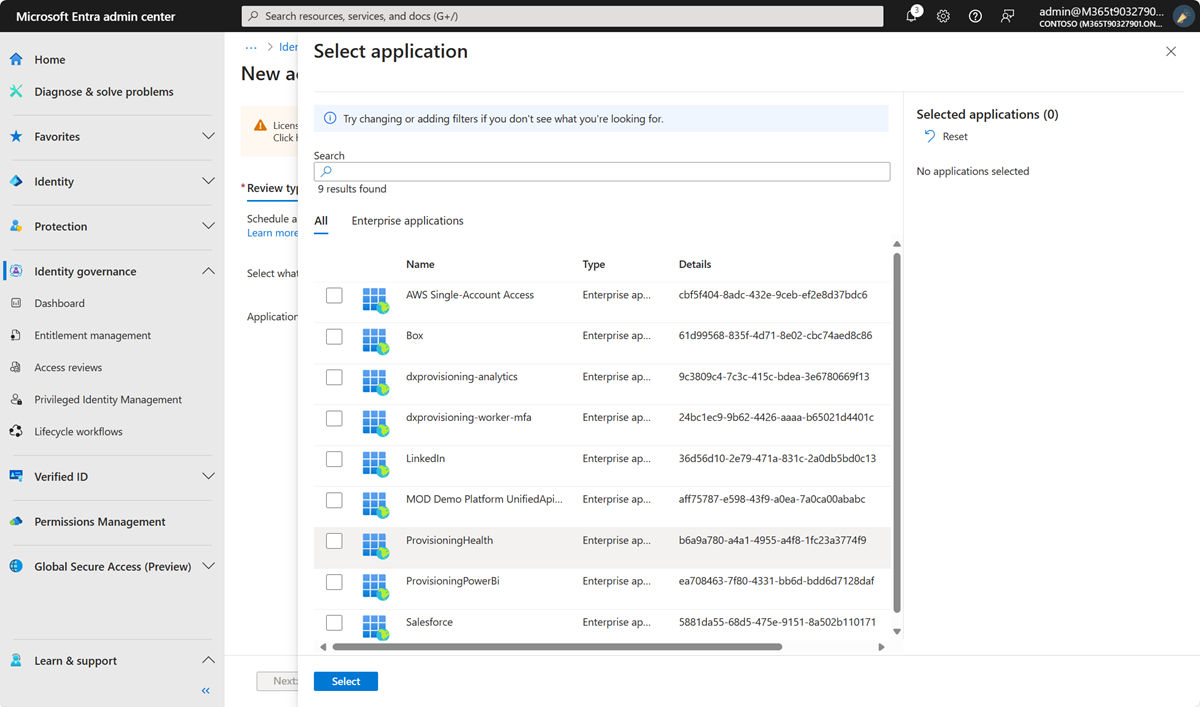
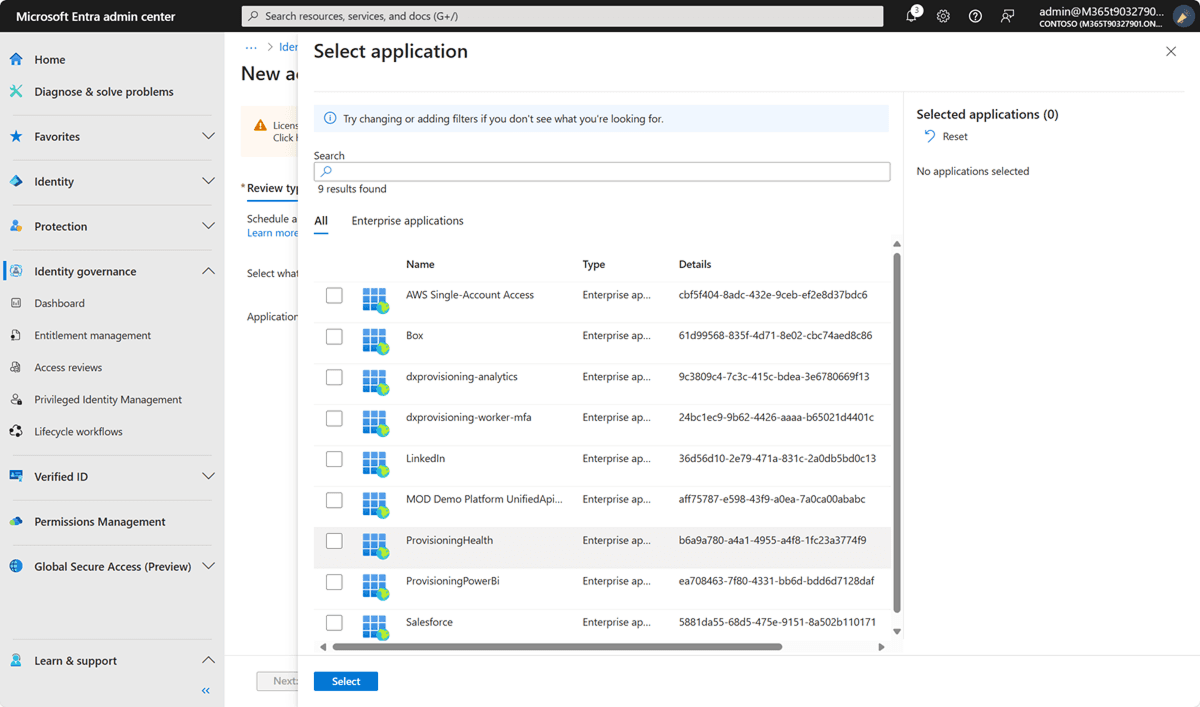
Microsoft Entra ID Governance is an IGA solution that uses AI-driven insights and automation to manage identity and access across on-premises and cloud environments. It helps ensure that users have appropriate access by automating identity and access lifecycles, enforcing policies, and providing visibility into access usage. The platform integrates with a range of systems and applications, enabling centralized governance and business participation in access decisions. It includes monitoring, auditing, and risk mitigation features to support security and compliance.
Features:
Identity lifecycle management: Automates user onboarding, changes, and offboarding based on signals from HR systems such as Workday and SuccessFactors.
Lifecycle workflows and automation: Executes automated tasks during events such as pre-boarding or role changes.
Entitlement management: Manages access through access packages that bundle group memberships, roles, and resources.
Access reviews and AI recommendations: Automates periodic reviews of user and guest access with AI-generated suggestions.
Access lifecycle governance: Enforces policies such as separation of duties and dynamic access changes based on user attributes.
Limitations (as reported by users on G2]:
Complex configuration and administration: Managing settings and troubleshooting can be difficult.
Steep learning curve: Users report challenges understanding configurations and licensing.
High cost for advanced features: Pricing can become significant at scale or with premium capabilities.
Challenging setup process: Initial setup, especially for advanced policies, can be complicated.
Licensing complexity: Licensing structure can be confusing to navigate and manage.
Source: Microsoft
5. SailPoint Identity Security Cloud

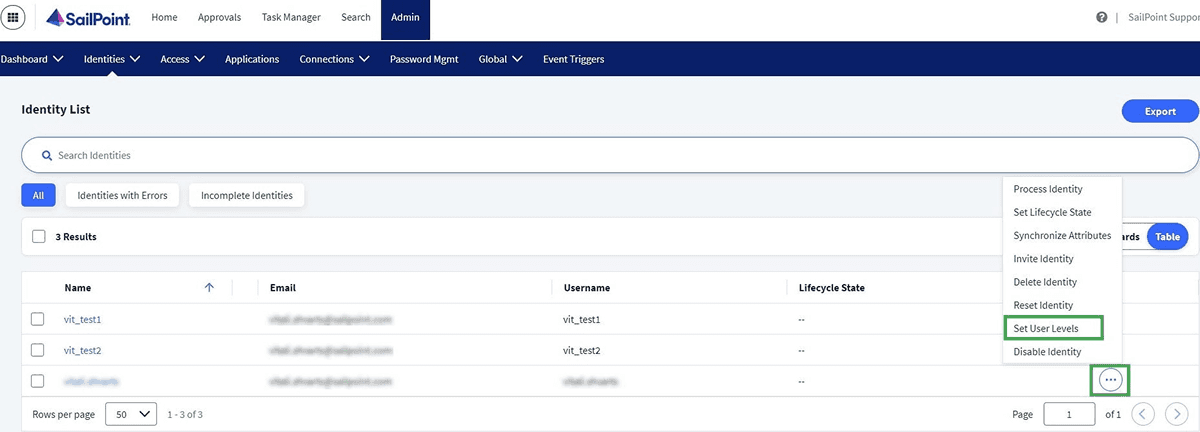
SailPoint Identity Security Cloud is an AI-driven IGA solution that centralizes identity security and governance across the enterprise. It combines automation, analytics, and visibility to ensure that authorized users have appropriate access. The platform unifies identity, access, and data governance to reduce risk and support compliance. It supports identity governance in complex environments.
Features:
AI-driven access decisions: Uses AI to analyze identity data and recommend or automate access decisions.
Automated identity lifecycle management: Automates joiner, mover, and leaver processes, including provisioning and deprovisioning.
Real-time visibility and insights: Provides visibility into identities, access rights, and entitlements.
Continuous compliance management: Maintains compliance through automated controls, monitoring, and reporting.
Access intelligence and analytics: Provides insight into access patterns and risks.
Limitations (as reported by users on Gartner]:
User interface limitations: The UI can be unintuitive and requires many clicks to manage tasks.
Heavy reliance on APIs: Advanced configurations often require API usage instead of the UI.
Complex to fully utilize: The platform’s breadth makes it difficult to leverage all capabilities effectively.
Immature add-on features: Some modules, such as non-employee management, are still evolving.
Limited configuration visibility: Finding and understanding settings in the admin interface can be difficult.
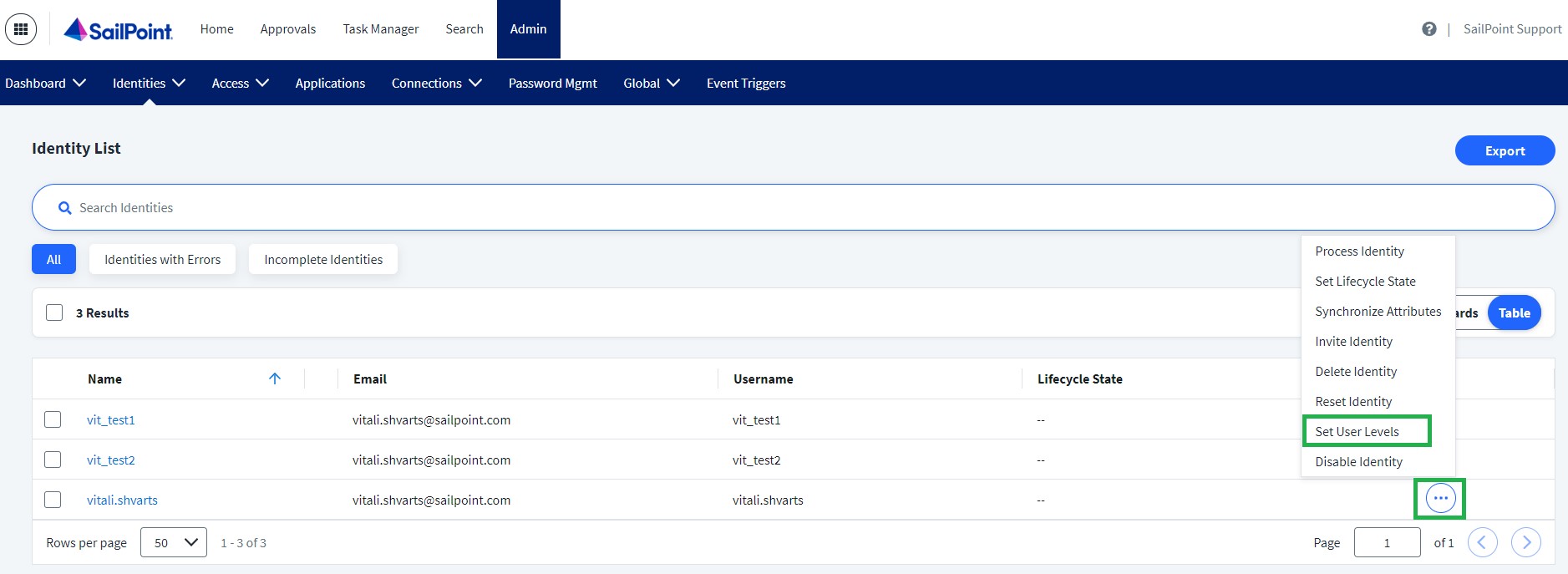
Source: SailPoint
6. Saviynt IGA

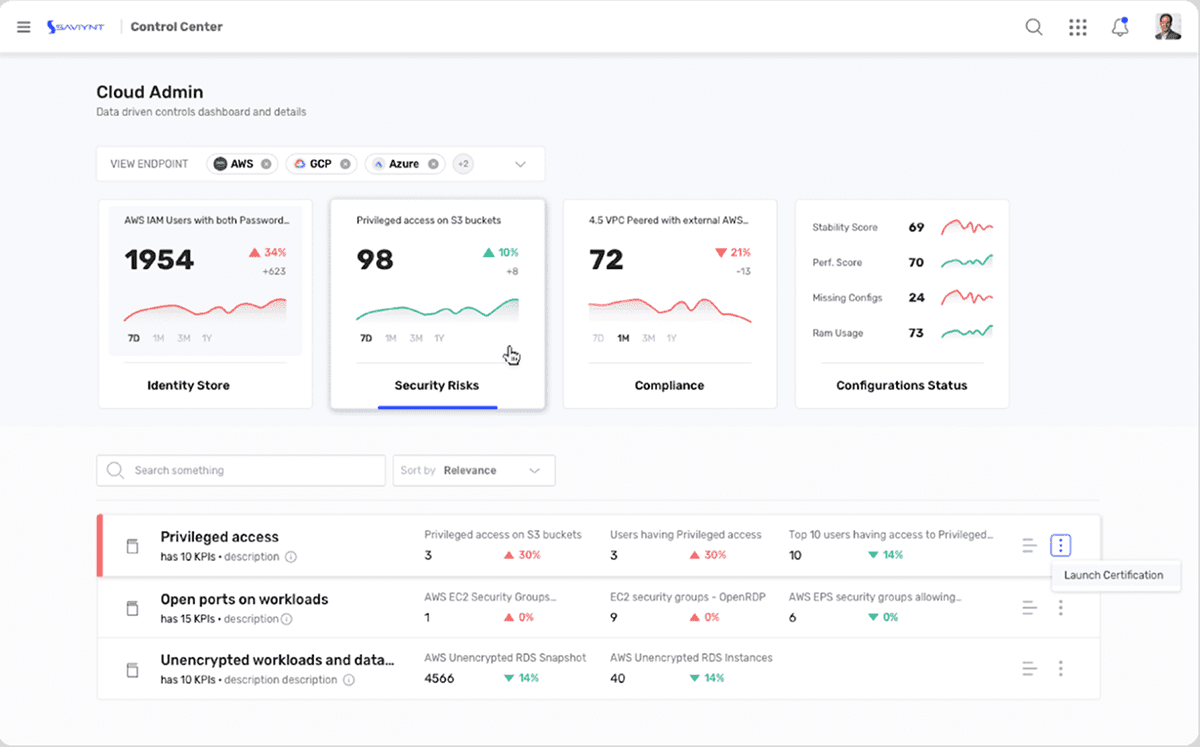
Saviynt IGA is a cloud-native identity governance solution that uses AI and automation to manage access across identities, applications, and environments. It provides a platform to govern human, machine, and AI identities while reducing operational overhead. By combining visibility, recommendations, and automated workflows, Saviynt helps organizations enforce compliance and reduce risk.
Features:
Unified identity governance platform: Centralizes identity data, access controls, and compliance processes.
AI-powered access decisions: Uses AI-driven recommendations to guide access requests and certifications.
Automated access reviews: Automates access review decisions, focusing attention on high-risk areas.
End-to-end identity lifecycle management: Automates onboarding, role changes, and offboarding.
Enterprise-wide visibility: Provides a view of access risks across identities, applications, and entitlements.
Limitations (as reported by users on G2]:
Steep learning curve: Non-intuitive UX and navigation make the platform harder to learn.
Limited features and customization: Gaps exist in areas like PAM and flexibility options.
User interface challenges: Interface design can cause confusion during setup and usage.
Configuration complexity: Setup and configuration can be difficult and impact usability.
Documentation and flexibility issues: Limited guidance and adaptability affect upgrades and operations.
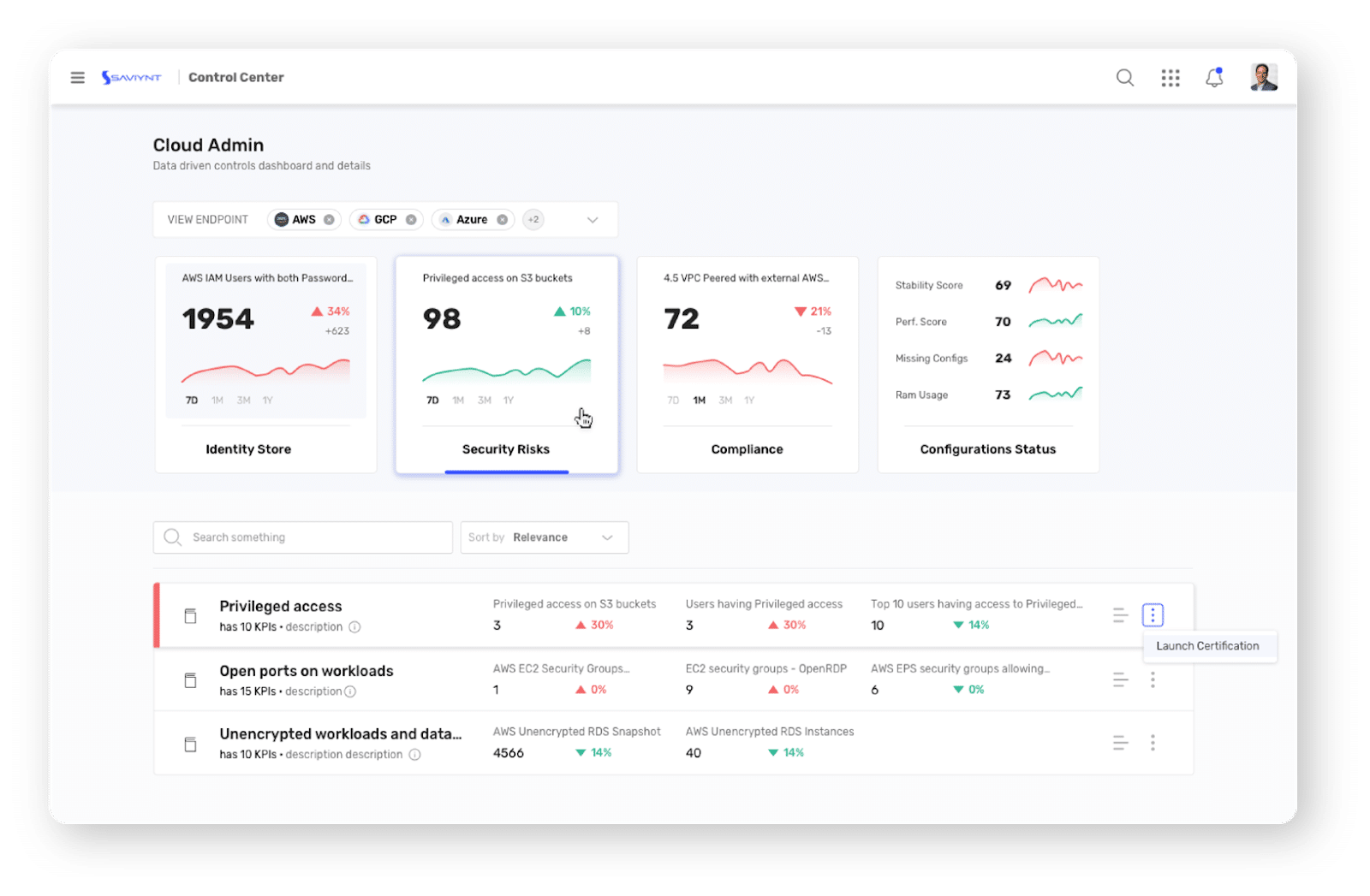
Source: Saviynt
IGA Metrics and KPIs
IGA programs require measurable outcomes to demonstrate security effectiveness, operational efficiency, and compliance performance. Metrics and KPIs help organizations track whether access governance processes are working as intended, identify gaps, and prioritize improvements. Effective IGA measurement combines operational metrics, security indicators, and governance outcomes across both human and non-human identities.
Common IGA metrics and KPIs include:
Time-to-provision SLA hit rate: Measures how often user access is provisioned within defined service-level agreements (SLAs). Fast provisioning improves productivity and reduces onboarding delays.
Time-to-deprovision SLA hit rate: Tracks whether access is removed within required timeframes after termination or role changes. Delayed deprovisioning increases the risk of unauthorized access and orphaned accounts.
Percentage of access granted via roles vs. direct grants: Evaluates how consistently role-based access control (RBAC) is applied. High numbers of direct grants often indicate governance gaps, poor role design, or excessive manual exceptions.
Orphan account count: Measures the number of active accounts that are no longer tied to valid users or identities. Orphan accounts represent significant security risks because they may remain unnoticed and unmonitored.
Certification completion rate: Tracks the percentage of access reviews completed within the required review period. Low completion rates may indicate review fatigue or weak governance participation.
Certification revocation rate: Measures how often access is removed during certification campaigns. Higher revocation rates can reveal excessive privileges or ineffective provisioning controls.
Access request approval time: Measures the average time required to approve or reject access requests. Long approval cycles can slow business operations and encourage policy bypasses.
Privileged account coverage: Tracks how many privileged accounts are governed by the IGA platform. Full visibility into administrative access is critical for risk reduction.
Separation of duties (SoD) violation count: Measures detected conflicts between incompatible access rights. Monitoring SoD violations helps prevent fraud and compliance failures.
How to Choose the Right IGA Solution
Evaluate Coverage Across All Identity Types
Modern environments include far more than employee accounts. When assessing IGA solutions, confirm that the platform governs human identities, non-human identities such as service accounts, API keys, bots, and cloud workloads, and agentic AI systems. Gaps in coverage leave privileged accounts unmanaged and create blind spots that attackers can exploit.
Look for platforms that provide unified visibility across IaaS, SaaS, PaaS, and on-premises environments from a single interface. A solution that requires separate tools for human and non-human identities adds operational complexity and reduces confidence in governance completeness.
Assess Lifecycle Automation and Least-Privilege Enforcement
Effective IGA should enforce least privilege from day one, not as an afterthought. Evaluate whether the platform automatically provisions the right access when users join, adjusts entitlements as roles change, and fully revokes access at offboarding, without requiring manual intervention at each stage. Solutions that rely heavily on manual processes or periodic batch jobs introduce delays and access drift.
Pay attention to how the platform handles role changes specifically. Right-sizing access for movers (adding what is needed, retiring what is not, and setting expiries on elevated permissions) is a strong indicator of mature lifecycle automation. Platforms that surface approvals only when risk warrants them reduce review fatigue while maintaining control.
Look for Risk Scoring and Contextual Access Intelligence
Not all access risk is equal. Prioritize platforms that continuously score entitlement risk using contextual signals such as usage patterns, peer comparisons, role alignment, and separation of duties impact. Static, periodic reviews are not sufficient in environments where permissions change frequently and threats evolve in real time.
Risk scoring should inform both access requests and certification campaigns. When reviewers see pre-scored requests enriched with business context (such as last access date, peer usage, and policy alignment) they can make faster, more confident decisions. This reduces rubber-stamp approvals and improves the overall quality of access governance.
Consider Audit Readiness and Evidence Generation
Compliance teams should not be scrambling to compile evidence before an audit. Evaluate whether the platform continuously maintains an audit trail of every access decision, change, and entitlement mapping, and whether that evidence can be exported on demand in formats auditors accept. Solutions that require manual report assembly add risk and overhead to compliance programs.
Strong audit readiness also means the platform can demonstrate least privilege at any point in time, not just at the moment of a review campaign. Look for dynamic review scoping that filters out low-risk, policy-aligned access and focuses certifications on outliers and high-risk exceptions, keeping campaigns manageable and meaningful.
Prioritize Deployment Speed and Operational Simplicity
Long IGA deployments delay value and increase project risk. Favor solutions that use agentless discovery to identify accounts and permissions across systems without requiring agents on every endpoint, and that offer low-code or no-code workflow configuration to reduce dependence on professional services. SaaS delivery models further reduce infrastructure overhead and simplify ongoing maintenance.
Evaluate how quickly the platform can onboard new applications and whether integrations with your existing cloud providers, SaaS tools, and HR systems are prebuilt or require custom development. Time-to-value is a practical measure of how well an IGA solution fits the pace of your organization's security and compliance needs.
Ability to Unify Fragmented Identity Records
Modern organizations often store identity data across disconnected systems such as HR platforms, Active Directory, cloud identity providers, SaaS applications, contractors databases, and legacy business systems. This fragmentation creates inconsistent user records, duplicate identities, and gaps in lifecycle governance. When evaluating an IGA solution, assess whether the platform can correlate identities across these systems into a single authoritative identity profile.
Effective identity unification also improves access reviews, analytics, and risk scoring. Security teams can understand the full set of entitlements tied to a user, including cloud roles, SaaS permissions, privileged access, and non-human accounts associated with workloads or automation. Modern IGA platforms should support flexible identity matching, ongoing reconciliation, and integration with authoritative data sources such as HRIS platforms and identity providers.
Conclusion
Identity Governance and Administration (IGA) is essential for securing modern, distributed environments. By adopting modern platforms, organizations can move past the limitations of legacy systems, leveraging AI and automation for continuous, risk-based access control. These solutions unify governance across human and non-human identities, ensuring timely provisioning and deprovisioning to enhance security, simplify compliance, and improve operational efficiency.