What is AI Agent Security?
AI agent security is the practice of protecting autonomous AI systems that reason, plan, and take actions. Because these agents connect to critical databases and use APIs independently, security focuses on limiting their privileges, validating inputs, and maintaining strict human-in-the-loop oversight to prevent unauthorized system changes.
AI agents, unlike traditional software, can make decisions and perform actions in dynamic environments without direct human oversight. This autonomy introduces new vectors for attacks, including manipulation of agent goals, exploitation of tool integrations, and interference with agent memory. As a result, AI agent security focuses on safeguarding both the agent’s internal logic and its interactions with external systems.
The scope of AI agent security spans identity management, access control, runtime monitoring, and the validation of agent actions. It also involves protecting data handled by agents and preventing unauthorized escalation of agent privileges.
Top AI agent threat vectors include:
Prompt and context manipulation: Prompt injection, memory poisoning, and goal hijacking can alter how agents interpret instructions and make decisions.
Abuse of tools and privileges: Overprivileged agents can misuse connected tools, escalate privileges, and perform unauthorized actions.
Sensitive data compromise: Agents can expose or exfiltrate confidential information through prompts, tool outputs, memory, or external integrations.
Unsafe autonomous behavior: Excessive autonomy, high-impact actions, and manipulated approval workflows can lead to costly or irreversible outcomes.
Operational and infrastructure attacks: Cascading failures, malicious console changes, denial-of-wallet attacks, and supply chain compromises can disrupt agent operations at scale.
Governance and access risks: Toxic permission combinations and weak separation of duties increase the risk of fraud, policy violations, and unauthorized access.
Core defensive strategies include:
Enforce strong identity and access controls: Apply least privilege, manage agents as non-human identities, continuously inventory access, and right-size permissions over time.
Keep humans involved in critical decisions: Require approvals for high-impact actions and separate read-only capabilities from write-capable operations.
Secure tool and memory usage: Validate tool inputs and outputs, and govern agent memory to prevent persistent manipulation or data leakage.
Monitor agent behavior continuously: Detect anomalous activity, risky entitlements, and policy violations through runtime monitoring and analytics.
Protect credentials and privileged access: Rotate or revoke agent credentials quickly to limit exposure after compromise or configuration changes.
We cover additional threat vectors and defensive strategies below.
This is part of a series of articles about AI security
3 Reasons AI Agent Security Matters
1. Agents Can Take Real Actions
AI agents are not limited to generating text or answering questions. They can use tools, call APIs, retrieve data, update systems, send messages, create files, trigger workflows, and make decisions across connected environments. This means a security failure can move beyond misleading output and result in operational impact, such as unauthorized data access, unintended transactions, system changes, or workflow abuse.
Because agents can plan and execute multi-step tasks, security controls must account for individual actions and the full chain of behavior. A single tool call may look safe in isolation, but when combined with memory, external instructions, or additional tools, it can contribute to a harmful outcome. This makes approval flows, scoped permissions, action validation, and runtime monitoring central parts of AI agent security.
2. Agents Expand the Attack Surface
AI agents introduce a broader attack surface than traditional applications or standalone LLMs because they combine multiple components: prompts, tools, plugins, memory, external data sources, APIs, models, user identities, and execution environments. Each component can become an entry point for abuse. Attackers may try to manipulate the agent through prompt injection, poison its context, compromise tool outputs, exploit broad permissions, or influence long-term memory.
The risk increases when agents operate across enterprise systems, especially if they have access to sensitive data, production environments, communication tools, or privileged APIs. Security teams must evaluate not only the model itself but also the surrounding agent architecture. This includes tool schemas, authentication flows, authorization boundaries, logging, data handling, input validation, and how the agent decides which actions to take.
3. Agents Challenge Existing Governance Models
AI agents extend security governance to a new type of identity that can act autonomously, make decisions, and access multiple systems on behalf of users or business processes. Organizations already have mature governance models for human users, service accounts, and workloads. The challenge is adapting those same governance principles so they also apply to AI agents, with policies that reflect how agents operate.
The two IAM disciplines most directly responsible for governing agent identities are identity governance and administration (IGA) and privileged access management (PAM). IGA governs the agent identity lifecycle, ownership, access requests, entitlement management, and periodic access reviews to ensure agents have only the permissions they require. PAM governs privileged credentials, privileged session management, credential rotation, approval workflows, and monitoring for agents that perform administrative or other high-impact actions.
However, agents also introduce characteristics that existing governance processes must account for. An agent may dynamically select tools, invoke other agents, execute long-running workflows, or change its behavior based on memory and context. As a result, organizations increasingly need governance that combines traditional identity controls with runtime authorization, continuous monitoring, and policy enforcement.
How Do AI Agents Impact Compliance Requirements?
AI agent governance is becoming relevant across many regulatory frameworks because agents increasingly access sensitive data, make decisions, and perform actions that were previously limited to human users or traditional service accounts. Auditors are beginning to ask how organizations identify AI agents, control their permissions, approve high-risk actions, and demonstrate accountability for autonomous behavior. In practice, this means applying established identity and security controls to agent identities rather than treating agents as an exception.
Although most regulations do not explicitly mention AI agents, their existing requirements already apply when agents access regulated systems or data. Organizations should be prepared to show how agent identities are authenticated, how permissions are granted and reviewed, what actions are logged, and how privileged operations require appropriate oversight. Runtime monitoring and immutable audit logs are also important because agents can execute complex, multi-step workflows without continuous human involvement.
Common examples include:
SOX: Demonstrate segregation of duties, approval workflows, and audit trails for agents that can modify financial systems or business records.
SOC 2: Show that agent access is governed through logical access controls, monitoring, change management, and security logging.
ISO/IEC 27001: Apply identity management, least privilege, access reviews, and risk management controls to agent identities alongside human and machine identities.
HIPAA: Ensure AI agents accessing protected health information follow minimum necessary access, authentication, audit logging, and data protection requirements.
PCI DSS: Restrict agent access to cardholder data, protect credentials, monitor privileged activity, and maintain detailed audit logs.
NYDFS Cybersecurity Regulation: Govern agent identities through privileged access management, multi-factor authentication where applicable, continuous monitoring, and documented cybersecurity policies.
NIS2: Implement governance, risk management, logging, access control, and incident response processes for agents operating within critical services.
GDPR: Ensure agents process personal data lawfully, limit access to personal information, maintain accountability, and support requirements such as data minimization, purpose limitation, and auditability.
AI Agent Security Risks
1. Prompt Injection (Direct and Indirect)
Prompt injection occurs when an attacker uses malicious instructions to manipulate how an AI agent interprets a task, prioritizes instructions, or uses connected tools. Direct prompt injection comes from user-supplied input, while indirect prompt injection is hidden in external content the agent reads, such as webpages, documents, emails, tickets, or tool outputs.
Impact
The impact can be significant because the agent may follow attacker-controlled instructions instead of the legitimate user’s request. This can lead to sensitive data disclosure, unauthorized tool use, incorrect decisions, unsafe system changes, or actions that violate business policy. Indirect prompt injection is especially risky because the malicious instruction may be hidden inside content the agent treats as normal context.
Mitigation
Separate trusted system instructions from untrusted user input and external content.
Treat retrieved documents, webpages, emails, and tool outputs as untrusted input.
Restrict tool access based on task, user role, and context.
Validate tool calls before execution, especially when they affect data, access, money, or production systems.
Require human approval for sensitive or irreversible actions.
Log prompts, retrieved content, tool calls, and agent decisions.
2. Tool Abuse and Privilege Escalation
Tool abuse occurs when an AI agent is tricked into misusing connected tools, APIs, plugins, or automation functions. Privilege escalation happens when the agent gains or exercises more authority than intended, often because tools are over-permissioned, poorly scoped, or not tied to the user’s access rights.
Impact
The impact can include unauthorized access to systems, data modification, command execution, workflow manipulation, or administrative changes. Since agents may operate through trusted integrations, a malicious or manipulated action can appear legitimate to downstream systems.
Mitigation
Apply least-privilege permissions to every tool and integration.
Bind tool permissions to the human user, session, role, and business context.
Use allowlists for approved tools, actions, and parameters.
Require step-up authentication or human confirmation for privileged operations.
Validate tool inputs and outputs before execution.
Monitor tool invocation patterns for unusual frequency, sequencing, or scope.
3. Data Exfiltration
Data exfiltration occurs when an attacker manipulates an AI agent into extracting, summarizing, transmitting, or exposing sensitive information. Because agents can access files, databases, SaaS platforms, communication tools, and APIs, they can become a path between protected systems and unauthorized destinations.
Impact
The impact may include exposure of credentials, customer records, financial data, intellectual property, source code, internal communications, or regulated information. This risk increases when agents can retrieve data from multiple systems and send outputs through email, chat, tickets, files, or external APIs.
Mitigation
Classify sensitive data and limit which agents can access it.
Apply data loss prevention controls to prompts, tool outputs, responses, and outbound actions.
Prevent agents from sending sensitive information to unapproved destinations.
Enforce role-based and attribute-based access controls on connected data sources.
Redact secrets, tokens, credentials, and regulated data before content enters model context.
Maintain audit logs showing what data was accessed, by which agent, and on behalf of which user.
4. Memory Poisoning
Memory poisoning occurs when malicious, false, or misleading information is written into an agent’s short-term or long-term memory. Since agents may reuse memory across future sessions, poisoned memory can influence later decisions, recommendations, tool selection, or user interactions.
Impact
The impact can be persistent and difficult to detect. A poisoned memory may cause the agent to trust malicious sources, misinterpret user intent, apply incorrect policies, leak information, or repeatedly make unsafe decisions. Unlike a one-time prompt injection, memory poisoning can affect future behavior even after the original attacker's input is gone.
Mitigation
Treat memory writes as sensitive operations.
Validate and sanitize information before storing it in memory.
Separate user preferences, operational facts, security policies, and tool history into different memory categories.
Require approval for memory updates that affect permissions, identity, tools, policies, or security behavior.
Track memory provenance, including where each memory came from and when it was created.
Periodically review, expire, and remove stale or suspicious memories.
5. Goal Hijacking
Goal hijacking occurs when an attacker changes the agent’s objective so it pursues a malicious or unauthorized goal instead of the user’s request. This can happen through direct prompts, poisoned external context, manipulated tool outputs, or misleading intermediate results.
Impact
The impact is dangerous because the agent may still appear to be working toward the original task while shifting its behavior. For example, an agent asked to summarize a document could be manipulated into collecting sensitive data, sending information externally, or preparing an unauthorized action as part of a larger workflow.
Mitigation
Define clear task boundaries and success criteria before execution.
Re-check the user’s original intent during multi-step workflows.
Prevent external content from redefining the agent’s objective.
Use policy checks to compare planned actions against approved goals.
Require confirmation when the agent changes scope, adds new objectives, or attempts a different category of action.
Monitor for goal drift across long-running or multi-tool workflows.
6. Excessive Autonomy
Excessive autonomy occurs when an AI agent is allowed to plan, decide, and act with too little oversight or too few technical constraints. The risk grows when agents can chain tools, run workflows, make decisions, or operate continuously without meaningful human review.
Impact
The impact can include unauthorized system changes, incorrect transactions, data exposure, compliance violations, and operational disruption. Even when the agent is not malicious, mistakes can scale quickly because the agent may repeat actions or apply flawed reasoning across systems.
Mitigation
Match autonomy levels to the risk of the task.
Require human approval for sensitive, irreversible, or high-value actions.
Set execution limits, such as time limits, action limits, spending limits, and API rate limits.
Require authorization before moving from analysis to action.
Use sandbox environments for testing and high-risk tasks.
Monitor agent behavior during execution.
7. High-Impact Action Abuse
High-impact action abuse occurs when an AI agent performs actions that affect money, access, legal obligations, production systems, customer communications, or business-critical workflows. A single incorrect or unauthorized step can create serious consequences.
Impact
The impact may include fraudulent payments, deleted resources, unauthorized access grants, incorrect customer notifications, production outages, or regulatory exposure. Organizations need controls that evaluate not only whether the agent can act but whether it should act in a specific situation.
Mitigation
Classify tools and workflows by impact level.
Require stronger controls for high-impact tools, including approvals and policy checks.
Use transaction limits, approval thresholds, and scoped permissions.
Use dry-run modes before executing production changes.
Add rollback procedures for reversible actions.
Require multi-party approval for critical operations.
8. Decision and Approval Manipulation
Decision and approval manipulation occurs when an attacker influences how an agent evaluates risk, presents options, requests approval, or summarizes a recommended action. Instead of bypassing approval directly, the attacker may try to make a harmful action appear normal, urgent, low risk, or already authorized.
Impact
The impact is that human reviewers may approve unsafe actions based on incomplete or misleading information. If the agent hides important details, omits risk signals, exaggerates confidence, or summarizes tool outputs inaccurately, the approval process can become a weak point rather than a safeguard.
Mitigation
Show reviewers the exact action, target system, data involved, and expected impact.
Display raw tool inputs and outputs for sensitive approvals.
Prevent the agent from summarizing important risk details.
Use independent policy checks rather than relying only on the agent’s self-assessment.
Require approvals to be specific, time-limited, and action-bound.
Log approval prompts, reviewer decisions, and executed actions.
9. Cascading Failures
Cascading failures occur when one agent error, unsafe tool call, poisoned input, or bad decision triggers additional failures across connected systems. Since agents can chain actions, depend on other tools, and interact with other agents, a small problem can spread through a workflow.
Impact
The impact can include widespread data corruption, repeated incorrect decisions, automated misconfigurations, service outages, or multi-system compromise. Cascading failures are especially concerning in enterprise environments where agents operate across ticketing systems, cloud platforms, identity systems, CI/CD pipelines, or customer-facing workflows.
Mitigation
Limit tool chaining and recursive agent-to-agent delegation.
Isolate agents by task, environment, and privilege level.
Add circuit breakers that stop execution when errors, anomalies, or policy violations occur.
Use staged execution for complex workflows.
Validate intermediate outputs before allowing the next step.
Monitor dependencies between agents, tools, and external systems.
10. Malicious Configuration of AI Consoles
AI console malicious configuration occurs when the management interface used to configure agents, models, tools, prompts, connectors, or policies is modified in an unsafe or malicious way. This can include changing system prompts, enabling risky tools, weakening guardrails, adding untrusted connectors, or disabling monitoring.
Impact
The impact can be broad because console-level changes may affect many agents, users, or workflows at once. A malicious configuration can create persistent backdoors, expand permissions, expose sensitive data, alter agent behavior, or hide evidence of misuse by reducing logging and oversight.
Mitigation
Restrict administrative access to AI consoles using strong identity controls.
Require multi-factor authentication and privileged access management for console users.
Apply change approval workflows for prompts, tools, policies, and connectors.
Maintain version history and rollback for agent configurations.
Monitor configuration drift and alert on risky changes.
Separate development, testing, and production agent configurations.
11. Denial of Wallet (DoW)
Denial of Wallet is a cost-exhaustion attack where an attacker causes an AI system to consume excessive compute, tokens, API calls, tool invocations, or paid third-party services. Agents are exposed because they may perform multi-step reasoning, retry failed tasks, call external tools, or operate continuously.
Impact
The impact is financial and operational. Organizations may face unexpected cloud bills, model inference costs, API charges, quota exhaustion, degraded performance, or service interruptions. In severe cases, attackers can use cost exhaustion to disrupt availability or force systems to shut down once spending limits are reached.
Mitigation
Set budget limits, token limits, rate limits, and tool-call limits.
Use quotas by user, tenant, agent, workflow, and API.
Detect loops, repeated retries, and unusually long task chains.
Require approval before expensive actions or large-scale processing.
Monitor cost anomalies in near real time.
Stop or throttle execution when budget thresholds are reached.
12. Sensitive Data Exposure
Sensitive data exposure occurs when confidential information is unintentionally included in prompts, retrieved context, model outputs, logs, memory, tool responses, or generated artifacts. This risk can occur during normal agent operation, even without a deliberate attack, if data handling controls are weak.
Impact
The impact can include exposure of personal data, credentials, secrets, financial records, contracts, internal documents, source code, or regulated information. Sensitive data may be shown to unauthorized users, stored in logs, sent to external tools, retained in memory, or included in generated content.
Mitigation
Minimize the data provided to agents for each task.
Mask or redact sensitive fields before they enter prompts or memory.
Prevent credentials and secrets from being stored in model context.
Apply access controls before retrieval, not only after generation.
Configure logging to avoid storing sensitive prompts, outputs, or tool responses unnecessarily.
Use retention policies for prompts, outputs, traces, and memory.
13. Supply Chain Attacks
Supply chain attacks target components used to build, deploy, or operate AI agents. These components can include models, packages, plugins, tools, datasets, MCP servers, containers, prompts, templates, APIs, and third-party services. Because agents often depend on many external capabilities, a compromised component can influence agent behavior or gain access to sensitive systems.
Impact
The impact can include malicious tool behavior, data theft, manipulated outputs, credential compromise, hidden backdoors, or unauthorized persistence in the agent environment. Supply chain attacks are especially risky when agents automatically trust third-party tools, update components without review, or use external services with broad permissions.
Mitigation
Maintain an inventory of models, tools, plugins, packages, datasets, and external services.
Use approved registries and trusted sources for agent components.
Pin versions and verify integrity before deployment.
Review tool descriptions, schemas, permissions, and update history before approval.
Scan dependencies, containers, and code for known vulnerabilities.
Monitor third-party components for changes in behavior, ownership, permissions, or security posture.
14. SoD and Toxic Combination
SoD and toxic combination risk occur when an AI agent accumulates permissions across multiple systems that should remain separated. For example, the same agent may be able to request access, approve access, modify roles, deploy code, and update production systems.
Impact
The impact can be severe because the agent can create the same toxic combinations as an overprivileged human user, but at machine speed and scale. This can lead to unauthorized approvals, fraud, policy bypass, privilege escalation, production changes, or access to sensitive data without independent review.
Mitigation
Map agent permissions across all connected systems.
Enforce separation of duties across tools, roles, workflows, and approval paths.
Prevent one agent from both initiating and approving the same action.
Use policy checks to detect toxic permission combinations before execution.
Bind agent permissions to the user, task, session, and business context.
Review agent access regularly and remove permissions that are no longer needed.
AI Agent Security Best Practices and Strategies
1. Apply Least Privilege to Every Agent
Each AI agent should receive only the access needed to complete its approved tasks. This includes limiting access to tools, APIs, data sources, files, environments, and actions. Agents should not inherit broad administrative permissions or shared service-account access simply because they operate inside a trusted application.
Least privilege is especially important because agents can chain actions and make decisions dynamically. A permission that appears harmless in one workflow may become risky when combined with another tool, memory entry, or external instruction. Organizations should scope agent permissions by user role, business purpose, data sensitivity, environment, and task context.
2. Treat AI Agents as Non-Human Identities
AI agents should be managed as non-human identities (NHIs) rather than as application features. Each agent should have its own unique identity, credentials, and permissions that can be authenticated, authorized, monitored, and audited independently. Sharing identities or long-lived service accounts between multiple agents reduces accountability and makes investigations more difficult.
Agent identities should integrate with existing identity and access management processes. Apply role-based and attribute-based access controls, short-lived credentials where possible, credential rotation, and strong authentication for privileged operations. Every action should be traceable to both the agent identity and the human user or workflow on whose behalf the agent is acting.
3. Continuously Discover and Inventory Agent Access
Organizations should maintain an up-to-date inventory of AI agents, the tools they can use, the systems they can access, the data they can retrieve, and the credentials they rely on. Without discovery and inventory, agents can become unmanaged automation paths that bypass visibility and governance controls.
This inventory should include production agents and experimental agents, as well as third-party tools, plugins, MCP servers, APIs, data connectors, memory stores, and model configurations. Security teams should be able to answer which agents exist, who owns them, what they can do, which users they serve, and whether their access is appropriate.
4. Right-Size Agent Permissions Over Time
Agent permissions should not be static. As use cases change, workflows evolve, tools are added, and business needs shift, agent access should be reviewed and adjusted. Permissions that were appropriate during testing or early deployment may become excessive once the agent is used in production.
Right-sizing reduces standing privileges and limits the blast radius of compromise or misuse. Organizations should review agent access regularly, remove unused tools, downgrade permissions where possible, and align access with observed behavior. Runtime logs, tool-call history, workflow patterns, last-used timestamps, and access frequency telemetry provide the evidence needed to identify permissions that are no longer required. Without usage telemetry, permission right-sizing becomes largely guesswork rather than a data-driven security process.
5. Require Human Approval for High-Impact Actions
Agents should not independently execute actions that could create significant financial, operational, legal, security, or customer impact. High-impact actions include deleting resources, changing access rights, transferring funds, modifying production systems, sending external communications, approving contracts, or making irreversible changes.
Human approval should be specific to the action being taken, not a broad approval for the agent to continue operating. Reviewers should see the target system, requested action, affected data, expected outcome, and risk level before approving. For critical actions, organizations should use step-up authentication, multi-party approval, or separation of duties.
6. Separate Read-Only and Write-Capable Tools
Read-only tools and write-capable tools should be separated so agents can gather context without automatically receiving permission to modify systems. Many agent workflows begin with research, retrieval, or analysis, and these tasks often do not require write access. Keeping these capabilities separate reduces the chance that a compromised prompt or malicious context can trigger an unwanted action.
Write-capable tools should have stronger controls than read-only tools, including stricter authorization, input validation, approval requirements, and monitoring. Agents should move from read mode to action mode only when the user’s intent is clear and the requested operation matches an approved workflow.
7. Validate Tool Inputs and Outputs
Tool inputs should be validated before execution to ensure the agent is calling the correct tool, using acceptable parameters, and operating within the approved scope of the task. This is especially important when tool calls affect access, data, money, infrastructure, or customer-facing systems.
Tool outputs should also be treated carefully because agents may rely on them for future reasoning and decisions. Outputs from tools, documents, webpages, emails, tickets, or APIs may contain malicious instructions, misleading data, or unexpected content. Validation should check format, source, integrity, policy compliance, and whether the result should influence the agent’s next action.
8. Govern Agent Memory Carefully
Agent memory should be controlled because stored information can influence future behavior, decisions, tool selection, and user interactions. Memory should not become an unreviewed location where sensitive data, false instructions, attacker-controlled content, or outdated context persists across sessions.
Organizations should define what agents are allowed to remember, who can update memory, how long memories are retained, and how memory entries are reviewed or deleted. Security-sensitive memories, such as permissions, policies, identities, tool instructions, or business rules, should require stronger validation than simple user preferences. Memory should also include provenance so teams can understand where stored information originated.
9. Monitor Agent Behavior at Runtime
Runtime monitoring is essential because an agent's effective behavior depends on its prompts, retrieved context, memory, tool calls, and decisions at execution time. Organizations should continuously monitor agent activity, including prompts, reasoning traces where available, tool invocations, data access, workflow execution, and outbound communications. This visibility helps detect misuse, policy violations, compromised agents, and unexpected behavior that static permission reviews cannot identify.
Monitoring should go beyond simple logging. Use peer-group analytics to identify agents whose behavior differs significantly from that of similar agents performing comparable tasks. Apply anomaly detection to tool usage patterns, such as unusual tool sequences, abnormal execution frequency, unexpected combinations of tools, access outside normal business context, or sudden increases in data retrieval.
Automatically classify high-risk agent entitlements based on the permissions they hold, the sensitivity of accessible resources, toxic permission combinations, and the potential business impact of misuse. Prioritize monitoring and review for agents with the highest-risk access and investigate behavioral deviations before they result in unauthorized actions.
10. Revoke or Rotate Agent Credentials Quickly
Agent credentials should be easy to revoke, rotate, and replace when they are no longer needed, suspected of compromise, or associated with a risky configuration. Long-lived credentials, shared API keys, and unmanaged tokens increase the chance that an attacker can continue using agent access even after the original issue is discovered.
Organizations should use short-lived credentials where possible, avoid hardcoded secrets, and tie credentials to specific agents, users, sessions, tools, and scopes. Credential rotation should be part of the agent lifecycle, including onboarding, permission changes, incident response, decommissioning, and third-party tool reviews.
AI-Native Identity Security with Opti
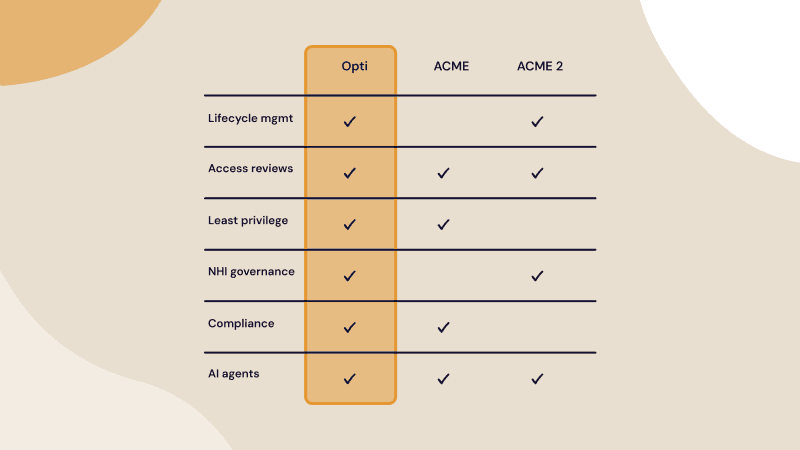
As organizations deploy more AI agents alongside human users and other non-human identities, identity security requires continuous visibility and automated governance. Opti is an AI-native identity security platform that helps security teams discover identity risks, prioritize remediation, automate access reviews, and administer access across human, non-human, and agentic identities. By combining identity context with AI-driven analysis, the platform reduces manual IAM operations while enforcing least privilege and improving governance.
Key capabilities of Opti.ai:
Unified identity visibility: Continuously discovers and correlates human, non-human, and agentic identities, applications, entitlements, and relationships to provide a complete view of identity risk across the environment.
AI-powered risk detection and remediation: Identifies overprivileged access, toxic permission combinations, orphaned accounts, and identity misconfigurations, then recommends validated remediation actions based on business context and least privilege principles.
Automated access reviews: Transforms entitlement data into intelligent, risk-based access reviews that prioritize high-risk permissions, reduce reviewer workload, and streamline compliance processes.
Intelligent access administration: Automates access requests, approvals, provisioning, and entitlement decisions using AI models trained for identity governance, reducing manual effort while maintaining policy enforcement and human oversight for sensitive actions.
Continuous least privilege: Monitors identity usage and access patterns to recommend permission right-sizing, helping organizations remove unnecessary privileges and reduce the attack surface as identities and workloads evolve.
AI-native governance for agentic identities: Extends identity governance beyond human users to AI agents and other machine identities, enabling organizations to inventory agent access, monitor privileges, and govern autonomous identities using the same security principles applied across the broader identity ecosystem.