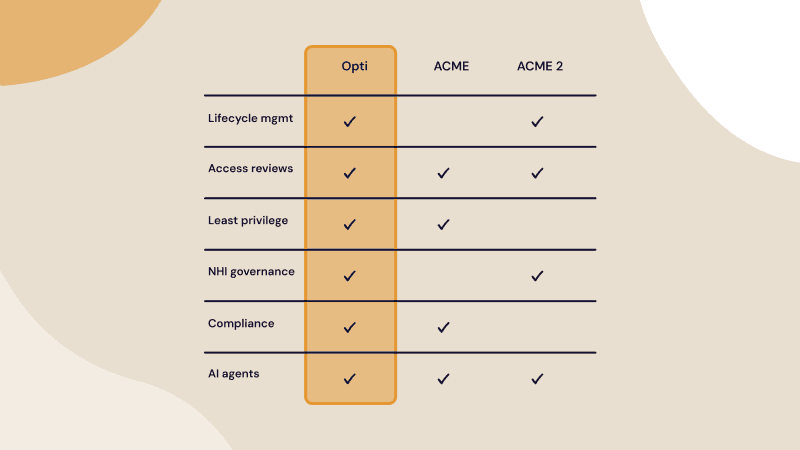
TL;DR: Evaluate IAM security solutions across six criteria: identity visibility, risk detection, automated remediation, governance, NHI and AI agent coverage, and integration fit. Opti stands out for broad identity coverage and automated remediation; Veza for effective-permission visibility and risk detection; SailPoint for governance and access reviews; and Silverfort for runtime enforcement.
What Are IAM Security Solutions and How Should You Evaluate Them?
Evaluating Identity and Access Management (IAM) security solutions requires assessing how well they handle deep visibility, accurate risk detection, and safe automated remediation across modern hybrid and cloud environments.
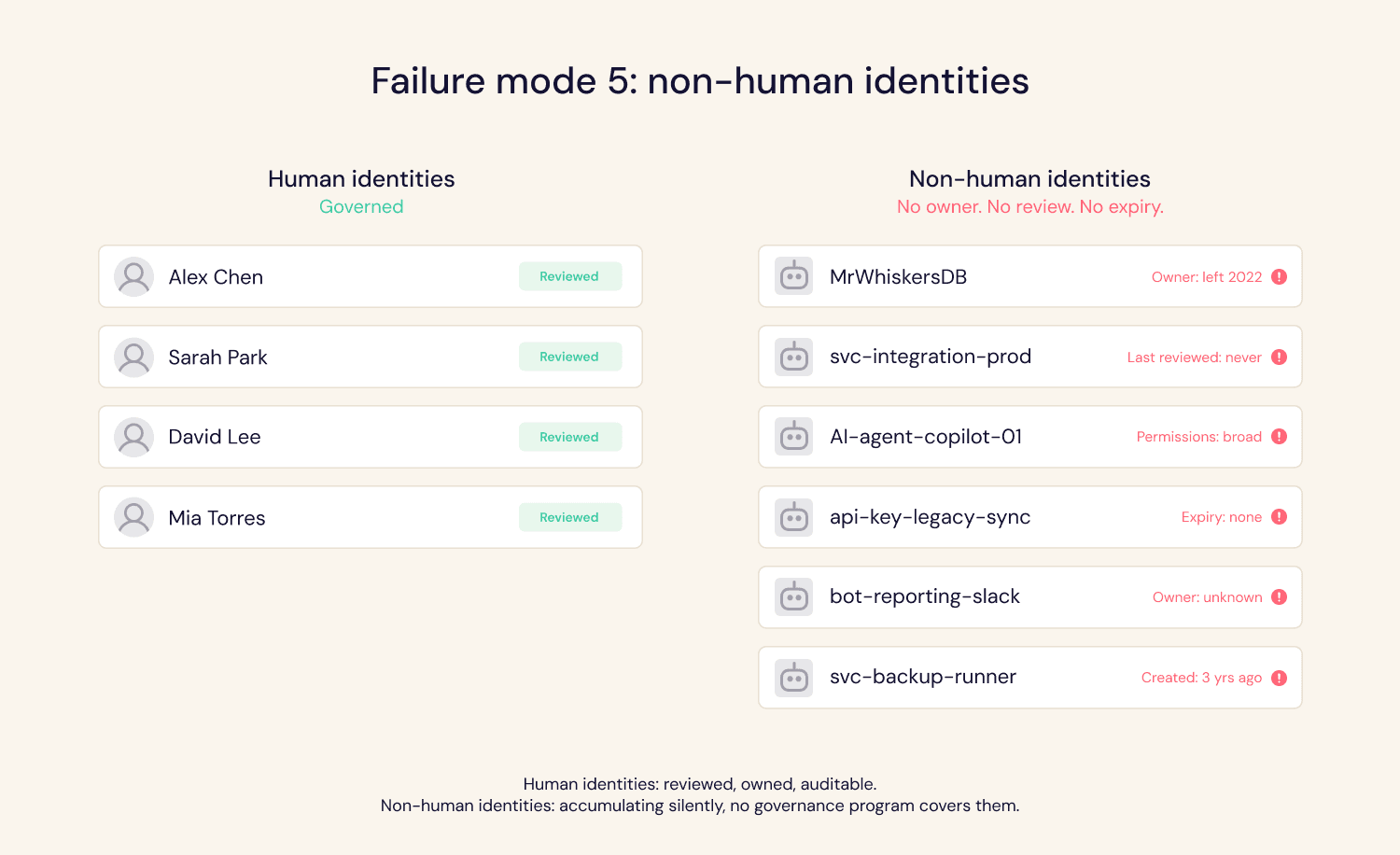
Modern IAM must cover more than human users. Organizations also rely on non-human identities (NHIs), such as service accounts, workloads, API keys, and machine identities, as well as AI agent identities that can independently access systems and perform actions. Effective IAM security solutions provide visibility and governance across human, non-human, and agentic identities so that access policies apply consistently regardless of who—or what—is requesting access.
Use these six criteria to compare IAM security solutions consistently:
Identity visibility and coverage: whether the solution sees every human, non-human and AI agent identity, and the entitlements attached to each.
Risk detection and prioritization: how the solution identifies risky access and ranks it so teams work on the right issues first.
Automated remediation and least privilege enforcement: what the solution can change on its own, from revoking entitlements to granting time-bound access.
Governance, access reviews, and compliance: support for certification campaigns, separation of duties, audit evidence and reporting against specific regulatory frameworks.
NHI and agentic identity coverage: discovery and governance for service accounts, workloads, keys and AI agents, on the same platform as human identities.
Integration and deployment fit: how well it connects to directories, cloud platforms, SaaS, on-prem and custom applications, and how long it takes to get value.
Solutions compared in this guide against these evaluation criteria:
Opti: Best for enterprises automating IAM decisions with identity-trained AI, living access graphs, plain-English policies, one-click remediation, NHI governance, and AI agent security.
Veza: Best for mapping effective permissions to data across enterprise systems using the Access Graph, prebuilt risk queries, SoD detection, access reviews, and dry-run lifecycle changes.
Silverfort: Best for runtime MFA and access controls across legacy, hybrid, cloud, OT, and hard-to-protect systems without agents, proxies, or application changes.
CrowdStrike Falcon next-gen identity security: Best for real-time identity threat detection and enforcement, especially for organizations already using Falcon across endpoint, cloud, SaaS, and identity security.
SailPoint identity security cloud: Best for large enterprises with certification-heavy governance programs, lifecycle orchestration, compliance management, identity graph visibility, and zero standing privilege.
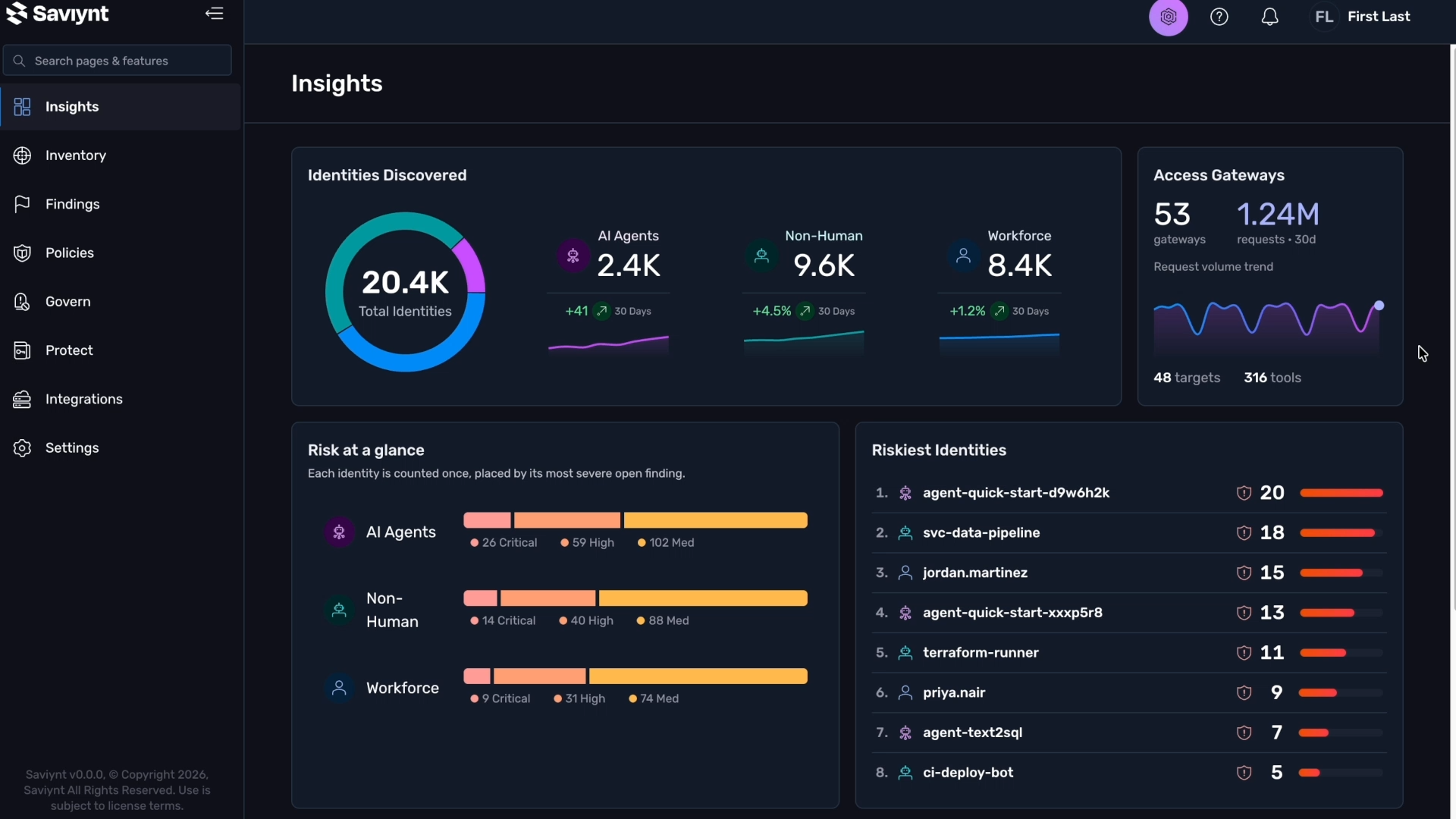
Saviynt identity cloud: Best for converged IGA, PAM, and application access governance, with strong cross-application SoD, just-in-time access, NHI management, and AI agent coverage.
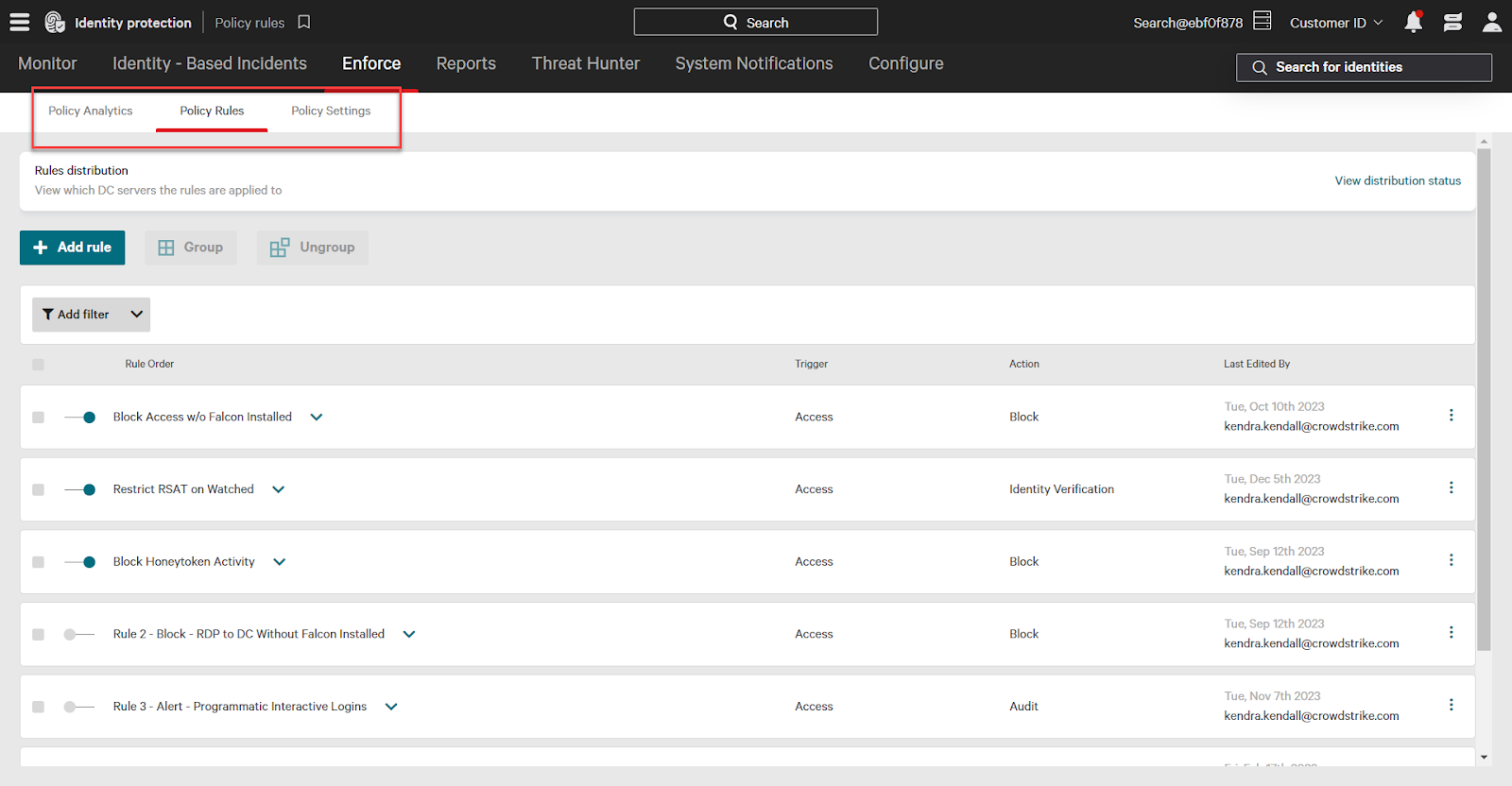
Okta workforce identity: Best for centralizing workforce access management with SSO, adaptive MFA, lifecycle management, governance add-ons, posture management, and a large integration network.
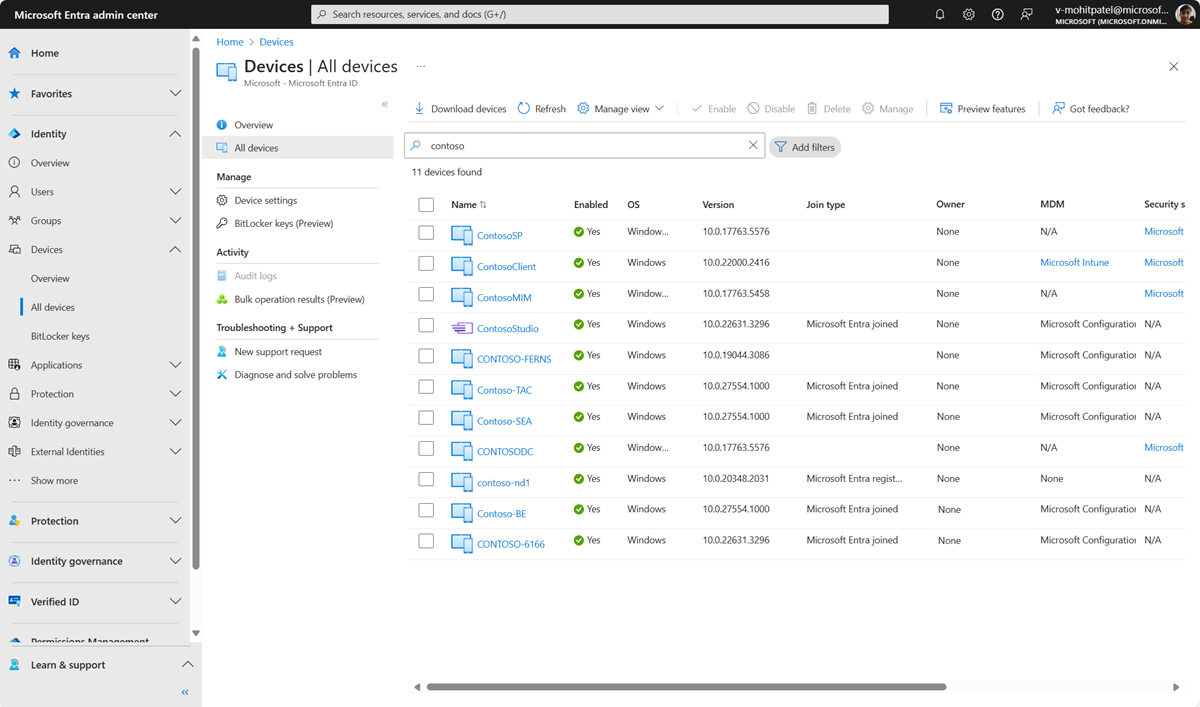
Microsoft Entra ID: Best for Microsoft-centric organizations standardizing on one directory with conditional access, risk-based protection, PIM, entitlement management, and access reviews.
How IAM Security Solutions Address Visibility, Risk Detection, and Automated Remediation
When evaluating IAM security solutions, three capabilities are especially important: identity and access visibility, risk detection, and automated remediation. Together, they determine whether a platform can do more than administer access—whether it can continuously identify identity exposure and help security teams reduce it.
IAM Security Visibility
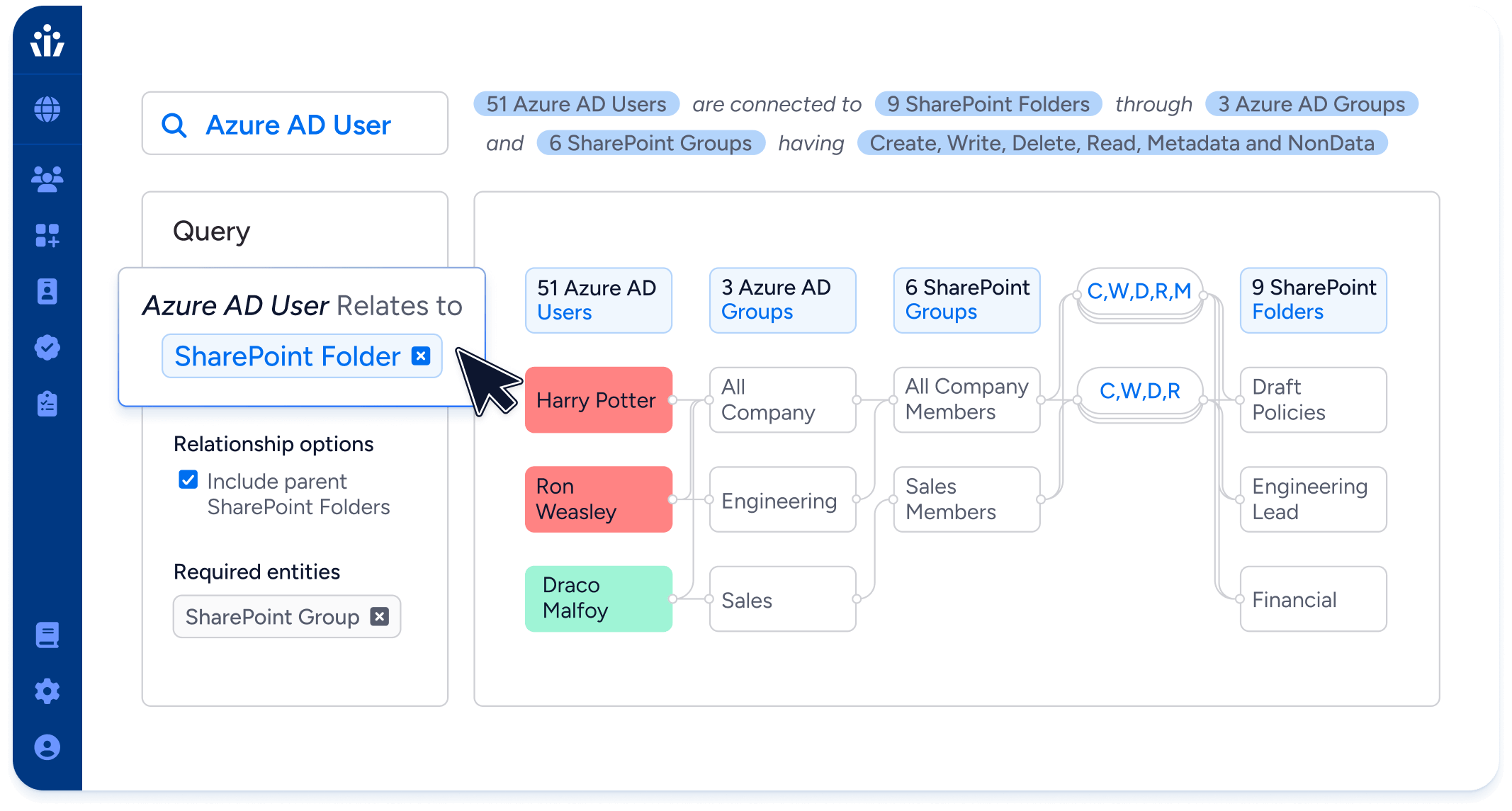
IAM security visibility should provide a unified view of identities, accounts, roles, entitlements, and their relationships across applications and infrastructure. This includes human and non-human identities, privileged accounts, group memberships, and direct or inherited permissions. Security teams need this context to understand who can access each resource and how that access was granted.
Usage telemetry is another essential visibility capability. Last-used data and access frequency show whether permissions are actively used, rarely needed, or potentially stale. An access list without usage data only shows what exists, not what is actually being used or justified. Combining entitlement data with usage telemetry gives teams the evidence needed to identify unnecessary access and support least-privilege decisions.
IAM Risk Detection
IAM risk detection should identify access that is unusual, excessive, or conflicts with policy. Strong solutions use peer-group analytics to compare a user or identity against others with similar roles and flag outlier access that may indicate privilege creep or inappropriate entitlements. They should also analyze access usage patterns to detect anomalies, such as rarely used permissions, unexpected resource access, or activity that differs from an identity’s normal behavior.
Risk detection should also include policy-based controls such as segregation of duties (SoD) checks and toxic combination detection. These capabilities identify combinations of permissions that create unacceptable risk, even when each entitlement appears valid on its own. This is more useful than generic AI-assisted scoring because it gives security teams specific, explainable access risks they can investigate and prioritize.
Related content: Read our article about the top IAM security risks and the capabilities that address them.
Automated IAM Remediation
Automated remediation should connect risk detection directly to access changes in a closed-loop workflow. Identifying excessive or inappropriate access is only the first step; the platform must also be able to revoke, reduce, or otherwise correct that access. The gap between detecting a risk and actually removing the entitlement is where many IAM tools still require manual intervention.
Lifecycle-triggered remediation should also use an authoritative source such as an HRIS to reflect changes in employment status, department, role, or manager. When those changes occur, the IAM platform can automatically adjust or revoke access according to policy. This reduces stale permissions and helps ensure that remediation follows current business context rather than relying on periodic manual reviews.
How to Choose and Evaluate an IAM Security Solution: 6 Key Criteria
Each criterion below includes the concrete checks to run during an evaluation. Applying all six to every shortlisted platform will surface where a solution genuinely covers a capability and where it depends on another product, an add-on module or a manual process.
1. Identity Visibility and Coverage
Visibility determines everything downstream: a platform cannot detect risk in access it never ingested, and it cannot remediate what it cannot see. The useful test is not whether a platform lists accounts, but whether it resolves effective permissions at the resource level, connects them back to a person or workload, and keeps that picture current as access changes. Coverage across on-prem directories, cloud infrastructure, SaaS and homegrown applications matters as much as depth, because gaps concentrate in exactly the legacy systems that attackers target.
Evaluation criteria:
Does it discover human, non-human and AI agent identities in one inventory?
Does it resolve effective permissions at resource level, including inherited and nested access?
Does it cover on-prem directories, IaaS, PaaS, SaaS, databases and custom applications?
Does it include usage telemetry such as last-used data and access frequency?
How often is the access map refreshed, and is the refresh continuous or scheduled?
2. Risk Detection and Prioritization
Detection quality is what stops an identity program from drowning in findings. Strong platforms compare identities against peer groups, flag entitlements that are held but never used, and identify combinations of permissions that create risk even when each permission is defensible alone. Prioritization matters just as much: an unranked list of thousands of findings produces the same outcome as no findings at all. Look for explainable scoring that a reviewer can act on rather than an opaque number.
Evaluation criteria:
Does it run peer-group analytics to surface outlier access?
Does it detect separation of duties conflicts and toxic entitlement combinations?
Can it distinguish dormant or unused entitlements from actively used ones?
Is each risk explainable, with the evidence behind the score visible to a reviewer?
Does it detect anomalous behavior and misconfigurations, not only static posture issues?
3. Automated Remediation
This is where most IAM programs stall. Detection is common; closing the loop between a finding and an access change is not. The question to ask is what the platform can execute itself, through which system, and with what guardrails. Time-bound and just-in-time access matter here too, because removing standing privilege permanently is more durable than revoking it repeatedly. Safeguards such as approval gates and dry-run modes decide whether automation is safe to switch on in production.
Evaluation criteria:
Can it revoke, reduce or right-size entitlements directly, or only raise a ticket?
Does it support just-in-time and time-bound access with automatic expiry?
Are there approval gates, dry-run modes or simulation before changes are applied?
Does it write changes back through the IdP, IGA or target application?
Are lifecycle events from an HRIS able to trigger remediation automatically?
4. Governance and Compliance
Compliance is where identity work becomes evidence. A platform should run certification campaigns, scope them to what actually needs review, capture reviewer decisions and produce an audit trail that maps to the frameworks the organization is assessed against. Frameworks differ in what they demand, so ask about them by name rather than accepting a general claim of compliance support. Evaluators typically need coverage across SOX, SOC 2, ISO 27001, HIPAA, PCI-DSS, NYDFS Part 500, NIS2 and GDPR, and the specific frameworks a vendor documents vary widely.
Evaluation criteria:
Which frameworks are explicitly supported: SOX, SOC 2, ISO 27001, HIPAA, PCI-DSS, NYDFS, NIS2, GDPR?
Can review campaigns be scoped by risk, so reviewers see exceptions rather than full entitlement dumps?
Does the reviewer see business context such as last access, peer comparison and risk indicators?
Is there a complete audit trail of every access decision and change?
Are separation of duties policies enforced continuously or only checked at campaign time?
5. NHI and Agentic Identity Coverage
Service accounts, workloads, API keys and AI agents now outnumber employees in many environments, and they rarely have an owner, an expiry date or a review cycle. Coverage here is uneven across the market: some platforms inventory non-human identities on the same graph as human ones, while others treat them as a separate module or a roadmap item. AI agents add a further requirement, since what matters is not only that an agent exists but what it can read, write or manage in connected systems.
Evaluation criteria:
Are non-human identities inventoried on the same platform as human identities?
Does it discover unmanaged or shadow AI agents and their integrations?
Can it show exactly what each agent or service account can access?
Does it assign ownership and detect stale or expired credentials?
Can non-human access be right-sized and revoked, not only reported?
Related content: Read our article about non-human identity security gaps and how to mitigate them.
6. Integration and Deployment Fit
Integration breadth decides how much of the environment the platform actually governs, and deployment model decides how long that takes. Agentless, read-only connectors are usually faster to approve than agents or proxies, but they may limit enforcement. Custom and legacy applications are the usual sticking point, so check whether onboarding them requires professional services. Ask for a realistic timeline to first useful output rather than to initial connection.
Evaluation criteria:
How many prebuilt connectors exist for your directories, cloud platforms and SaaS estate?
How are homegrown and legacy applications onboarded, and at what cost?
Is deployment agentless, agent-based or proxy-based, and what does enforcement require?
Is there an open API for custom integrations and workflow automation?
What is the realistic time to first useful output in an environment of your size?
Common IAM Security Solutions and How They Meet the Criteria
The table below summarizes how each solution measures up against the six criteria. Each one is explored in detail in the sections that follow.
Category | Solution | How It Meets the Criteria |
Identity security posture and risk platforms | Opti | Builds an access graph across human, non-human and agentic identities, then applies identity-trained models to recommend and execute remediation with human approval. Covers reviews and role mining, and layers over an existing IdP or IGA. |
Identity security posture and risk platforms | Veza | Resolves effective permissions to data across enterprise systems through the Access Graph, with 500+ prebuilt risk queries, SoD detection, access reviews and lifecycle changes that can be dry-run before execution. |
Identity security posture and risk platforms | Silverfort | Enforces MFA and access policy inline at authentication across on-prem, cloud and legacy systems. Strong on runtime protection, service accounts and ITDR; entitlement-level governance is not its focus. |
Identity security posture and risk platforms | CrowdStrike Falcon Next-Gen Identity Security | Correlates identity, endpoint, SaaS and cloud signals to detect attacks and enforce in real time, including mid-session revocation, just-in-time privilege and phishing-resistant MFA. |
Identity governance and access management platforms | SailPoint Identity Security Cloud | Full IGA suite with identity graph discovery, automated lifecycle orchestration, certification campaigns, compliance management and zero standing privilege enforcement, extensible through advanced modules. |
Identity governance and access management platforms | Saviynt Identity Cloud | Converges IGA, PAM and application access governance on one platform, with cross-application SoD, just-in-time access, and AI agent registration and runtime evaluation through Zuma. |
Identity governance and access management platforms | Okta Workforce Identity | Combines access management, lifecycle management, governance, privileged access and posture management on one identity platform with a large integration network; governance is a separate product. |
Identity governance and access management platforms | Microsoft Entra ID | Directory, authentication and conditional access with risk-based detection, privileged identity management, entitlement management and access reviews. Depth of governance depends on licence tier. |
Notable IAM Security Solutions Compared on the 6 Evaluation Criteria
How we selected these solutions: We shortlisted IAM security solutions based on identity visibility across human, non-human and AI agent identities, risk detection and prioritization, automated remediation and least privilege enforcement, governance and access review capabilities, and integration and deployment fit.
Identity Security Posture and Risk Platforms
1. Opti

Best for: Enterprises automating IAM decisions with identity-trained AI models
Strengths: Access graph, plain-English policies, one-click remediation
Things to consider: Newer platform that layers over an existing identity stack
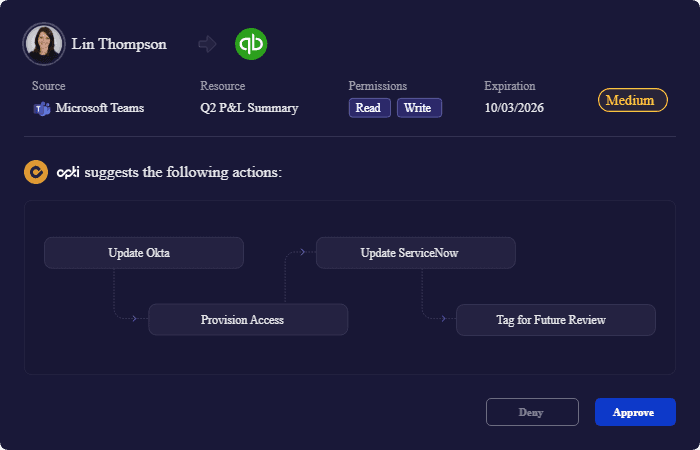
Opti is an AI-native identity security platform that ingests, normalizes and analyzes identities across applications, covering human, non-human and agentic identities. A context-aware engine continuously analyzes access behavior and risk across every identity and application, building a living access graph of identities, entitlements and usage.
The platform runs on proprietary language models built for identity security. An entitlement analysis framework is trained on enterprise-scale entitlement data covering permissions, roles and usage patterns, and an adaptive workflow model handles access requests, remediation plans, policy refinement and audit attestations.
Opti connects to an existing IdP, IGA, HRIS, ITSM and business applications rather than replacing them, and its integration AI extends coverage to legacy and homegrown systems. Connecting Okta or Entra maps the organization's real role structure within hours, with no app integrations or schemas required to start.
Key features include:
Contextual access graph: Unifies identities, entitlements and business context into a single view, showing specific entitlements rather than application-level access, with continuous sync across every connected system.
Natural language queries and policies: Answers questions such as who has admin access to a given system without SQL or filters, and lets teams write policies in everyday language that Opti then scans against continuously.
One-click remediation: Produces a precise remediation path for over-privileged access and orphaned accounts and executes it from the platform, revoking unused entitlements based on actual usage with human approval on critical changes.
Least privilege and just-in-time access: Suggests the minimal privilege set per role, grants elevated access only when requested and approved, and expires permissions once tasks are complete.
Lifecycle management: Applies least privilege at onboarding based on role, team and peer behavior, recalibrates entitlements as people move, sets expiries on elevated access, and revokes cleanly at offboarding.
Access reviews with dynamic scoping: Filters out low-risk and policy-aligned access so campaigns focus on outliers and exceptions, and surfaces last access, peer comparison and risk indicators to reviewers.
NHI governance: Discovers and right-sizes service accounts, API keys, bots, cloud roles and service principals across AWS, Azure, GCP and Oracle Cloud, plus secrets in vaults and access to databases and data lakes.
AI agent security: Shows what each agent can read, write or manage across connected applications, monitors agent activity, flags over-privileged capabilities and enforces runtime guardrails.
Adaptive role mining: Builds a role model from ingested identity data, proposes role updates as the organization changes, and folds SoD constraints and business rules into every suggestion.
Criterion | Solution Fit | Key Considerations |
Identity visibility and coverage | Living access graph of identities, entitlements and usage across clouds and applications, covering human, non-human and agentic identities, with continuous sync. | Depth on any given application depends on which connectors are in place; homegrown systems are onboarded through the integration AI rather than a prebuilt connector. |
Risk detection and prioritization | Entitlement models analyze roles, peer usage and business context to surface overprivileged access, sprawl and policy violations, with contextual risk scores and evidence-backed explanations. | Peer-based scoring improves as more of the estate is connected, so early findings reflect the systems onboarded first. |
Automated remediation and least privilege enforcement | Revokes unused entitlements based on real usage, applies least privilege recommendations, and runs just-in-time access with automatic expiry. Changes execute from the platform with human approval on critical actions. | Enforcement is executed through connected systems, so the pace of rollout follows integration coverage. |
Governance, access reviews, and compliance | Consolidates identity, access and entitlement data against policies, roles and usage; produces access reviews on demand with an audit trail of every decision, change and access mapping. SoD constraints and regulatory rules can be defined in plain English. | Named framework mappings are not enumerated on the product pages; confirm reporting fit for SOX, PCI-DSS, NYDFS or NIS2 during evaluation. Opti itself maintains SOC 2 and ISO 27001 controls. |
NHI and agentic identity coverage | Covers service accounts, workloads, API keys, bots, vault secrets and AI agents across IaaS, SaaS, PaaS and on-prem, with discovery, right-sizing and remediation, plus granular visibility into agent permissions. | Agent coverage spans major AI platforms; niche or internally built agent frameworks may need integration work. |
Integration and deployment fit | Deploys in hours, connects to existing IdP, IGA, HRIS, ITSM and business applications, and offers more than 250 integrations. Role mining starts from an IdP connection alone. | The platform is designed as an intelligence and automation layer, so existing directories and governance tooling remain part of the architecture. |
2. Veza

Best for: Mapping effective permissions to data across enterprise systems
Strengths: Access Graph, 500+ prebuilt queries, dry-run lifecycle changes
Things to consider: Cost and setup effort reported by smaller programs
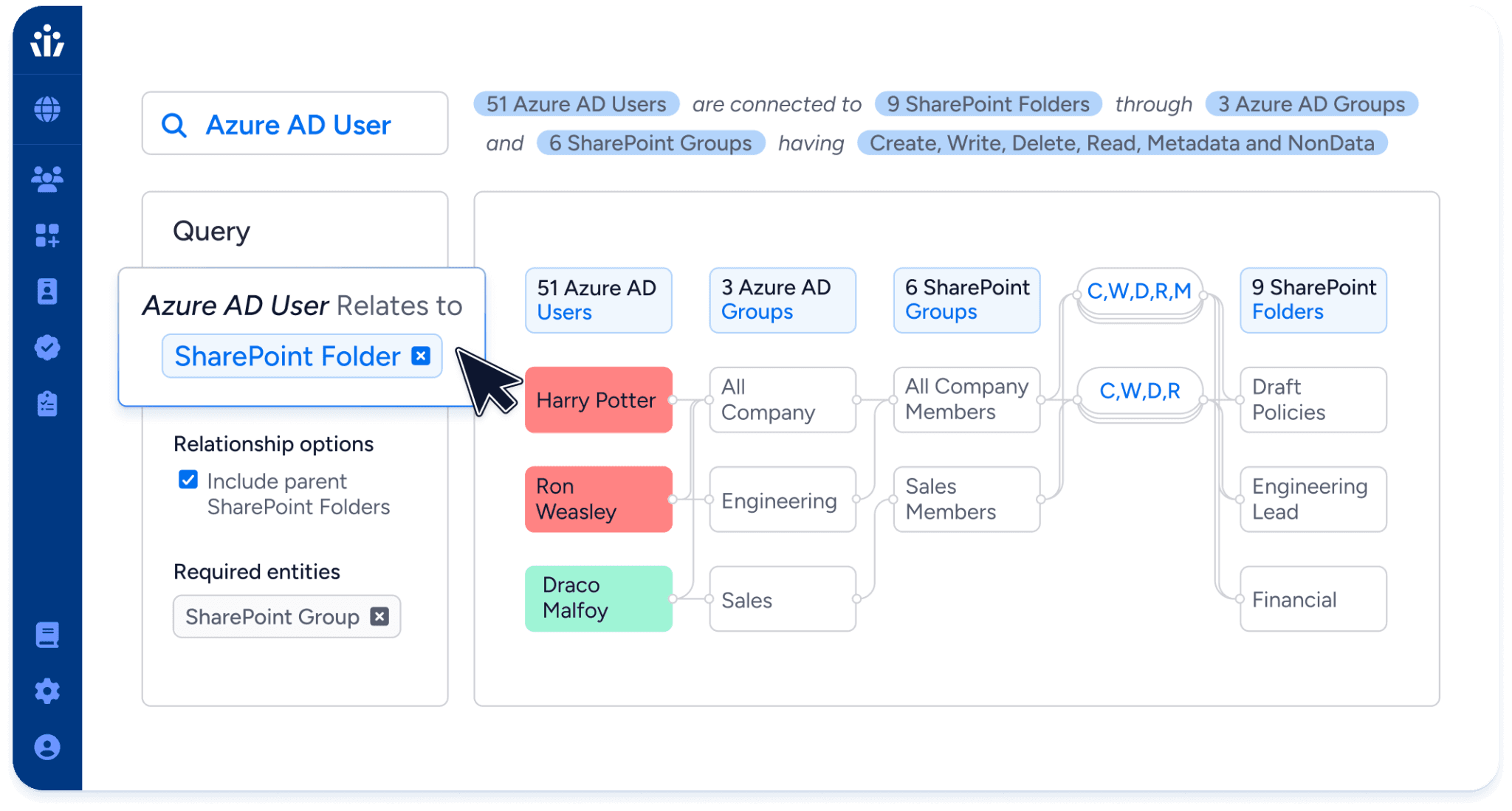
Veza is an access platform built around the Access Graph, which traverses users, groups, roles and policies to connect identities to their effective permissions, expressed in create, read, update and delete terms. The graph covers human and machine identities across enterprise systems.
The platform is organized into three product areas. Identity Security Posture Management covers access visibility, intelligence and monitoring. Identity Governance Administration covers access reviews, lifecycle management, access requests, authorization and separation of duties. A third area covers non-human and AI agent identity security.
Veza deploys through agentless, read-only integrations with identity systems, cloud providers, data systems and on-prem applications, with an Open Authorization API for custom applications. The platform is SOC 2 Type I, SOC 2 Type II and ISO 27001 certified.
Key features include:
Access Graph: Visualizes relationships between human and machine users, applications, systems and data sources, resolving inherited and nested permissions into effective permissions on each resource.
Access Intelligence: Detects privileged users, dormant permissions, policy violations and misconfigurations using more than 500 prebuilt queries, and creates tickets for remediation.
Access Monitoring: Tracks not only who can access a resource but who has accessed it, which supports right-sizing roles, trimming entitlements and removing dormant entities.
Access Reviews: Builds certification campaigns that prioritize risky access first and give reviewers the context needed to approve or reject.
Lifecycle Management with dry run: Grants and revokes access on joiner, mover and leaver events, and can dry-run changes to catch access mistakes and policy violations before they are applied.
Separation of Duties: Discovers and mitigates toxic permission combinations and SoD violations within and across platforms.
NHI Security: Creates an inventory of service accounts, keys and secrets, assigns ownership, and detects expired credentials and over-permissioned accounts alongside human identities.
AI Agent Security: Shows what data and applications AI agents can reach, maps human owners and provides audit trails for AI security posture management.
Access AI and Access Hub: Adds generative AI capabilities across Veza products and gives managers and employees a central place to view, request and govern access.
Criterion | Solution Fit | Key Considerations |
Identity visibility and coverage | Access Graph resolves effective permissions for human and machine identities across cloud, SaaS, data systems and on-prem applications through 300+ agentless integrations. | Users report that broad coverage requires integrating multiple systems, which lengthens initial rollout. |
Risk detection and prioritization | 500+ prebuilt queries surface privileged users, dormant permissions and misconfigurations; SoD detection covers toxic combinations within and across platforms. | Query-driven detection assumes someone tunes and maintains the query set for the environment. |
Automated remediation and least privilege enforcement | Lifecycle Management grants and revokes access on identity events, Access AuthZ automates enforcement, and changes can be dry-run first. Access Intelligence can generate remediation tickets. | Some remediation paths route through ticketing rather than executing directly, depending on the target system. |
Governance, access reviews, and compliance | Access Reviews automate certification campaigns with risk-prioritized scoping and reviewer context; REST API supports audit reporting and workflow integration. | Framework coverage is not enumerated per regulation on the product page beyond a DORA-focused brief; confirm SOX, HIPAA, PCI-DSS, NYDFS and NIS2 reporting needs directly. |
NHI and agentic identity coverage | Full inventory of service accounts, keys and secrets with ownership assignment, expired credential detection and AI agent visibility, on the same platform as human identities. | Ownership assignment is an operational exercise the customer runs, not something the platform can infer everywhere. |
Integration and deployment fit | 300+ agentless, read-only integrations deploy without service interruption, with an Open Authorization API for custom applications and API-first automation. | Reviewers describe the platform as expensive and better suited to larger programs, with support responsiveness noted as an area to test. |
Source: Veza
3. Silverfort

Best for: Runtime MFA and access controls across legacy and hybrid systems
Strengths: Inline enforcement without agents, proxies or application changes
Things to consider: Focused on runtime protection rather than entitlement governance
Silverfort enforces identity security inline at the moment of authentication. Its Runtime Access Protection technology integrates with the existing IAM infrastructure, which forwards each access request to Silverfort for risk analysis and returns a security verdict before access is granted or denied.
Because enforcement happens inside the IAM infrastructure rather than through a proxy or an endpoint agent, the platform extends controls to resources that traditionally resist modern authentication, including legacy systems, command-line tools and OT environments, alongside cloud workloads and SaaS applications.
The platform follows a discover, analyze and enforce model. It discovers every identity across every environment and monitors access activity, analyzes identities and access attempts continuously to uncover exposures and detect threats, and enforces controls in real time. Coverage spans workforce users, privileged users, third parties, non-human identities and AI agents.
Key features include:
Runtime Access Protection: Evaluates every authentication request inline and independently, regardless of static policy, and returns a verdict to the IAM infrastructure before access is granted.
Universal MFA: Extends multi-factor authentication to systems and protocols that cannot normally support it, including legacy applications and on-prem infrastructure.
Authentication Firewall: Applies deny rules across authentication traffic to block access paths and contain lateral movement.
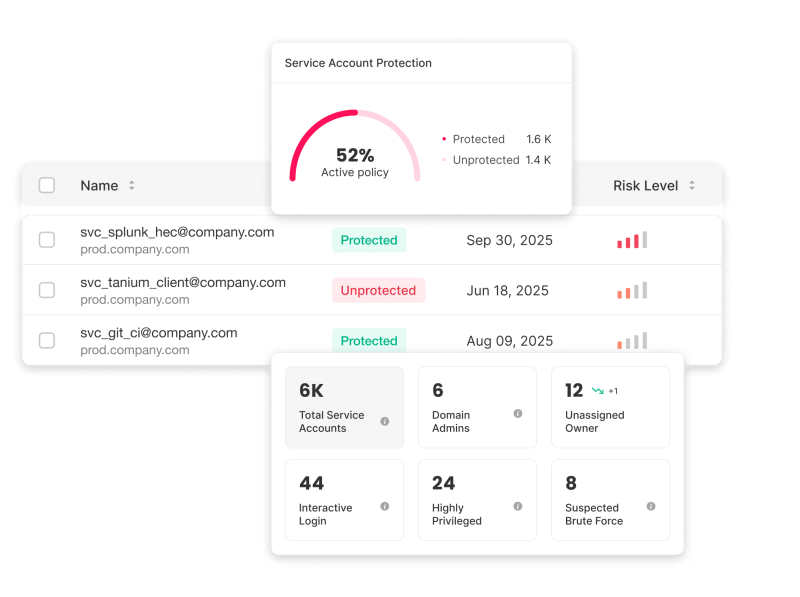
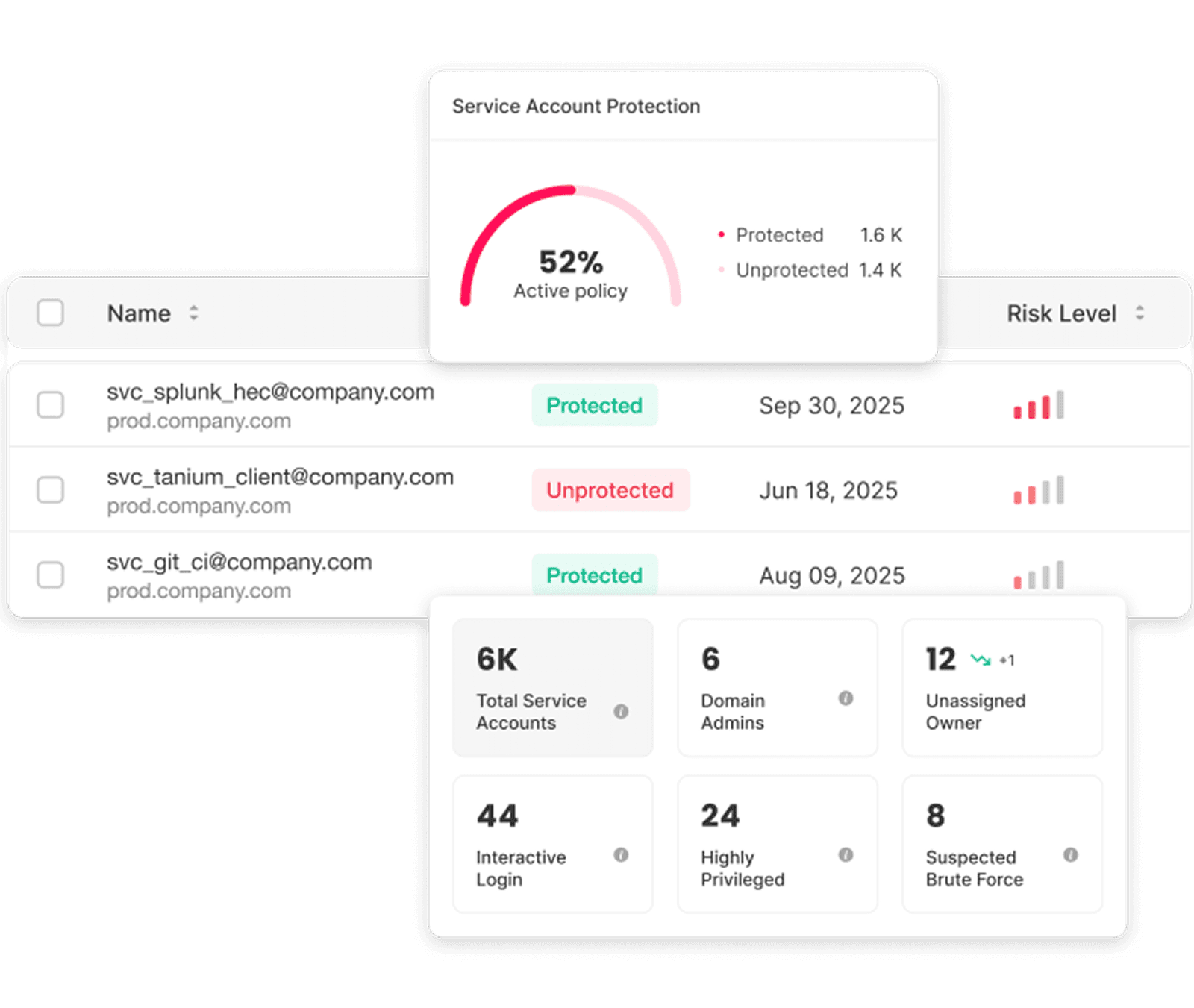
NHI Security: Discovers, monitors and protects non-human and machine identities, with service account protection as a distinct use case.
Privileged Access Security: Secures privileged accounts without vault complexity, offered as a vaultless approach to privileged access.
ISPM and ITDR: Finds and fixes identity weaknesses across the environment and detects and responds to identity threats using behavioral analytics and identity context.
Identity Graph and Access Intelligence: Discovers every identity and its relationships and provides context on access rights across the environment.
AI Agent Security: Discovers, monitors and protects AI agents, enforcing identity controls at the moment an agent acts.
Criterion | Solution Fit | Key Considerations |
Identity visibility and coverage | Discovers every identity across on-prem, OT, hybrid, cloud and multi-cloud environments and monitors all access activity in one place, with an Identity Graph of identities and their relationships. | Visibility is centred on authentication and access activity rather than fine-grained entitlement mapping inside applications. |
Risk detection and prioritization | Continuous analysis of identities and access attempts uncovers exposures and detects threats in real time, using behavioral analytics and identity context to identify malicious patterns. | Detection is oriented to attack behavior and posture weaknesses; peer-group entitlement analytics and SoD are not the focus. |
Automated remediation and least privilege enforcement | Enforces security controls at runtime, assessing and acting before access is granted rather than after an alert is triaged, through MFA challenges and deny policies. | Enforcement blocks or challenges access rather than revoking underlying entitlements, so privilege cleanup still needs a governance layer. |
Governance, access reviews, and compliance | Offers a regulatory compliance use case and a unified policy layer for security and compliance, positioned to close compliance gaps early and simplify cyber insurance requirements. | Certification campaigns and access review workflows are not part of the platform; specific framework mappings are not listed on the platform page. |
NHI and agentic identity coverage | Covers non-human and machine identities and AI agents alongside workforce, privileged and third-party users, with service account protection as a dedicated capability. | Coverage is protection-oriented; entitlement right-sizing for non-human identities is limited compared with graph-based platforms. |
Integration and deployment fit | Connects to the existing IAM infrastructure with no proxies, no application changes and no user friction, and customers report deployments completed in hours. | G2 reviewers note that version upgrades require vendor approval, and pricing is not published. The review base is small, at 18 reviews. |
Source: Silverfort
4. CrowdStrike Falcon Next-Gen Identity Security

Best for: Real-time detection and enforcement across the identity attack chain
Strengths: ITDR, zero standing privilege and phishing-resistant MFA
Things to consider: Value depends on adopting the wider Falcon platform
Falcon Next-Gen Identity Security is CrowdStrike's identity offering, delivered through the Falcon platform under the Continuous Identity approach. It discovers, correlates and enriches every identity across applications, workloads and data, covering human, non-human and AI identities, and exposes overprivileged access, misconfigurations and attack paths.
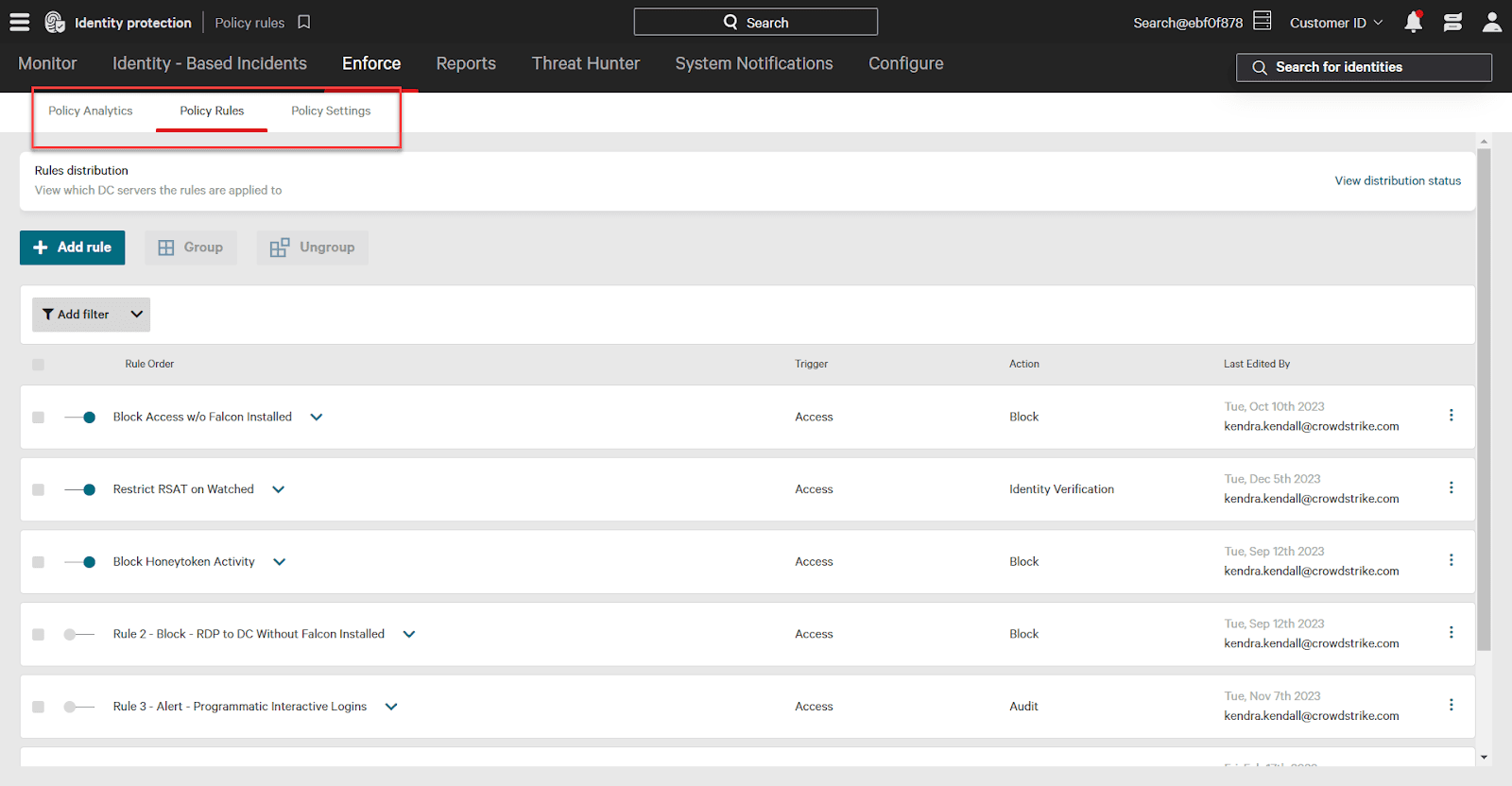
The platform connects detection directly to enforcement. Access can be revoked mid-session, multi-factor authentication can be triggered in response to changing risk, and lateral movement can be interrupted before privilege escalation. Continuous Identity evaluates identity, device, threat and business context to enforce zero standing privileges.
Identity, endpoint, SaaS, browser and cloud security run through one sensor and one console, which is where much of the correlation advantage comes from. It also means the identity module is most useful to organizations already standardized on Falcon.
Key features include:
Identity discovery and correlation: Discovers and enriches human, non-human and AI identities across applications, workloads and data, exposing overprivileged access, misconfigurations and attack paths.
Identity Threat Detection and Response: Detects identity-based attacks across on-prem and cloud and responds autonomously, including automatic enforcement of MFA or password resets.
Falcon Privileged Access: Removes standing privileges through just-in-time access and continuous validation, dynamically granting, adjusting and revoking access based on real-time risk and business context.
Context-aware authorization: Through ongoing integration of SGNL technology, extends continuous authorization decisions across human, non-human and AI identities.
FalconID: Provides phishing-resistant, passwordless MFA built on FIDO2 standards, with access enforcement that adapts as risk changes.
Identity Security Posture Management: Surfaces posture weaknesses and drives risk reduction across the hybrid identity estate.
SaaS and AI identity security: Extends visibility into identities and misconfigurations across SaaS applications through the platform's SSPM capability.
Managed identity protection: Falcon Complete and Adversary OverWatch provide 24/7 monitoring, detection and response using platform telemetry and threat intelligence.
Criterion | Solution Fit | Key Considerations |
Identity visibility and coverage | Discovers, correlates and enriches human, non-human and AI identities across applications, workloads and data, surfacing overprivileged access and attack paths in hybrid environments. | Reviewers note that meaningful coverage requires proper integration with existing identity infrastructure such as Active Directory and Entra ID, plus policy tuning. |
Risk detection and prioritization | Correlates identity signals with endpoint, SaaS, browser and cloud telemetry, and consolidates detections into enriched cases for investigation. | Users report high alert volumes during the initial learning phase, and limited customization of reports and dashboards. |
Automated remediation and least privilege enforcement | Connects detection to enforcement, revoking access mid-session, triggering MFA and stopping lateral movement, with just-in-time privilege replacing standing access. | Enforcement acts on sessions and privilege elevation; entitlement cleanup inside business applications is outside its scope. |
Governance, access reviews, and compliance | Provides posture management and continuous validation of access, with case management that produces investigation records. | Certification campaigns and audit evidence for frameworks such as SOX or PCI-DSS are not part of the offering; a separate IGA layer is typically required. |
NHI and agentic identity coverage | Covers non-human and AI agent identities explicitly, with a dedicated use case for discovering, governing and protecting service accounts, API keys, cloud workloads and AI agents. | Some newer agentic capabilities are recent additions, so confirm general availability for the specific features in scope. |
Integration and deployment fit | Delivered through one sensor and one console alongside endpoint, cloud and SaaS security, without separate integration projects for each identity capability. | Reviewers describe pricing as high and initial configuration as complex, and note that some third-party integrations are not officially supported. |
Source: CrowdStrike
Identity Governance and Access Management Platforms
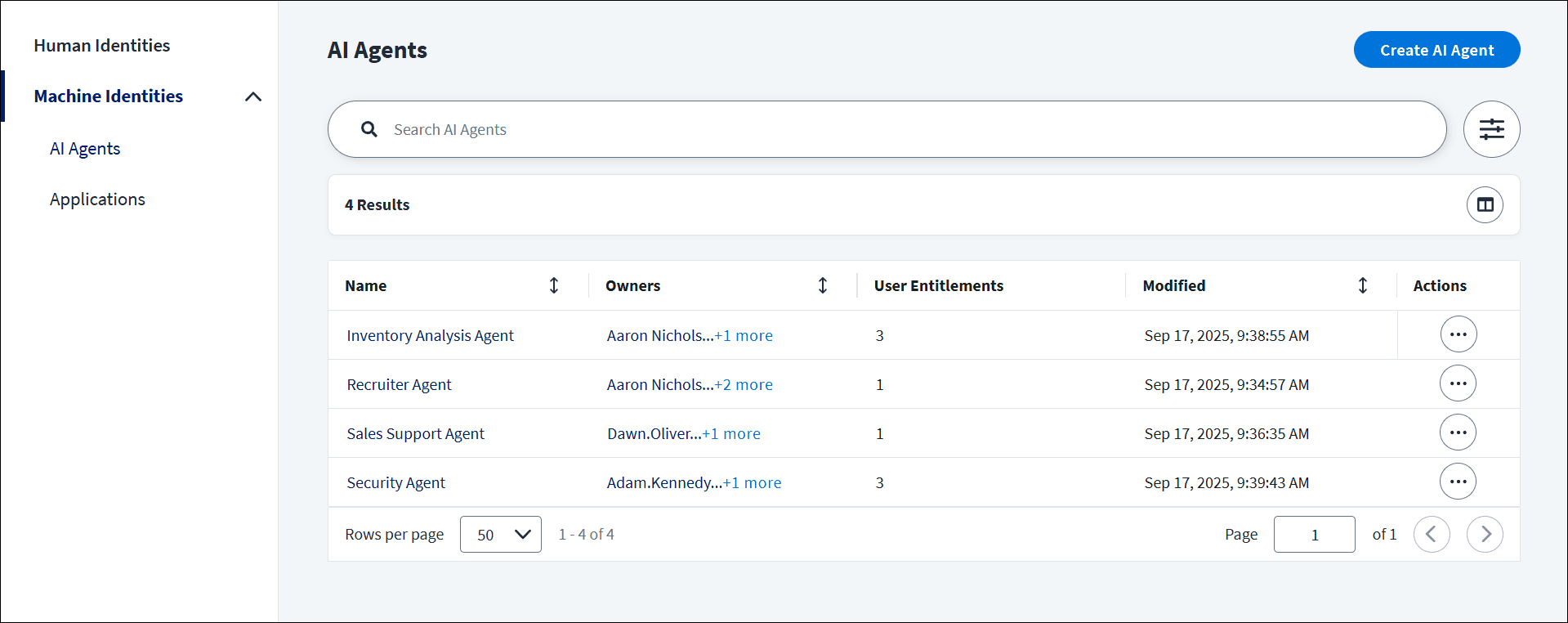
5. SailPoint Identity Security Cloud

Best for: Large enterprises running certification-heavy governance programs
Strengths: Identity graph, lifecycle orchestration and zero standing privilege
Things to consider: Configuration effort and cost reported by enterprise users
SailPoint Identity Security Cloud, now presented as SailPoint Human Fabric, is an enterprise identity governance platform built on the SailPoint Atlas foundation. SailPoint describes Human Fabric as the evolution of Identity Security Cloud, shifting from point-in-time certification cycles to continuous governance.
The platform organizes its capabilities around three pillars. Discover uses AI-driven intelligence and the Identity Graph to map every identity, access path and entitlement. Govern replaces manual review cycles with automated lifecycle orchestration, policy analysis and AI-guided decisions. Protect enforces zero standing privilege through just-in-time access and isolates accounts when anomalous behavior or policy drift appears.
Advanced modules extend the core platform into adjacent problems: third-party identity risk, cloud entitlements, unstructured data access and real-time access risk analysis. An on-premises option remains available through IdentityIQ.
Key features include:
Identity Graph: Provides a risk-aware view of every identity, access path and entitlement, giving proactive insight into who has access to what and how that access was granted.
Access Modeling and Identity Outliers: Uses machine learning to recommend roles based on peer group comparison and to flag abnormal access patterns for review.
Automated lifecycle orchestration: Handles provisioning, changes and deprovisioning across connected systems, replacing manual processes and periodic certification as the primary control.
Compliance Management: Enforces access policies automatically and runs audits with visibility into user entitlements, producing documented evidence for auditors.
Zero standing privilege with just-in-time access: Grants fine-grained, context-aware access at the moment it is needed and isolates compromised accounts in real time.
Cloud Infrastructure Entitlement Management: Discovers and governs cloud entitlements and certifications with an identity-focused approach.
Non-Employee Risk Management: Applies risk-based access and lifecycle management to contractors, vendors and other third-party identities.
Data Access Security and Access Risk Management: Extends governance to unstructured data and adds real-time access risk analysis, including for ERP environments.
Accelerated Application Management: Uses AI-assisted onboarding to bring applications under governance and provide visibility across the application estate.
Criterion | Solution Fit | Key Considerations |
Identity visibility and coverage | Identity Graph provides a risk-aware view of identities, access paths and entitlements, extended to cloud entitlements and unstructured data through separate modules. | Full coverage often means licensing several advanced capabilities rather than one product. |
Risk detection and prioritization | Access Modeling and Identity Outliers apply peer group comparison and anomaly detection; Access Risk Management adds real-time access risk analysis. | Reviewers report that reporting and analytics need enhancement and that AI functionality is still maturing relative to expectations. |
Automated remediation and least privilege enforcement | Automated lifecycle orchestration provisions and revokes access across systems, with zero standing privilege enforced through just-in-time access and real-time isolation of compromised accounts. | Configuration is complex and often requires coding, so automation depth depends on implementation effort and skilled resources. |
Governance, access reviews, and compliance | Compliance Management automates policy enforcement and audits with full visibility into entitlements, supporting continuous compliance rather than periodic campaigns. | Framework coverage is described generally rather than enumerated; confirm SOX, HIPAA, PCI-DSS, NYDFS and NIS2 evidence requirements against the reporting available. |
NHI and agentic identity coverage | Covers human and non-human identities, with a dedicated use case for securing non-human identities and an Agentic Fabric suite for agentic environments. | Agentic capabilities are newer than the core human-identity governance functionality, so maturity differs between the two. |
Integration and deployment fit | SaaS delivery on SailPoint Atlas with a large connector catalog and AI-powered application onboarding to speed coverage of enterprise applications. | Licensing and deployment are widely described as expensive, and users report a steep learning curve plus questions about the long-term on-premises roadmap. |
Source: SailPoint
6. Saviynt Identity Cloud

Best for: Converged IGA, PAM and application access governance
Strengths: Cross-application SoD, non-human identity and AI agent coverage
Things to consider: Customization effort and support responsiveness noted by users
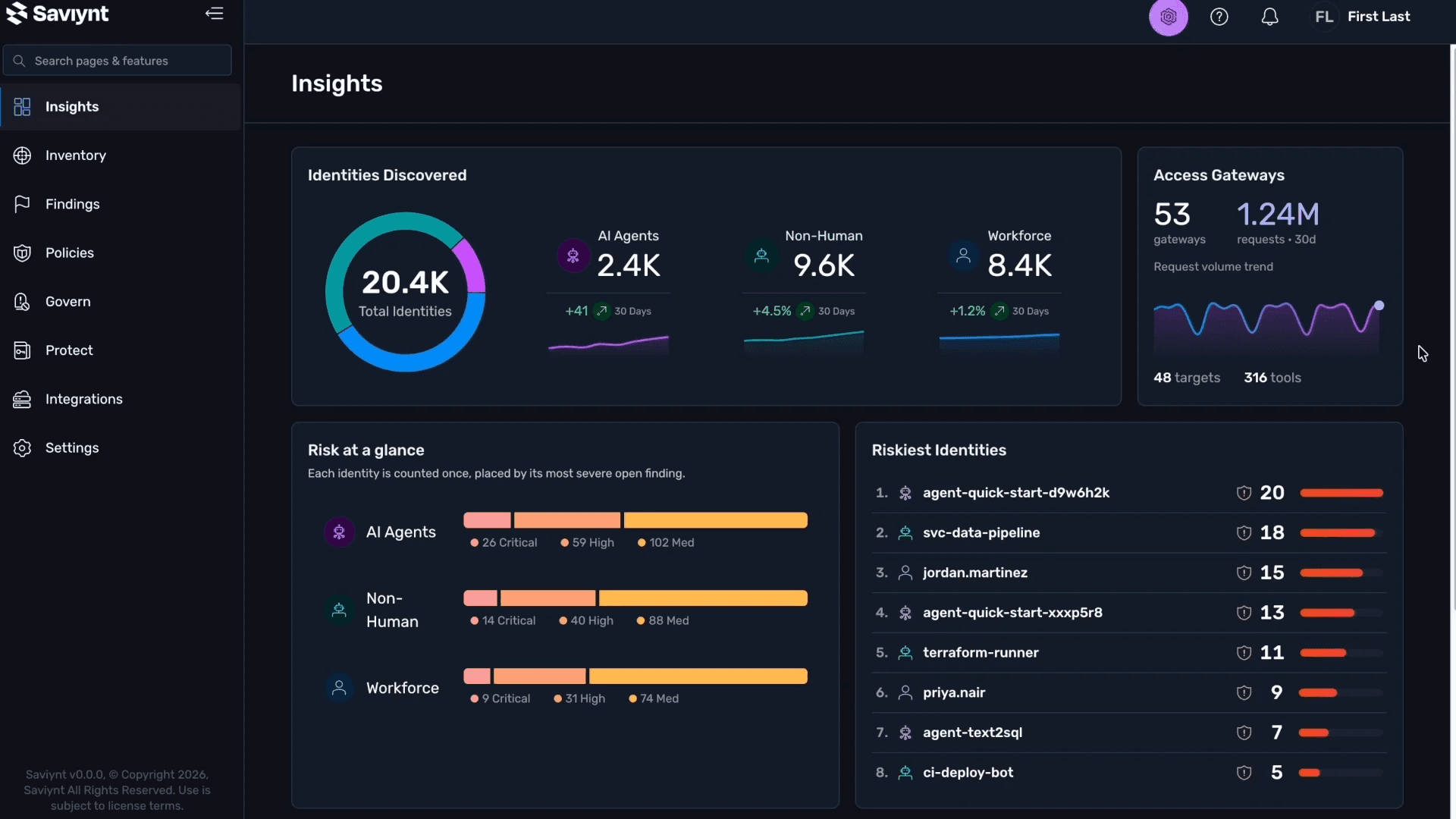
Saviynt Identity Cloud converges identity governance and administration, privileged access management and application access governance into a single platform, covering internal workforce, external workforce, privileged users, non-human identities and AI agents.
The platform's newest component is Zuma, an AI identity security layer. Zuma registers and manages AI agents including their access privileges and risk profile, finds and remediates ungoverned shadow AI agents, and evaluates intent and context for every request at runtime so agents operate within their intended scope.
Alongside governance, Saviynt offers just-in-time access, application onboarding, intelligent recommendations and identity security posture management, with prebuilt integrations for SAP, AWS, ServiceNow, CrowdStrike, Wiz and Zscaler. An MCP server is available for connecting the platform to AI tooling.
Key features include:
Identity Governance and Administration: Manages access requests, approvals, certifications and lifecycle events across internal employees, external partners and machine accounts on one platform.
Application Access Governance: Governs fine-grained access inside business applications, including cross-application separation of duties for ERP environments.
Privileged Access Management: Manages privileged accounts within the same platform as governance rather than as a separate product.
Just-in-Time Access: Grants elevated access for a defined window rather than maintaining standing privileged entitlements.
Zuma AI identity security: Registers AI agents and their privileges and risk profile, discovers shadow AI agents, and evaluates intent and context at runtime for each agent request.
Non-Human Identity management: Covers credentials, accounts and workloads alongside human identities.
Identity Security Posture Management: Discovers and inventories AI agents and identity sprawl with risk context, offered at no cost as a starting point.
Intelligent Recommendations: Provides access recommendations during requests and reviews, with Copilot-style assistance and integration into Slack and Teams.
Application onboarding: Brings applications under governance through guided onboarding, with prebuilt integrations for major enterprise and security platforms.
Criterion | Solution Fit | Key Considerations |
Identity visibility and coverage | Covers internal workforce, external workforce, privileged users, non-human identities and AI agents in one platform, with posture management for discovering identity sprawl. | Reviewers note limited public documentation and learning material, which slows teams building their own visibility baselines. |
Risk detection and prioritization | Application access governance provides cross-application separation of duties and access analytics, with intelligent recommendations surfacing risk context during decisions. | Users report that reporting and log management need improvement, and that analytics often require customization. |
Automated remediation and least privilege enforcement | Automates provisioning and deprovisioning across platforms, supports just-in-time access for elevated privileges, and applies access recommendations during requests and reviews. | Reviewers describe processes as resource intensive and note that extensive customization is often needed to fit specific workflows. |
Governance, access reviews, and compliance | Certification campaigns, attestation and auditing are core functions, with application GRC and cross-application SoD aimed at regulated ERP environments. | Specific frameworks are not enumerated on the product page; SOX-style SoD is the clearest fit, so confirm HIPAA, PCI-DSS, NYDFS and NIS2 reporting separately. |
NHI and agentic identity coverage | Registers and manages AI agents with privileges and risk profiles, discovers and remediates shadow AI, and manages credentials, accounts and workloads as first-class identities. | Zuma is a recent addition, so agentic capabilities have a shorter production track record than the core IGA functionality. |
Integration and deployment fit | Cloud-native SaaS with tenant isolation, guided application onboarding and prebuilt integrations for SAP, AWS, ServiceNow, CrowdStrike, Wiz and Zscaler. | Users report a steeper learning curve, slow support response times and frequent version changes that large organizations find disruptive. |
Source: Saviynt
7. Okta Workforce Identity

Best for: Centralizing workforce access management with governance add-ons
Strengths: SSO, adaptive MFA, posture management and a large integration network
Things to consider: Governance and posture management are licensed separately
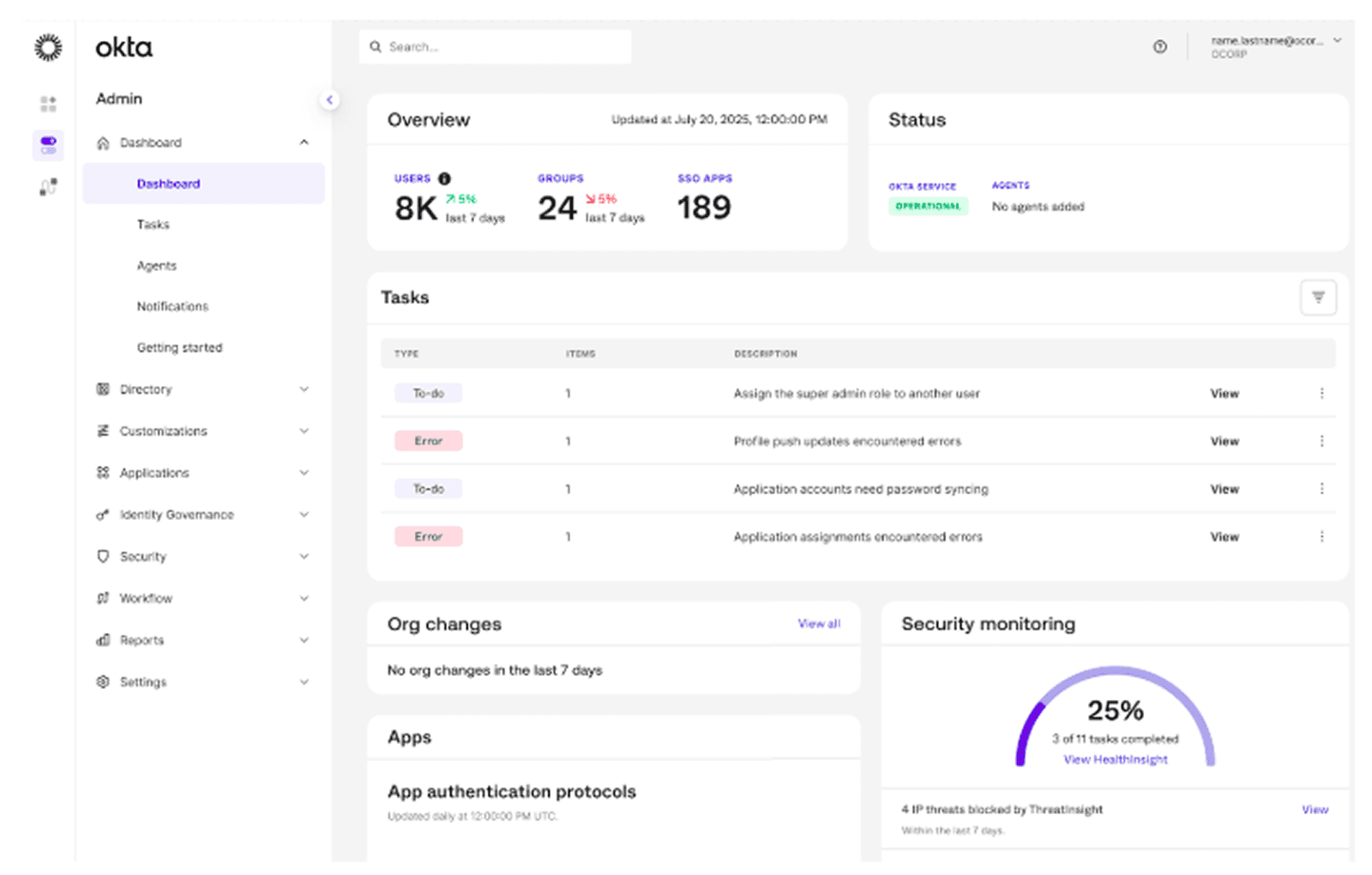
Okta Workforce Identity manages access for employees, contractors and partners across a set of products that share one identity platform. The core covers single sign-on, adaptive multi-factor authentication, device access, a universal directory and lifecycle management.
Governance, privileged access and threat protection sit alongside the core as separate products. Okta Identity Governance handles access certifications, self-service access requests, entitlement management and reporting, using more than 600 native integrations to discover users and permissions across the stack. Identity Security Posture Management identifies vulnerabilities, prioritizes risks and streamlines remediation of identity sprawl.
Automation runs through Okta Workflows, a no-code orchestration layer, and integration breadth comes from the Okta Integration Network with more than 8,000 prebuilt integrations.
Key features include:
Single sign-on and adaptive MFA: Unifies access across applications and devices and applies risk-aware authentication policies, with FastPass providing phishing-resistant passwordless authentication.
Universal Directory and Lifecycle Management: Maintains one directory for users, groups and devices and automates onboarding and offboarding across directories and cloud applications.
Identity Governance: Schedules periodic access certifications with automated manager notifications, runs self-service access requests through a portal and through Slack or Teams, and manages fine-grained entitlements within applications.
Governance Analyzer: Combines risk signals into recommendations that inform certification and request decisions.
Identity Security Posture Management: Identifies identity security blind spots, prioritizes risks and streamlines remediation across identity sprawl.
Identity Threat Protection with Okta AI: Continuously monitors and analyzes risk signals to detect threats and orchestrate responses across applications and infrastructure.
Privileged Access and Advanced Server Access: Enforces least privilege for critical accounts and protects server infrastructure through the same identity platform.
Okta Workflows: Automates identity processes without code, including tasks such as identifying inactive application users to reduce licence spend.
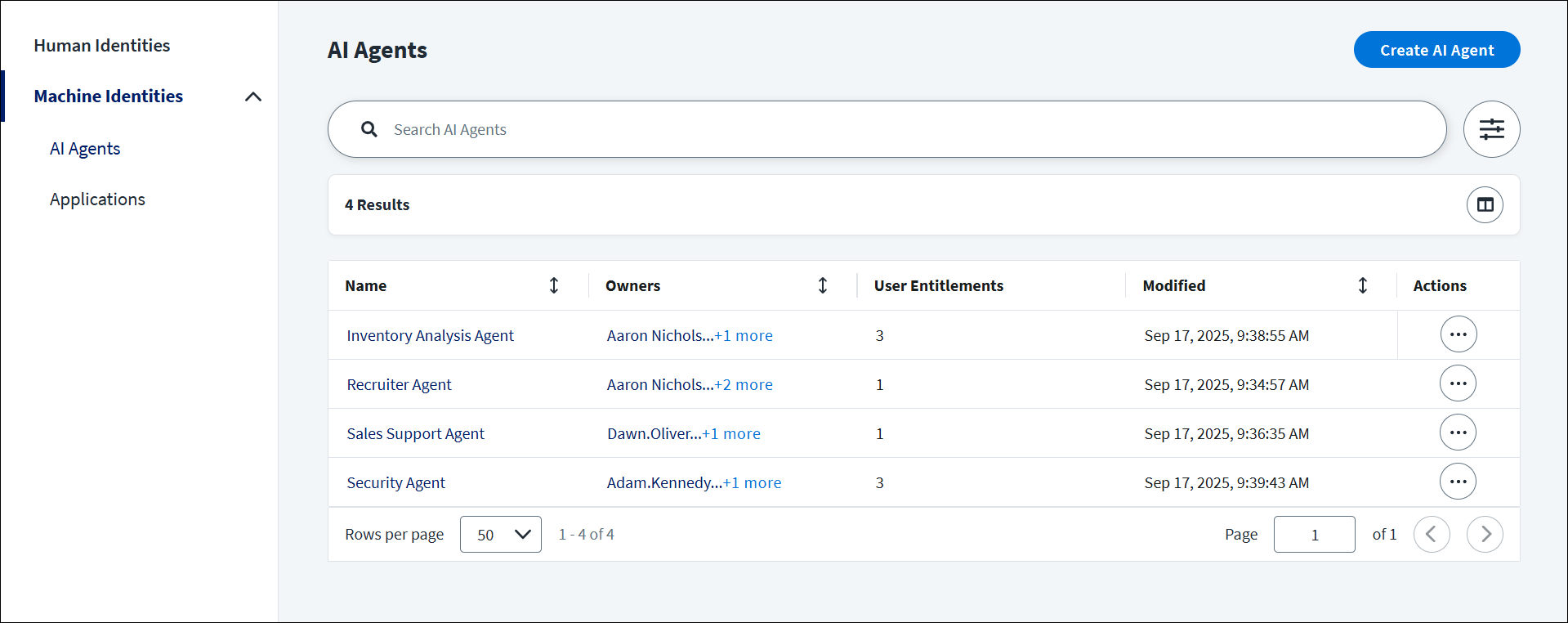
Okta for AI Agents: Extends identity management to AI agent identities, alongside a dedicated non-human identity solution and the Cross App Access protocol.
Criterion | Solution Fit | Key Considerations |
Identity visibility and coverage | Universal Directory centralizes users, groups and devices, and Identity Governance discovers users and permissions across more than 600 native integrations, with ISPM surfacing identity sprawl. | Entitlement-level visibility depends on the governance product; the access management core alone gives application-level rather than fine-grained coverage. |
Risk detection and prioritization | Identity Threat Protection with Okta AI analyzes risk signals continuously, and Governance Analyzer combines signals into recommendations for review decisions. | Reviewers ask for more robust logging and reporting for advanced use cases, and note that identity governance capabilities need further development. |
Automated remediation and least privilege enforcement | Lifecycle Management automates provisioning and deprovisioning, access requests and certifications drive entitlement changes, and Workflows orchestrates remediation without code. | Enforcement of least privilege inside downstream applications depends on entitlement support for each integration. |
Governance, access reviews, and compliance | Scheduled access certifications with automated reviewer notifications produce documented evidence for auditors, supported by queryable reporting across identity use cases. | Compliance material is framed generally rather than mapped to named regulations; verify SOX, HIPAA, PCI-DSS, NYDFS and NIS2 evidence requirements during evaluation. |
NHI and agentic identity coverage | Dedicated solutions for non-human identities and AI agent identities, plus the Cross App Access protocol for agent-to-application access. | These are newer additions relative to the workforce access core, so confirm maturity for the specific agent and service account use cases in scope. |
Integration and deployment fit | More than 8,000 prebuilt integrations through the Okta Integration Network, with Access Gateway extending coverage to on-premises applications without code changes. | Users report high pricing, complexity integrating with existing systems such as AWS and Active Directory, and occasional service outages. |
Source: Okta
8. Microsoft Entra ID

Best for: Microsoft-centric organizations standardizing on one directory
Strengths: Conditional access, risk-based protection, PIM and access reviews
Things to consider: Governance depth is tied to P2 and Entra Suite licensing
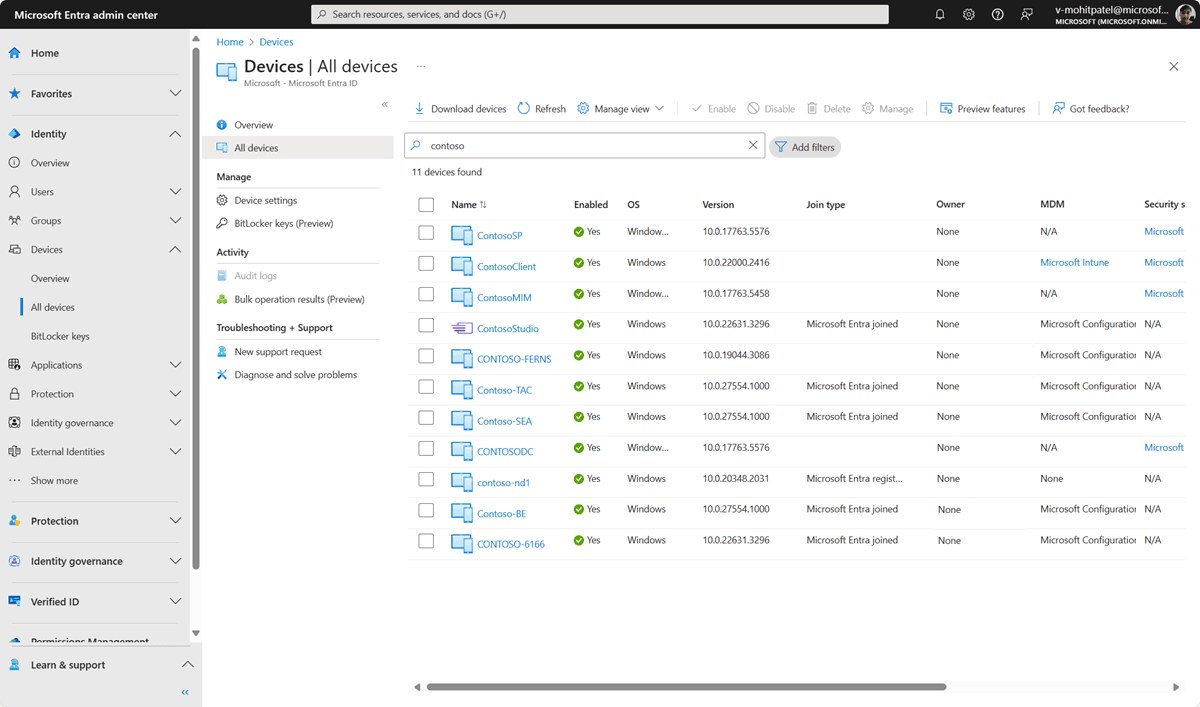
Microsoft Entra ID, previously Azure Active Directory, is a cloud identity and access management service that secures and manages identities across cloud and on-premises environments. It handles authentication, single sign-on and application access, along with administration and hybrid identity for organizations still running on-premises directories.
Access control is policy-driven. Conditional access applies adaptive policies at sign-in, and Entra ID Protection uses machine learning to detect and block risky sign-ins and identity compromise in real time. Privileged Identity Management provides just-in-time access to sensitive resources.
Capability depends on licence tier. The P1 tier covers authentication, conditional access, passwordless and reporting. The P2 tier adds ID Protection, risk-based conditional access, privileged identity management and basic entitlement management and access reviews, with deeper governance available through Entra ID Governance and the Entra Suite.
Key features include:
Single sign-on and application access: Provides authentication and SSO across cloud and on-premises applications from a single directory.
Multi-factor and passwordless authentication: Supports phishing-resistant authentication methods to protect access to data and applications.
Conditional access: Applies adaptive access policies based on signals such as user, device and risk before granting access.
Entra ID Protection: Uses machine learning to detect identity takeover risk and apply risk-based access policies in real time.
Privileged Identity Management: Enables just-in-time access for sensitive resources so elevated privileges are not held permanently.
Entitlement management and access reviews: Provides basic access package management and access review campaigns at the P2 tier, extended through Entra ID Governance.
Self-service access requests: Lets users manage their own accounts and submit access requests, reducing administrative handling.
Event logging and reporting: Captures sign-in and audit logs with advanced security and usage reports for investigation and reporting.
Entra Agent ID: Extends identity management to AI agent identities, currently in preview, alongside the wider Entra product family.
Criterion | Solution Fit | Key Considerations |
Identity visibility and coverage | Centralizes identities across cloud and on-premises through hybrid identity and directory synchronization, with event logging and advanced security and usage reports. | Visibility is strongest inside the Microsoft estate; reviewers ask for better visualization tools and note gaps in cross-tenant interactions. |
Risk detection and prioritization | Entra ID Protection applies machine learning to detect identity compromise and risky sign-ins, feeding risk-based conditional access decisions. | Risk detection sits at the P2 tier, and users report that reporting and logging capabilities could be stronger for investigation work. |
Automated remediation and least privilege enforcement | Risk-based conditional access blocks or challenges risky sign-ins automatically, and Privileged Identity Management enforces just-in-time elevation for sensitive roles. | Remediation is centred on authentication and role elevation; entitlement cleanup across third-party applications needs Entra ID Governance or another layer. |
Governance, access reviews, and compliance | Basic entitlement management and access reviews are included at P2, with Entra ID Governance adding deeper protection, monitoring and auditing of access to critical assets. | Users ask for more granular role-based access controls and clearer documentation; confirm which framework evidence needs are met at your licence tier. |
NHI and agentic identity coverage | Entra Agent ID provides identity management for AI agents, and service principals are managed natively as directory objects. | Agent ID is in preview, and non-human identity governance is thinner than on platforms built around an entitlement graph. |
Integration and deployment fit | Deploys quickly in Microsoft-centric environments with SSO across Azure, Microsoft 365 and many SaaS applications, plus directory synchronization for hybrid estates. | Reviewers report complex licensing, integration friction with third-party applications, and price increases; several also cite scalability and interface usability as areas to test. |
Source: Microsoft
Conclusion
Selecting an effective IAM security solution requires a platform that delivers deep visibility into human, non-human, and agentic identities. Prioritize systems that offer actionable risk detection and closed-loop automated remediation rather than just reporting. Balancing these capabilities ensures robust protection across modern hybrid environments while minimizing manual intervention. Successful implementation relies on choosing a solution that aligns with your specific infrastructure and governance requirements.