What is Identity Sprawl?
Identity sprawl is the unmanaged proliferation of digital identities across an organization's systems, apps, and platforms. Driven by rapid cloud adoption, remote work, and non-human AI entities, it creates orphaned accounts, credential fragmentation, and severe security blind spots. Managing this threat requires a proactive security approach to prevent unauthorized access and data breaches.
In a modern organization, identities can belong to employees, contractors, partners, applications, devices, automated processes, non-human identities (NHIs), or autonomous AI agents that interact with systems and data on behalf of users or business workflows. As organizations deploy more AI-powered tools and agentic systems, the number of machine-managed identities can grow rapidly.
AI agents often require their own credentials, API keys, service accounts, and permissions to access applications and complete tasks. Without proper governance, these agentic identities can become difficult to inventory and monitor, contributing to identity sprawl in the same way as traditional service accounts and other non-human identities.
Causes of identity sprawl:
SaaS and cloud expansion: Every new cloud service introduces additional identities, credentials, and access policies that fragment identity management.
Decentralization: Independent teams and business units create separate identity silos, leading to duplicate accounts and inconsistent governance.
Mergers and acquisitions: Combining disparate directories and applications leaves duplicate, legacy, and orphaned identities across environments.
Machine identities: Service accounts, API keys, workloads, bots, and other non-human identities now outnumber human accounts in many organizations.
AI agents and autonomous systems: Agentic AI requires dedicated identities and permissions that are often created outside traditional governance processes.
CI/CD pipelines and microservices: Cloud-native development continuously generates temporary service identities that are difficult to inventory and manage.
Dynamic and ephemeral identities: Short-lived machine identities are created and removed so rapidly that governance and security controls struggle to keep pace.
How to prevent identity sprawl:
Centralize identity visibility: Maintain a unified inventory of human and non-human identities across cloud, on-premises, and hybrid environments.
Enforce SSO and phishing-resistant MFA: Reduce credential proliferation while strengthening authentication with centralized sign-on and modern MFA.
Automate provisioning and deprovisioning: Use HR-driven lifecycle automation to create, modify, and remove accounts as users join, move, or leave.
Apply least privilege access: Grant only the access required, favor zero standing privileges, and remove unnecessary entitlements over time.
Conduct regular access reviews: Periodically validate identities and permissions to eliminate dormant accounts and excessive access.
Govern non-human identities: Apply ownership, lifecycle management, credential rotation, and monitoring to service accounts, APIs, and AI agents.
Monitor for identity risk signals: Use usage telemetry, behavioral analytics, and AI to identify dormant, over-permissioned, and anomalous identities.
This is part of a series of articles about identity and access management
Identity Sprawl vs. Privilege Sprawl vs. Entitlement Sprawl
Identity sprawl refers to the growth of unmanaged digital identities across an organization. The problem is the number of accounts itself. As employees, contractors, applications, devices, non-human identities (NHIs), and AI agents accumulate across systems, organizations lose visibility into what identities exist and whether they are still needed.
Privilege sprawl focuses on the level of access assigned to identities. It occurs when users, service accounts, NHIs, or AI agents accumulate elevated permissions beyond what they need to perform their functions. Even if an organization has a manageable number of identities, excessive privileged access can increase the risk of misuse, credential compromise, and lateral movement by attackers.
Entitlement sprawl is a related concept that refers to the accumulation of permissions, roles, and access rights across existing identities over time. Unlike identity sprawl, which is about having too many accounts, entitlement sprawl is about access becoming overly broad and complex within those accounts. Unlike privilege sprawl, which specifically concerns elevated or administrative permissions, entitlement sprawl includes all types of access rights, including routine application and data permissions.
Organizations often face all three issues simultaneously, making identity governance and access reviews essential for maintaining security and control. The following table summarizes the key differences.
Aspect | Identity Sprawl | Privilege Sprawl | Entitlement Sprawl |
What grows? | Number of identities and accounts | Elevated privileges | Permissions, roles, and access rights |
Primary issue | Too many unmanaged identities | Excessive administrative or privileged access | Overly broad and complex access across identities |
Typical examples | Duplicate users, orphaned accounts, NHIs, AI agents | Unnecessary admin rights, privileged service accounts | Accumulated application roles, data permissions, and group memberships |
Main risk | Reduced visibility and larger attack surface | Privilege abuse, lateral movement, credential compromise | Excessive access, policy violations, and increased audit complexity |
Key Security Risks Posed By Identity Sprawl
Expanded Attack Surface
Identity sprawl expands an organization's attack surface. Each digital identity, whether for a human or a machine, represents a potential entry point for attackers. As the number of identities grows, so does the likelihood that some will have weak, reused, or compromised credentials. Attackers can exploit these vulnerabilities to gain unauthorized access, move laterally within the environment, and escalate their privileges to access sensitive data or disrupt operations.
The dispersed nature of identities makes it difficult for security teams to monitor all access points. This lack of centralized oversight increases the chances of missing suspicious activity or failing to detect unauthorized access promptly. Attackers often take advantage of this complexity, targeting overlooked accounts or exploiting gaps in security controls. Organizations with identity sprawl face greater challenges in maintaining effective security monitoring and incident response.
Stale and Orphaned Accounts
Stale and orphaned accounts are a direct byproduct of identity sprawl. These are accounts that are no longer actively used, often belonging to former employees, contractors, or decommissioned systems. Without proper identity lifecycle management, such accounts remain active long after their legitimate use has ended. These forgotten accounts are targets for attackers, who can use them to bypass security controls unnoticed.
The risk increases when these accounts retain high levels of access or are not subject to regular review. Attackers exploiting orphaned accounts can operate with less chance of detection, as their activity may not trigger alerts associated with active users. Regularly identifying and removing stale accounts is necessary, but this becomes increasingly difficult as identity sprawl accelerates and the total number of accounts grows beyond manageable levels.
Password Fatigue
Password fatigue is a common consequence of identity sprawl, as users must manage multiple credentials for different systems and applications. This leads to poor password hygiene, such as reusing passwords across accounts, choosing weak passwords, or storing them insecurely. Attackers exploit these weaknesses through techniques like credential stuffing, phishing, or brute-force attacks to compromise accounts.
Password fatigue also reduces user productivity and increases helpdesk costs due to frequent password resets. When users are overwhelmed by the number of identities and passwords they must manage, they are more likely to circumvent security policies or make mistakes that compromise security. The proliferation of identities without streamlined authentication mechanisms undermines security and efficiency.
Compliance Failures
Identity sprawl complicates compliance with regulations such as GDPR, HIPAA, or SOX, which require organizations to control and audit access to sensitive data. When identities are scattered across multiple systems and not centrally managed, it becomes difficult to demonstrate who has access to what, enforce least privilege, or provide audit trails. This lack of visibility and control increases the risk of compliance violations and potential penalties.
Regulatory frameworks often require prompt deprovisioning of access when users leave the organization or change roles. Identity sprawl makes it easy to overlook accounts or permissions that should be revoked, leading to gaps in compliance. As auditors scrutinize access management processes, organizations with uncontrolled identity sprawl may face challenges during assessments or investigations.
SoD Violations
Segregation of duties (SoD) violations become more difficult to identify as identity sprawl increases. SoD controls are designed to prevent a single user from accumulating conflicting permissions that could enable fraud, abuse, or unauthorized actions. For example, the same individual should not be able to both create a vendor and approve payments to that vendor. When identities and access rights are spread across multiple applications and directories, these toxic combinations can go undetected.
The challenge is compounded when users hold multiple accounts, inherit permissions through different roles, or gain access through connected systems. Security and compliance teams may have visibility into permissions within individual applications but lack a complete view across the environment. As identity sprawl grows, organizations face a higher risk of hidden SoD violations that can lead to compliance failures, insider threats, and operational risk.
Invisible Non-Human Identity (NHI) Attack Surface
Identity sprawl creates an invisible attack surface through the accumulation of non-human identities (NHIs), including service accounts, API keys, application identities, automation tools, and AI agents. These identities often outnumber human users and are frequently created without the same governance processes applied to workforce identities. As a result, many remain undocumented, unmonitored, or poorly understood by security teams.
The risk increases because NHIs often possess broad permissions and long-lived credentials. Service accounts and API keys are rarely reviewed, rotated, or deprovisioned, allowing excessive access to persist for years. Attackers who compromise these identities can gain access to critical systems and data while avoiding detection, since machine identities typically operate without interactive user activity. As organizations adopt more cloud services, automation platforms, and AI-driven workflows, unmanaged NHIs become a growing source of security exposure.
Related content: Learn more about the top IAM security risks and essential security capabilities.
Top 7 Causes of Identity Sprawl in a Modern IT Environment
1. SaaS and Cloud Expansion
The rapid adoption of SaaS and cloud services is a primary driver of identity sprawl. Each new cloud application typically requires its own identity store, authentication mechanisms, and access policies. As organizations add more SaaS providers to support business functions, the number of identities multiplies quickly. Without centralized identity management, users end up with separate accounts for each service, making it difficult to maintain visibility and control.
This fragmentation is exacerbated by the ease of procuring new SaaS tools, often without IT oversight, leading to shadow IT and unsanctioned identity creation. Cloud platforms also introduce identities for infrastructure resources, APIs, and automation scripts. The result is a decentralized identity environment that is difficult to govern and secure.
2. Decentralization
Decentralization of IT operations contributes to identity sprawl by removing central control over identity creation and management. In many organizations, different departments or business units deploy their own applications and manage access independently. This leads to multiple identity silos, each with its own processes and standards, making unified oversight difficult.
The lack of standardized identity governance increases the risk of redundant, duplicate, or conflicting accounts. Decentralization often means that identity lifecycle events, such as onboarding, role changes, or terminations, are not consistently enforced across the organization. This inconsistency allows stale or orphaned accounts to persist, further expanding the attack surface.
3. Mergers and Acquisitions
Mergers and acquisitions (M&A) introduce identity sprawl as organizations integrate disparate IT systems, applications, and user directories. Each merged entity brings its own set of identities and access controls, which are often incompatible or redundant. The process of consolidating these systems is complex and time-consuming, leading to parallel identity stores and duplicated accounts.
During the transition, organizations often maintain legacy accounts or delay deprovisioning to avoid disrupting business operations. This creates a window of increased vulnerability, as attackers can exploit inconsistencies or overlooked accounts. M&A activity often leaves organizations with a patchwork of identities that require rationalization and integration to reduce risk.
4. Machine Identities
The proliferation of machine and AI identities is a significant factor in identity sprawl. Modern IT environments rely on a growing ecosystem of non-human identities (NHIs), including service accounts, API keys, workload identities, containers, microservices, CI/CD pipelines, and robotic process automation (RPA) bots. Each of these systems requires credentials and permissions to interact with applications, infrastructure, and data. As organizations increase automation and deploy more AI-driven workflows, the number of machine-managed identities grows far faster than traditional identity management processes can accommodate.
In many enterprise environments, non-human identities now outnumber human identities by a wide margin. A single employee may have one or two user accounts, while dozens or even hundreds of machine identities are created to support applications, integrations, cloud workloads, and automated processes. This shift has changed the nature of identity sprawl from primarily a workforce identity problem to a machine identity problem. Yet many organizations still focus governance efforts on human users while giving limited attention to NHIs.
5. AI Agents and Autonomous Systems
AI agents are emerging as major contributors to identity sprawl. Unlike traditional applications that perform narrowly defined tasks, AI agents often interact with multiple systems, data sources, APIs, and business applications. To operate effectively, they require their own identities, credentials, tokens, and permissions. As organizations deploy more agentic AI systems, the number of identities can increase rapidly across the environment.
Many AI agents are provisioned outside traditional identity governance processes. Teams may create agents to automate workflows, perform research, analyze data, or execute operational tasks without establishing clear ownership or access review procedures. This can result in poorly documented identities with broad permissions, increasing both security risk and management complexity.
6. CI/CD Pipelines and Microservices
Modern software development practices generate large numbers of non-human identities through CI/CD pipelines, containers, microservices, Kubernetes workloads, and infrastructure-as-code deployments. Build servers, deployment tools, orchestration platforms, and individual services all require identities, service accounts, secrets, certificates, or workload credentials to authenticate with other systems. Because these identities are often created automatically as part of the development lifecycle, their numbers can grow rapidly, especially in cloud-native environments where applications consist of hundreds of independently deployed services.
The challenge is that many of these identities are temporary, distributed, and managed by different development teams rather than by centralized identity administrators. Permissions are frequently granted broadly to simplify deployments, while secrets and service accounts may remain active long after workloads are retired. Without centralized governance, organizations lose visibility into which machine identities exist, what resources they can access, and whether those permissions remain necessary. This makes CI/CD environments and microservice architectures a significant source of identity sprawl and increases the risk of excessive privileges and credential compromise.
7. Dynamic and Ephemeral Identities
The dynamic nature of machine identities further complicates security efforts. Unlike human users, who typically have relatively stable accounts, machine identities may be created and destroyed automatically within minutes or hours. Traditional identity governance tools and review processes often struggle to keep pace with this level of change. As a result, organizations may not discover excessive permissions, unused credentials, or unauthorized identities until after a security incident occurs.
As automation, cloud adoption, and AI deployment continue to accelerate, machine and AI identities have become one of the fastest-growing sources of identity sprawl. Effective governance requires treating these identities as first-class security subjects, with the same visibility, lifecycle controls, access reviews, and least-privilege policies applied to human users. Without these controls, the rapid growth of NHIs can create a large and difficult-to-manage attack surface.
Identity Sprawl Management: Tools and Capabilities
Identity Governance and Administration (IGA)
Identity governance and administration (IGA) provides the governance framework for managing identities and access throughout their lifecycle. It helps organizations ensure that users receive the right access when they join, change roles, or leave the organization, while maintaining visibility into permissions across business applications, directories, and cloud services. HRIS platforms typically act as the source of truth for workforce identity lifecycle events, enabling automated access changes through joiner, mover, and leaver (JML) workflows.
Key capabilities
Automated joiner, mover, and leaver (JML) workflows
HRIS-driven identity lifecycle management
Automated user provisioning and deprovisioning
Access reviews and certification campaigns
Segregation of duties (SoD) policy enforcement
Identity and entitlement governance across applications and cloud environments
How it helps with identity sprawl
Eliminates stale and orphaned accounts through automated deprovisioning
Reduces duplicate identities across connected systems
Prevents excessive access from accumulating over time
Maintains accurate identity records throughout the user lifecycle
Improves visibility and governance across distributed identity environments
Identity Security Posture Management (ISPM)
Identity security posture management (ISPM) continuously evaluates the security posture of identities, permissions, and authentication configurations across an organization's environment. Rather than governing identity lifecycles, ISPM identifies identity-related risks by analyzing access patterns, entitlements, credentials, and behavioral signals, allowing security teams to prioritize and remediate exposures.
Key capabilities
Continuous identity risk assessment
Detection of excessive privileges and misconfigurations
Analysis of identity usage and access behavior
Identification of dormant accounts and unused permissions
Risk scoring and remediation recommendations
Behavioral analytics and anomaly detection
How it helps with identity sprawl
Identifies dormant and forgotten identities
Detects excessive permissions created through identity growth
Highlights risky or unusual access patterns
Prioritizes identities requiring review or cleanup
Reduces attack surface through continuous remediation
Privileged Access Management (PAM)
Privileged access management (PAM) secures administrative and other high-risk accounts with elevated permissions. While IGA determines who should receive access, PAM controls how privileged access is granted, monitored, and used. Together, these capabilities reduce the security risks created by privileged identities across on-premises, cloud, and hybrid environments.
Key capabilities
Privileged credential vaulting
Automated password rotation
Just-in-time (JIT) privileged access
Privileged session monitoring and recording
Administrative account discovery and management
Privileged access approval workflows
How it helps with identity sprawl
Discovers privileged accounts across distributed systems
Eliminates unnecessary standing privileged access
Limits privilege duration through just-in-time access
Improves visibility into service and administrative accounts
Reduces the attack surface associated with privileged identities
Cloud Infrastructure Entitlement Management (CIEM)
Cloud infrastructure entitlement management (CIEM) focuses on managing identities and permissions within public cloud platforms. Because cloud environments generate large numbers of human, workload, and machine identities with complex permission relationships, CIEM helps organizations understand effective access, identify excessive permissions, and enforce least privilege across cloud resources.
Key capabilities
Discovery of cloud identities and entitlements
Analysis of effective permissions across cloud services
Detection of excessive or unused cloud privileges
Least-privilege recommendations and remediation
Identification of risky access paths and misconfigurations
Cloud permission analytics and continuous monitoring
How it helps with identity sprawl
Provides visibility into cloud identity growth
Detects over-permissioned human and machine identities
Removes unused cloud permissions based on actual usage
Reduces entitlement sprawl across cloud resources
Strengthens governance as cloud environments expand
7 Ways to Prevent and Reduce Identity Sprawl
1. Centralize Identity Visibility
Centralizing identity visibility is one of the most effective ways to address identity sprawl. Organizations should maintain a unified inventory of all human and non-human identities across cloud, on-premises, and hybrid environments. This provides security and IT teams with a single source of truth for understanding who has access to which systems and resources.
Achieving centralized visibility typically requires integrating identity providers, directories, SaaS applications, cloud platforms, and infrastructure services into a common management framework. With complete visibility, organizations can identify duplicate accounts, stale identities, excessive permissions, and unauthorized access. Centralized oversight also improves audit readiness and supports faster incident investigation and response.
2. Enforce SSO and Phishing-Resistant MFA
Single sign-on (SSO) reduces identity sprawl by allowing users to access multiple applications through a single, centrally managed identity. Instead of maintaining separate credentials for every application, users authenticate once through a trusted identity provider. This reduces the number of passwords users must manage and simplifies access administration.
Organizations should complement SSO with phishing-resistant multi-factor authentication (MFA), such as FIDO2 security keys, passkeys, or certificate-based authentication. These methods provide stronger protection than SMS codes or traditional one-time passwords, which can be intercepted or phished. Together, SSO and phishing-resistant MFA reduce the risk of credential theft and account compromise.
3. Automate Provisioning and Deprovisioning
Automating provisioning and deprovisioning reduces identity sprawl by ensuring access changes occur consistently throughout the identity lifecycle. Organizations should establish the human resources information system (HRIS) as the authoritative source of truth for workforce identity events. When employees join, change roles, or leave the organization, HRIS-driven joiner, mover, and leaver (JML) workflows can automatically trigger account creation, access modifications, and access removal across connected systems.
Automated provisioning helps ensure users receive appropriate access based on their role without relying on manual processes. Just as importantly, automated deprovisioning prevents accounts from remaining active after an employee, contractor, or partner no longer requires access. Stale accounts created by incomplete offboarding processes are one of the most common contributors to identity sprawl and a frequent source of audit findings. By automatically removing access when identities are no longer needed, organizations reduce both security risk and compliance exposure.
4. Apply Least Privilege Access
Least privilege is a foundational governance principle for controlling identity sprawl. It requires that users, applications, non-human identities, and AI agents receive only the access necessary to perform their intended functions. Rather than treating access as a permanent entitlement, organizations should adopt an "exceptions, not birthright access" approach in which access is granted only when justified by a business need.
This model favors zero standing access wherever practical. Users receive access on request, with appropriate business context, approvals, and time limitations. By limiting default access and regularly removing unnecessary entitlements, organizations reduce the accumulation of permissions that often accompanies identity sprawl. In this sense, least privilege defines the policy objective, while identity sprawl management provides the operational processes needed to continuously enforce it across the environment.
5. Conduct Regular Access Reviews
Regular access reviews help prevent identity sprawl by verifying that identities and their permissions remain appropriate over time. As employees change roles, projects end, and business requirements evolve, users often accumulate access that is no longer necessary. Periodic certification campaigns enable managers and application owners to validate existing access and remove unnecessary accounts, roles, and entitlements before they become long-term security risks.
Organizations should perform scheduled reviews for both human and non-human identities, with greater scrutiny applied to privileged accounts, service accounts, and access to sensitive systems. Integrating access reviews with identity governance and administration (IGA) platforms allows organizations to automate certification workflows, track remediation activities, and maintain audit evidence. Regular access reviews help eliminate dormant identities, reduce excessive permissions, strengthen compliance, and ensure identity sprawl does not gradually reappear after initial cleanup.
6. Govern Non-Human Identities
Non-human identities, including service accounts, API keys, containers, workloads, bots, and AI agents, often outnumber human users in modern environments. Despite their prevalence, these identities are frequently managed outside traditional identity governance processes. Without oversight, they can accumulate excessive privileges or remain active long after they are needed.
Organizations should inventory all non-human identities, assign ownership, and apply lifecycle management controls similar to those used for human accounts. Credentials should be securely stored, regularly rotated, and monitored for misuse. Extending governance policies to machine and AI identities helps close a visibility gap and reduces risks associated with automated systems.
7. Monitor for Identity Risk Signals
Continuous monitoring helps organizations identify identity sprawl before it creates significant security or compliance issues. Effective monitoring extends beyond simply counting accounts and focuses on understanding how identities are actually used. Usage telemetry such as last-login dates, last-used timestamps, access frequency, authentication activity, and entitlement utilization provides critical context for identifying dormant accounts, stale permissions, and unused identities that should be reviewed or removed.
Modern identity security platforms increasingly use AI and behavioral analytics to detect risk signals at scale. Peer-group analytics can identify users, service accounts, or AI agents whose access differs significantly from that of others with similar roles. Anomaly detection can highlight unusual authentication patterns, unexpected privilege usage, or changes in access behavior that may indicate compromise or excessive permissions. Many platforms can also automatically classify high-risk, over-permissioned, or dormant identities for investigation and remediation.
By combining continuous monitoring, usage telemetry, and AI-driven analysis, organizations can proactively identify identity sprawl, reduce unnecessary access, and focus governance efforts on the identities that present the greatest risk. This approach improves visibility across both human and non-human identities while helping maintain a more secure and manageable identity environment.
How Opti Helps You Prevent Identity Sprawl with AI-Native IAM
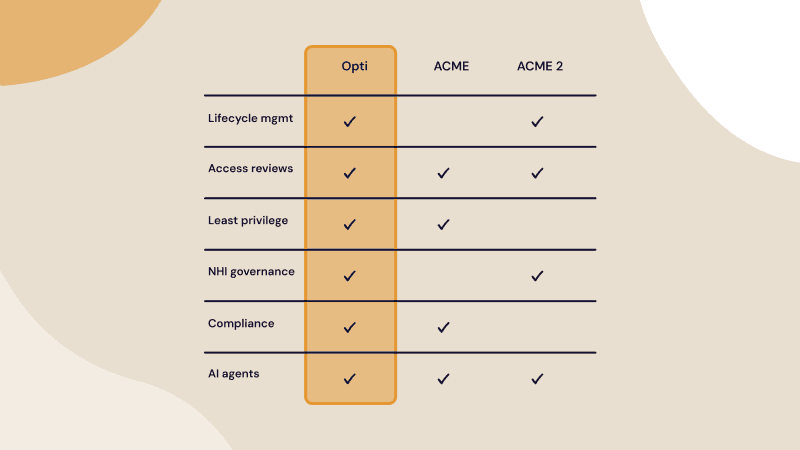
Opti is the AI-native identity and access management (IAM) platform that revolutionizes how modern teams define, protect, and govern identities. Instead of relying on the manual, fragmented processes that allow identities to multiply unchecked, Opti applies AI models purpose-built for IAM and a context-aware engine that continuously analyzes access behavior and risk across every identity and application. This gives security teams the speed and intelligence needed to bring sprawling, unmanaged identities back under control.
Key capabilities of Opti:
AI-powered identity fabric: Ingests, normalizes, and analyzes all identities - human, non-human, and agentic - across every application, providing the unified, unprecedented visibility that identity sprawl otherwise erodes.
Context-aware risk analysis: A context-aware engine continuously analyzes access behavior and risk across every identity and application, surfacing the dormant, over-permissioned, and anomalous identities that accumulate as environments grow.
Automated risk remediation: Specialized entitlement models understand and analyze the wide context to discover risky access and excessive privileges, while the identity workflow engine builds tailored, automated policies and remediation plans that turn identity risks into resolved outcomes.
Smarter governance with or without an IGA: Rich analytics replace rubber-stamping by fusing intelligence into lifecycle and governance processes, enhancing joiner, mover, and leaver (JML) workflows with AI-driven recommendations and automation.
Streamlined compliance: Opti continuously aggregates identity, access, and entitlement data and maps it to roles, policies, and usage, making governance more actionable and keeping audits from becoming a fire drill.
Fast, broad integration: Opti deploys in hours and integrates from IdP to IGA and everything in between, spanning 250+ applications and even homegrown systems, so coverage expands without a rip-and-replace.
Ready to bring sprawling identities under control? Learn more about the Opti AI-native IAM platform.