

TL;DR: Access governance for non-human identities covers discovery, ownership, least privilege, and lifecycle control over service accounts, keys, and AI agents. Opti is best for AI-native governance across all identity types, SailPoint for extending enterprise IGA to agents, Oasis for dedicated NHI lifecycle, and Aembit for secretless workload access.
What Is Access Governance for Non-Human Identities?
Access governance for non-human identities (NHIs), agentic identities, service accounts, and AI agents is handled by specialized security and identity platforms that discover, map ownership, and enforce least-privilege permissions across hybrid environments.
This includes service accounts, workloads, APIs, bots, machine identities, AI agents, and autonomous software that act on behalf of users or systems. The goal is to ensure every non-human or agentic identity has only the permissions it needs, that ownership is clear, and that access can be continuously monitored and reviewed.
Unlike secrets management or credential protection, access governance focuses on the identity lifecycle and the permissions attached to each identity. Identity governance and administration (IGA) platforms govern NHI and agentic identities using the same lifecycle controls applied to human users, including provisioning, ownership assignment, access reviews, policy enforcement, role management, and deprovisioning. This approach gives organizations a single governance model across human and non-human identities, distinguishing IGA-first platforms from credential- and secrets-focused tools.
Non-Human Identity Access Governance Platforms at a Glance
The table below summarizes the key differences between the platforms covered in this section. Each one is examined in more detail further down, including its capabilities and the limitations reported by users.
Category | Solution | Best For | Key Strengths | Things to Consider |
Identity governance platforms for human, non-human, and AI agent identities | Opti | Unified governance of human, non-human, and AI agent access | AI-native access graph with one-click least-privilege remediation | Newer platform; connector depth varies by legacy system |
Identity governance platforms for human, non-human, and AI agent identities | SailPoint Agentic Fabric | Extending enterprise IGA controls to AI agents and machines | Identity graph ties every agent and NHI to a human owner | Complex configuration and high licensing cost |
Identity governance platforms for human, non-human, and AI agent identities | Saviynt Identity Cloud | Governing non-human identities in a converged IGA platform | NHI inventory, posture, and lifecycle timeline in one console | Interface performance and connector gaps at scale |
Identity governance platforms for human, non-human, and AI agent identities | Veza NHI Security | Mapping effective permissions for service accounts and keys | Broad NHI entity coverage with human owner linkage | High cost and complex setup for smaller deployments |
Non-human identity and machine credential security platforms | Oasis Security | Dedicated lifecycle management for non-human identities | Ownership inference, posture ranking, safe secret rotation | Pending acquisition and limited public peer validation |
Non-human identity and machine credential security platforms | Token Security | Machine-first governance of AI agents and their credentials | Intent-based permissioning with broad integration coverage | Emerging vendor; verify coverage for your stack |
Non-human identity and machine credential security platforms | CyberArk Machine Identity Security | Broad machine identity coverage across secrets and certificates | Covers secrets, certificates, workload identities, SSH keys | Deployment complexity and administrative overhead |
Non-human identity and machine credential security platforms | Aembit | Secretless, policy-based access for workloads and AI agents | Short-lived credentials issued per task with full audit logs | Access-focused; pair with discovery and governance |
Related content: Read our guide to IGA solutions and their key features.
Why Organizations Need Unified Governance Across Machine Identities
Non-Human Identity Sprawl
Non-human identity sprawl occurs when the number of machine identities grows unchecked within an organization. This is often a byproduct of increased automation, microservices adoption, and frequent deployment cycles. Each new application, script, or service typically requires its own identity, resulting in a proliferation of accounts that are difficult to inventory and manage. Over time, organizations lose track of which identities exist, what they access, and whether they are still needed.
This sprawl creates blind spots for security teams, making it challenging to identify and remediate vulnerabilities. Orphaned or forgotten machine identities can retain privileged access long after their intended use, exposing organizations to unauthorized activities or lateral movement during a breach.
How to address:
Addressing identity sprawl requires automated discovery, ongoing inventory management, and clear processes for decommissioning unused accounts.
Excessive and Persistent Permissions
Machine identities are often granted broad or persistent permissions to simplify automation, but this practice introduces significant risk. Over-provisioning occurs when identities are given more access than necessary for their tasks, creating opportunities for attackers to exploit these privileges if the identity is compromised. Persistent permissions, which remain active indefinitely, further compound the risk by providing ongoing access even when not in use.
How to address:
To mitigate this, organizations must implement regular entitlement reviews and enforce the principle of least privilege. Automated tools can help analyze permissions, identify excessive access, and recommend adjustments to align with actual usage patterns. By minimizing standing privileges and adopting just-in-time access models, organizations reduce the attack surface and limit the potential impact of compromised machine identities.
Missing Identity Owners
A frequent issue in non-human identity governance is the absence of clear ownership for machine accounts. When no individual or team is accountable for a service account or API key, it becomes difficult to manage its lifecycle, review its permissions, or respond to incidents involving the identity. This lack of ownership often results from rapid application development and infrastructure changes, where identities are created without assigning responsibility.
Missing ownership leads to unmanaged or orphaned identities, which can persist unnoticed and unmonitored. These accounts are prone to accumulating excessive privileges, remaining active after their purpose has ended, or being overlooked during security audits.
How to address:
Assigning and tracking ownership for every non-human identity is essential for maintaining control and ensuring that all accounts are regularly reviewed and updated as needed.
Long-Lived Credentials and Secrets
Many non-human identities rely on static credentials, such as API keys or certificates, that remain valid for extended periods. These long-lived secrets are attractive targets for attackers because their discovery can lead to sustained unauthorized access. In many cases, organizations lack processes for regularly rotating credentials, increasing the risk that compromised secrets remain undetected and exploitable.
How to address:
Effective governance requires automated secret rotation and robust management practices. Tools that detect and replace aging credentials minimize the window of exposure and reduce the likelihood of misuse. By implementing short-lived credentials and enforcing rotation policies, organizations can significantly strengthen their security posture against credential-based attacks targeting machine identities.
Autonomous AI Agent Actions
The rise of autonomous AI agents introduces new challenges in non-human identity governance. These agents can make independent decisions, initiate transactions, or modify data without human oversight. Their dynamic and adaptive behavior complicates traditional access control models, as their required permissions may change based on evolving tasks or learning outcomes.
How to address:
Governing AI agents requires continuous monitoring and adaptive access policies that reflect real-time context and activity. Organizations must ensure AI agents operate within defined boundaries and only access resources necessary for their function. This involves integrating AI-specific controls into identity governance platforms, tracking agent actions, and enabling rapid response to anomalous or unauthorized activities initiated by autonomous systems.
Regulatory Compliance and Audit Readiness
Non-human identity governance supports compliance with frameworks and regulations such as SOX, SOC 2, ISO 27001, HIPAA, PCI DSS, NYDFS, NIS2, and GDPR. These requirements commonly expect organizations to control access, enforce least privilege, maintain accountability, review permissions, and retain evidence of security controls. Machine identities and AI agents must be included because they can access sensitive systems and data in the same way as human users.
How to address:
Unified governance helps organizations document each identity’s owner, purpose, permissions, usage, and lifecycle status. It also provides audit evidence for access reviews, policy enforcement, segregation of duties, credential changes, and deprovisioning. Without these controls, organizations may be unable to show that non-human access is authorized, monitored, and removed when no longer needed.
Key Capabilities of Non-Human Identity Governance Platforms
1. Continuous Identity and Credential Discovery
Continuous discovery is fundamental for effective non-human identity governance. Automated tools scan infrastructure, cloud environments, and application ecosystems to identify all machine identities and their associated credentials. This process provides a real-time inventory, ensuring no accounts or secrets go unnoticed. Discovery extends to ephemeral resources, such as containers or serverless functions, which can create and destroy identities rapidly.
Regular discovery allows organizations to detect new, modified, or orphaned identities as they appear. By maintaining up-to-date visibility, security teams can respond quickly to unauthorized accounts or unexpected changes in privileges. Continuous discovery forms the foundation for subsequent governance activities, such as entitlement analysis and credential rotation, ensuring comprehensive coverage of all non-human identities.
2. Ownership and Business Context Mapping
Assigning ownership to every non-human identity is critical for accountability and effective lifecycle management. Governance platforms map each machine identity to a responsible person or business unit, establishing clear lines of accountability. This mapping ensures that permissions are regularly reviewed, credentials are rotated, and identities are deprovisioned when no longer needed.
Integrating business context provides additional insight into the purpose and risk associated with each identity. Platforms can tag identities by application, environment, or sensitivity, enabling tailored governance policies. Contextual mapping helps prioritize remediation efforts and ensures that high-risk or critical machine identities receive appropriate scrutiny and protection.
3. Access Entitlement Analysis
Access entitlement analysis evaluates the permissions assigned to non-human identities to identify excessive, unnecessary, or risky access. Governance platforms compare granted permissions with actual usage to detect overprivileged service accounts, workloads, APIs, and AI agents. This analysis helps organizations remove unused entitlements, enforce least privilege, and reduce the attack surface created by machine identities.
Advanced platforms use peer-group analytics to identify non-human identities with permissions that differ significantly from similar workloads or applications. They also apply anomaly detection to usage patterns, highlighting unexpected privilege use, access outside normal operating behavior, or sudden changes in activity that may indicate compromise. Automated classification can automatically identify high-risk entitlements based on factors such as privilege level, resource sensitivity, and exposure, helping security teams prioritize remediation.
4. Least-Privilege Policy Enforcement
Enforcing least-privilege policies ensures non-human identities have only the minimum permissions required for their tasks. Governance platforms automate the application of least-privilege models by analyzing access patterns and recommending or enforcing reductions in entitlements. This minimizes the potential impact of compromised machine identities and limits lateral movement within the environment.
Automation is key to maintaining least-privilege in dynamic environments where identities and permissions change frequently. Platforms can implement just-in-time access, temporary privilege elevation, and automatic revocation of unused permissions. These controls reduce standing privileges and enhance overall security posture by continuously aligning access with actual operational needs.
5. Credential Rotation and Secret Management
Credential rotation and secret management are essential for reducing the risk of credential-based attacks. Governance platforms automate the rotation of passwords, API keys, certificates, and other secrets on a regular schedule or in response to specific events, such as suspected compromise or personnel changes. Automated rotation ensures that long-lived credentials are replaced frequently, limiting the window of exposure.
In addition to rotation, platforms provide secure storage, distribution, and access controls for sensitive secrets. Integration with vault solutions and policy-driven access controls prevent unauthorized retrieval or misuse of credentials. These practices not only support compliance requirements but also make it harder for attackers to exploit compromised secrets associated with non-human identities.
6. Lifecycle Management and Automated Deprovisioning
Lifecycle management governs non-human identities from creation through retirement. Governance platforms automate provisioning based on predefined policies, assign ownership, apply the required permissions, and track changes throughout the identity's lifetime. This reduces manual administration and helps ensure new machine identities are created with the correct access and security controls from the start.
Automated deprovisioning removes or disables non-human identities, credentials, and permissions when applications are retired, workloads are deleted, or services are no longer required. Timely deprovisioning prevents orphaned accounts from retaining unnecessary access and reduces the number of unmanaged identities in the environment. Automated workflows also support consistent enforcement of governance policies across cloud and on-premises systems.
7. Continuous Monitoring and Access Certification
Continuous monitoring ensures that non-human identities remain compliant with governance policies as environments change. Governance platforms track changes to identities, permissions, ownership, and credentials in real time, generating alerts when unauthorized modifications or policy violations occur. Continuous visibility allows organizations to detect excessive privileges, dormant identities, and suspicious activity before they become security risks.
Usage telemetry is a core capability for access certification. Platforms collect last-used timestamps, access frequency, and historical activity to determine whether permissions are still required. This evidence enables reviewers to make informed certification decisions and revoke unused or unnecessary access instead of relying on manual verification alone.
8. Segregation of Duties and Toxic Combination Detection
Segregation of duties (SoD) controls help prevent non-human identities from accumulating combinations of permissions that create unnecessary risk. Governance platforms continuously evaluate the entitlements assigned to service accounts, workloads, APIs, and AI agents to identify toxic combinations, such as the ability to both approve and execute sensitive transactions or to administer and audit the same system. Detecting these conflicts reduces the risk of fraud, privilege abuse, and excessive access.
Modern platforms automate SoD analysis by evaluating permissions across applications, cloud environments, and infrastructure against predefined policy rules. When violations are detected, they can trigger alerts, require remediation workflows, or revoke conflicting entitlements. Continuous SoD monitoring ensures that permission changes, new identities, and evolving workloads do not introduce governance gaps over time.
Notable Non-Human Identity Access Governance Platforms
How we selected these platforms: We shortlisted vendors that govern access for non-human identities, AI agents, and service accounts based on continuous discovery, ownership mapping, entitlement analysis, least-privilege enforcement, credential and secret handling, lifecycle automation, and access certification across hybrid environments.
Identity Governance Platforms for Human, Non-Human, and AI Agent Identities
1. Opti

Best for: Unified governance of human, non-human, and AI agent access
Strengths: AI-native access graph with one-click least-privilege remediation
Things to consider: Newer platform; connector depth varies by legacy system
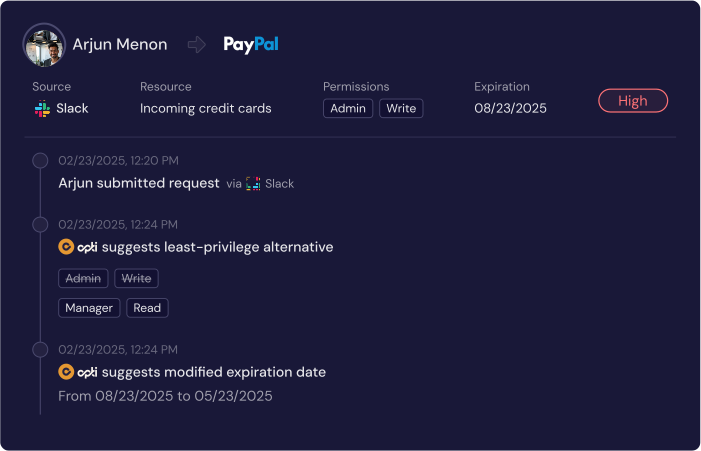
Opti is an AI-native identity security and access management platform that ingests, normalizes, and analyzes identities across applications, covering human, non-human, and agentic identities in the same system. Its non-human identity governance solution spans IaaS, SaaS, PaaS, and on-premises environments, and covers cloud workloads, service accounts, API keys, bots, and AI agents.
The platform builds a living access graph of identities, entitlements, and usage, then applies language models purpose-built for identity security to flag excessive privileges and generate remediation plans. Policies can be written in plain English, and Opti continuously scans for violations, executing revocations and entitlement changes from the same interface where the risk was surfaced.
Key features include:
Non-human identity discovery across environments: Opti covers non-human identities across IaaS, SaaS, PaaS, and on-premises systems, including cloud workloads, service accounts, API keys, bots, and AI agents.
Cloud IAM and workload identity right-sizing: Roles and service principals in AWS, Azure, GCP, and Oracle Cloud are analyzed and reduced to the permissions actually used.
Vault and secret governance: Secrets, tokens, and credentials stored in vaults and cloud secret managers are governed under least-privilege policies.
AI agent guardrails and revocation: IAM policies extend to AI agents so that every access decision, tool invocation, and workflow is tied to a verified identity, with monitoring and rapid revocation.
Granular AI access visibility: Shows what each AI agent can read, write, or manage across connected applications, supporting least-privilege enforcement and compliance monitoring.
Just-in-time access and automated revocation: Elevated privileges are granted on request and expire when the task completes, removing standing access.
Natural language policies with one-click remediation: Policies written in everyday language are continuously checked for violations, and remediation paths for over-privileged or orphaned accounts execute directly from the platform.
Interactive access graph as a control plane: Entitlements and permissions can be changed in real time from the graph, and a natural language interface answers access questions without queries or filters.
Continuous access reviews and audit evidence: Identity, access, and entitlement data is consolidated against policies and usage, campaigns are scoped to outliers and high-risk roles, and attestations and audit trails are generated on demand.
Database and data lake access visibility: Surfaces tables, schemas, and roles, and automatically remediates risky access.
Limitations (based on publicly available sources):
Recent market entry: Opti was founded in 2024 and has a shorter enterprise track record than long-established identity governance suites.
Integration onboarding for homegrown systems: Legacy and in-house applications are supported through Opti's integration AI, so coverage for unusual systems is built up during onboarding rather than available out of the box.
Human approval retained for critical changes: Remediation is automated, but the platform preserves human oversight on high-impact changes, so some review effort remains in the process.
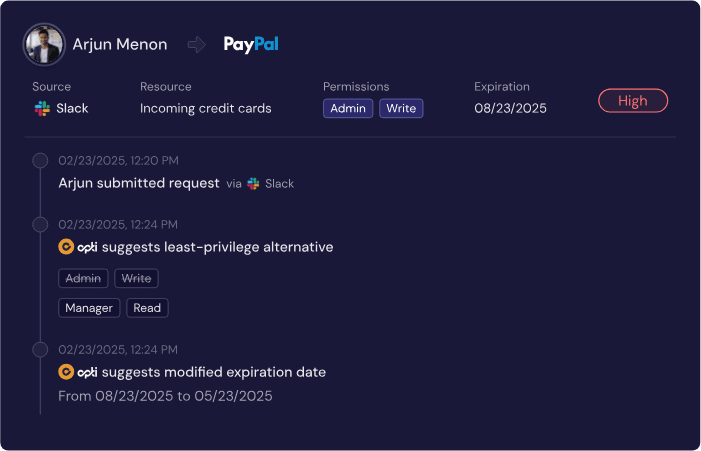
Source: Opti
2. SailPoint Agentic Fabric

Best for: Extending enterprise IGA controls to AI agents and machines
Strengths: Identity graph ties every agent and NHI to a human owner
Things to consider: Complex configuration and high licensing cost
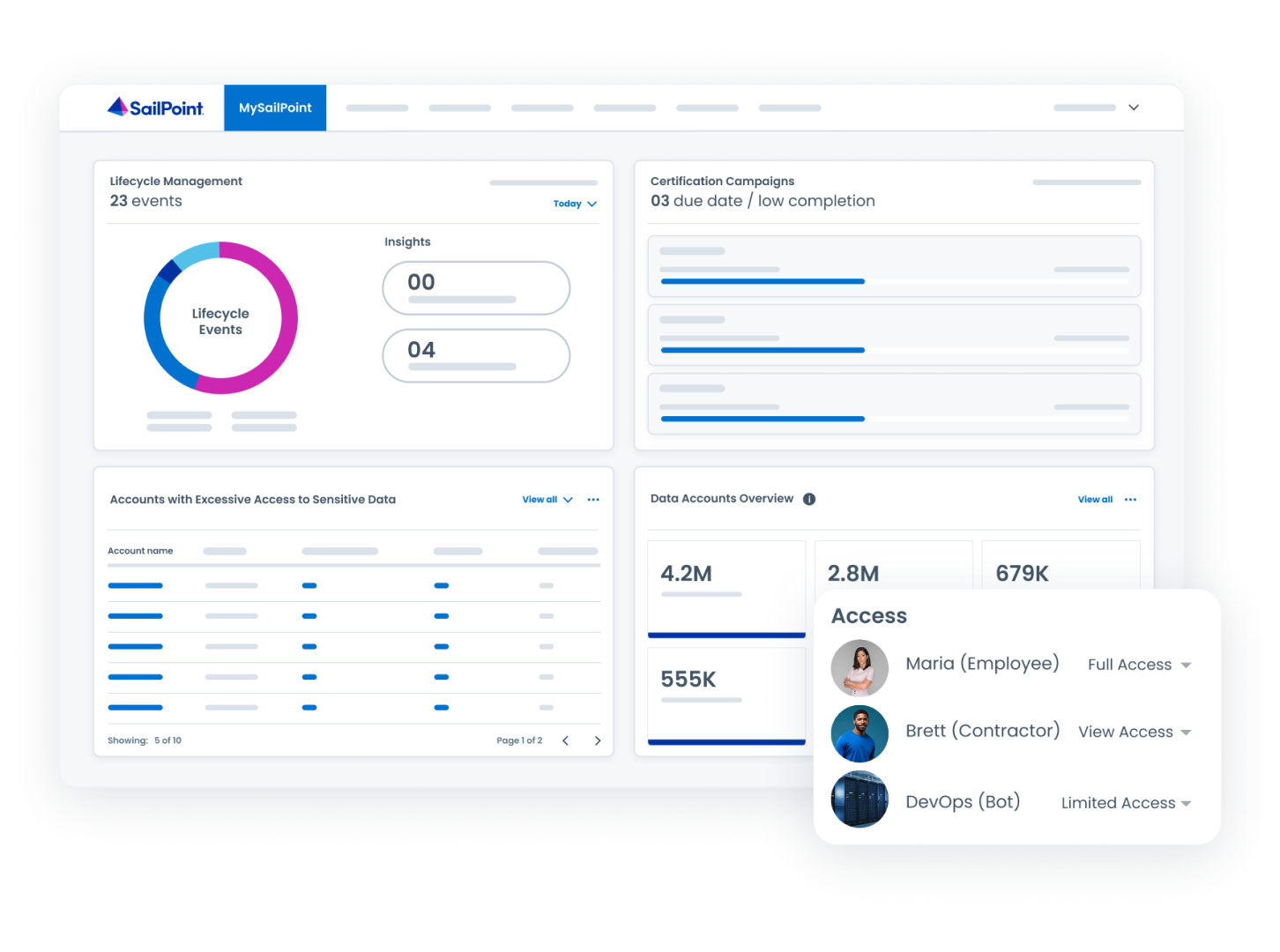
SailPoint Agentic Fabric extends the SailPoint platform beyond human users to AI agents, machine identities, and applications. It is organized around discovery, governance, and protection, and runs alongside Identity Security Cloud so that human and non-human identities are governed through one platform rather than a separate system.
Discovery registers every agent and non-human identity in a single source of truth and places it in a unified identity graph that maps relationships to human owners, entitlements, and sensitive data. Governance then applies provisioning, deprovisioning, and least-privilege policies from creation through retirement, with a full audit trail. SailPoint Entro adds discovery and protection for secrets, tokens, and keys.
Key features include:
Continuous agent and NHI discovery: Finds agents and non-human identities across agentic platforms, browsers, endpoints, and SaaS applications, and registers them in a single inventory.
Identity graph with ownership mapping: Contextualizes each agent by mapping its relationships to human owners, machine identities, entitlements, and sensitive data.
Machine identity governance: Provides visibility, ownership, and governance for service accounts, bots, and RPAs, with discovery, classification, ownership assignment, and certification.
Lifecycle governance for agents: Automated provisioning and deprovisioning enforce least privilege from creation to retirement, with clear human ownership attached to each agent.
Real-time authorization and response: Monitors agent behavior for drift and anomalous actions, calculates a dynamic agent risk score, and triggers responses such as revoking entitlements, disabling agents, or transmitting risk signals to other tools.
Data access governance for agents: Maps the full human-to-agent-to-data access path and enforces fine-grained controls at the data layer so agents cannot bypass existing data security controls.
Secrets and credential coverage through SailPoint Entro: Discovers and maps secrets, tokens, and keys at scale, with relationship mapping and real-time protection.
Free discovery tool: Uncovers unmanaged applications, identifies ownership, and exposes shadow AI activity and risky access patterns across existing environments.
Limitations (as reported by users on G2):
Complex setup and steep learning curve: Reviewers describe implementation as resource-intensive, often requiring specialized expertise and several months to reach production.
Cost: Users point to high licensing fees, with added charges for modules and paid expert services on top of the base platform.
Support responsiveness: Several reviewers report slow response times and a tendency to be redirected toward paid professional services.
Customization creates upgrade debt: Heavy use of custom rules, workflows, and code is reported to complicate upgrades and long-term maintenance.
Reporting and troubleshooting gaps: Users mention limited reporting flexibility and vague error messages that slow down problem resolution.
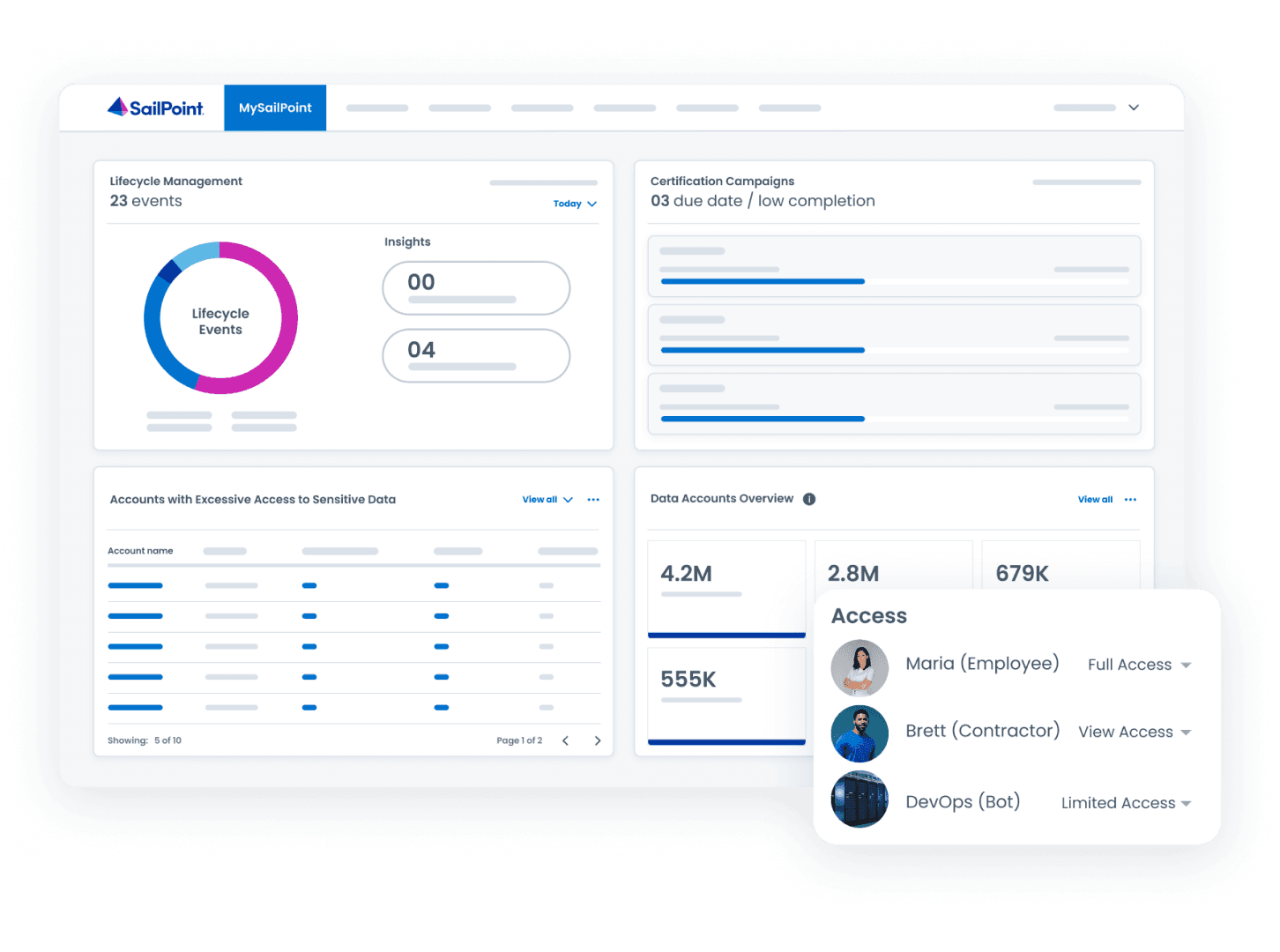
Source: SailPoint
3. Saviynt Identity Cloud (Non-Human Identity)

Best for: Governing non-human identities inside a converged IGA platform
Strengths: NHI inventory, posture, and lifecycle timeline in one console
Things to consider: Interface performance and connector gaps at enterprise scale
Saviynt extends its Identity Cloud to non-human identities so that workloads, accounts, and credentials are governed on the same platform used for human identities. The company defines non-human identities broadly, covering workloads such as VMs, containers, and serverless functions, bots and RPA scripts, AI agents, devices, IAM roles, service accounts and service principals, and credentials including tokens, certificates, API keys, and SSH keys.
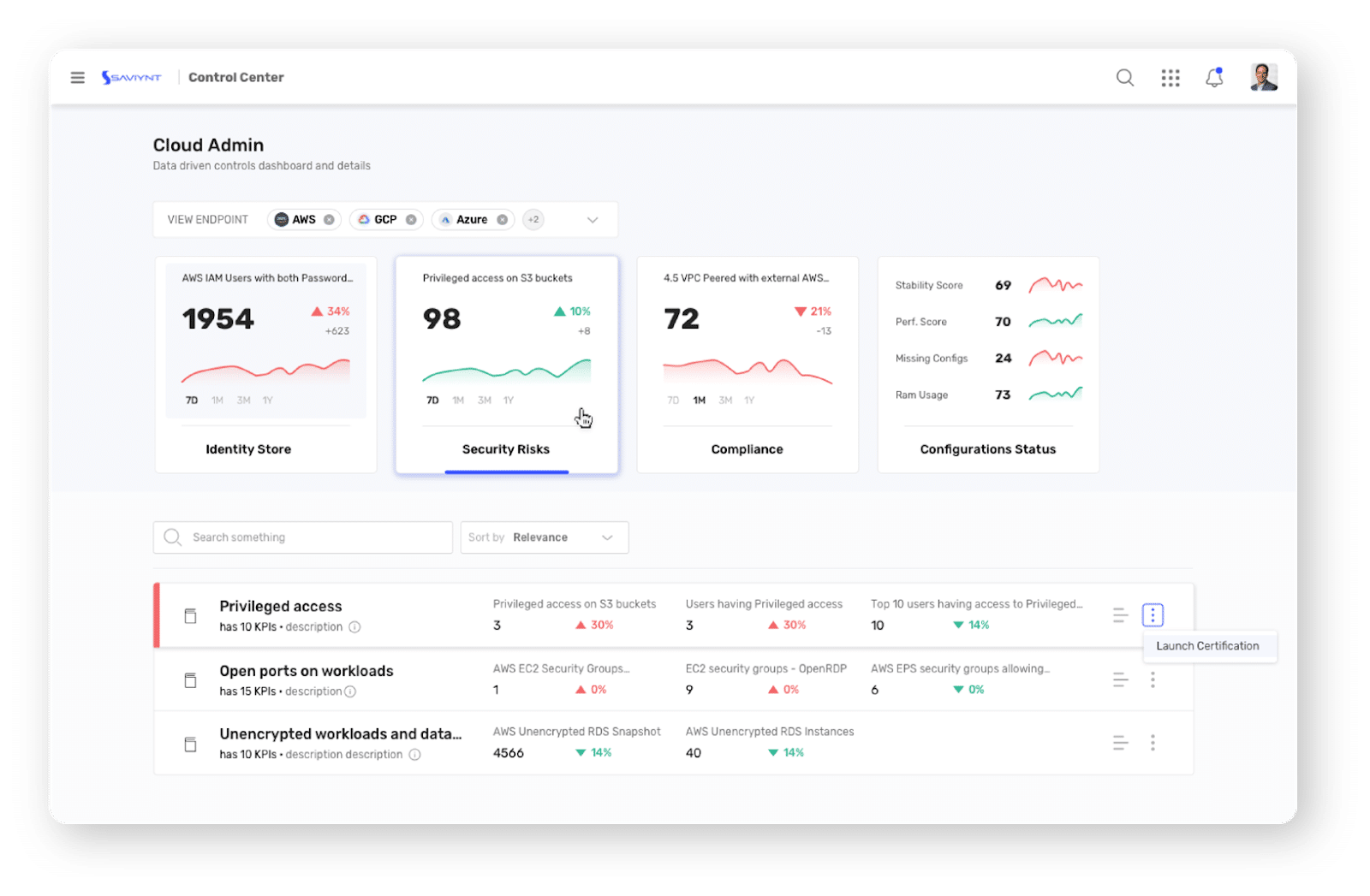
The product builds a real-time inventory of non-human identities across applications and environments, enriches each with contextual insight, and evaluates risk. Access maps show how non-human identities relate to resources, and a timeline records ownership changes and permission modifications for audit purposes. Remediation is driven by AI-guided recommendations from within the same console.
Key features include:
Real-time non-human identity inventory: Automatically discovers workloads, accounts, and credentials across environments and presents them in a dedicated NHI dashboard.
Contextual identity security posture: Attaches contextual insight to each non-human identity and surfaces critical risks so they can be prioritized before they become threats.
Unified NHI policy view: Consolidates all non-human identity policies, including violations, status, and severity, in a single view.
Access mapping: Generates access maps that show non-human access and the relationships between identities, applications, and resources.
Lifecycle event timeline: Records non-human identity changes over time, including ownership changes and permission modifications, to support audit readiness.
AI-guided remediation: Provides recommendations that direct teams to the actions needed to reduce risky non-human access.
View personalization: Supports flexible filters and sorting by identity type, ownership, and risk level.
Coverage without separate integration: Non-human identities are covered through the same platform and integrations used for human identities, so no additional integration effort is required.
Limitations (as reported by users on G2):
Interface complexity and learning curve: Reviewers describe the interface as complex for new users and note that advanced configurations demand significant technical expertise.
Performance at scale: Users report slow page loading and operations that take a long time to complete in larger environments.
Connector coverage gaps: Out-of-the-box connectors do not always cover all roles and licenses, pushing teams toward REST API connectors and custom development.
Job stability: Some reviewers report that separation-of-duties evaluation jobs fail and need improvement.
Implementation timeline: G2 data points to a typical implementation period of around nine months.
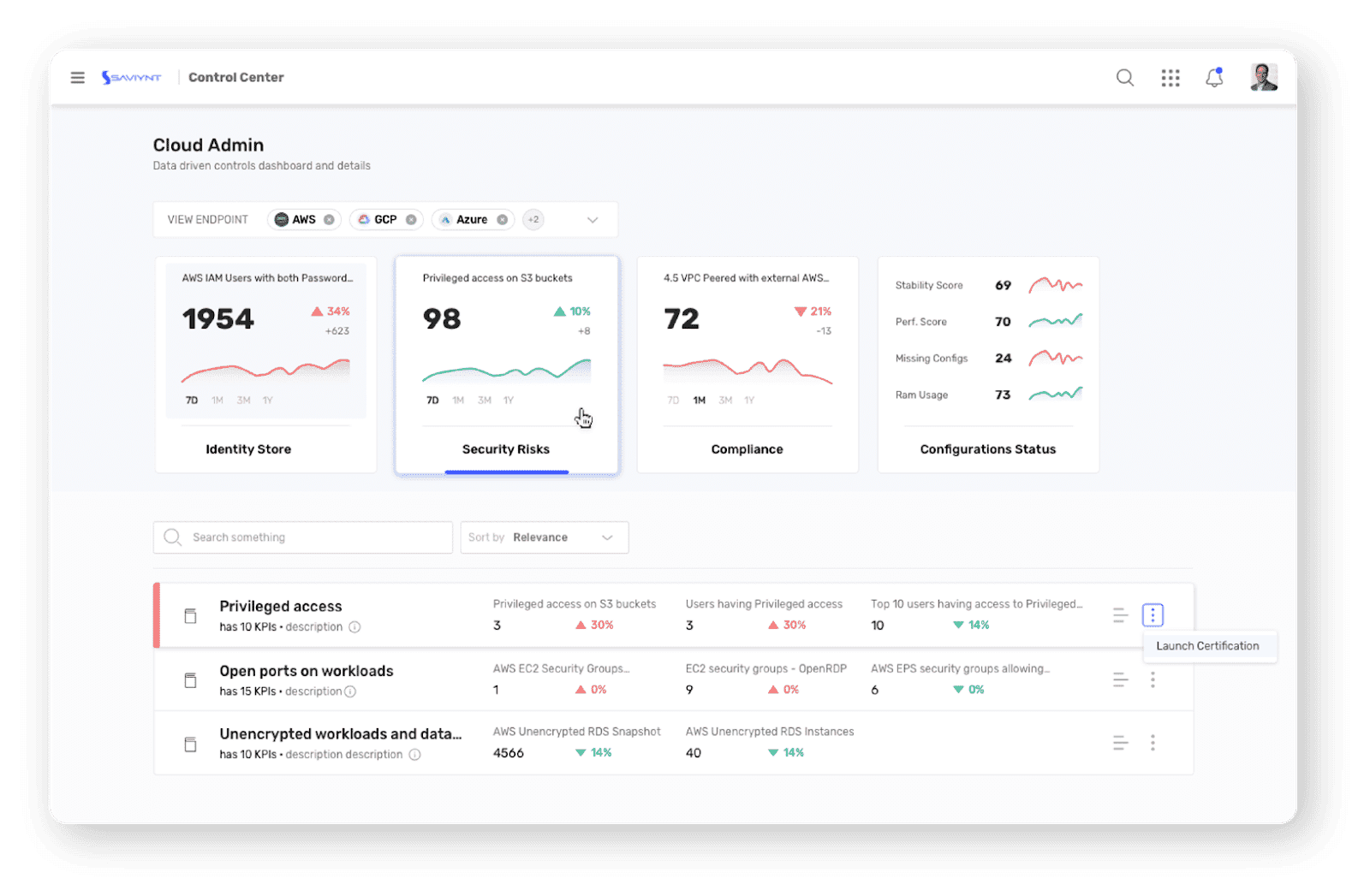
Source: Saviynt
4. Veza NHI Security

Best for: Mapping effective permissions for service accounts and keys
Strengths: Broad NHI entity coverage with human owner linkage
Things to consider: High cost and complex setup for smaller deployments
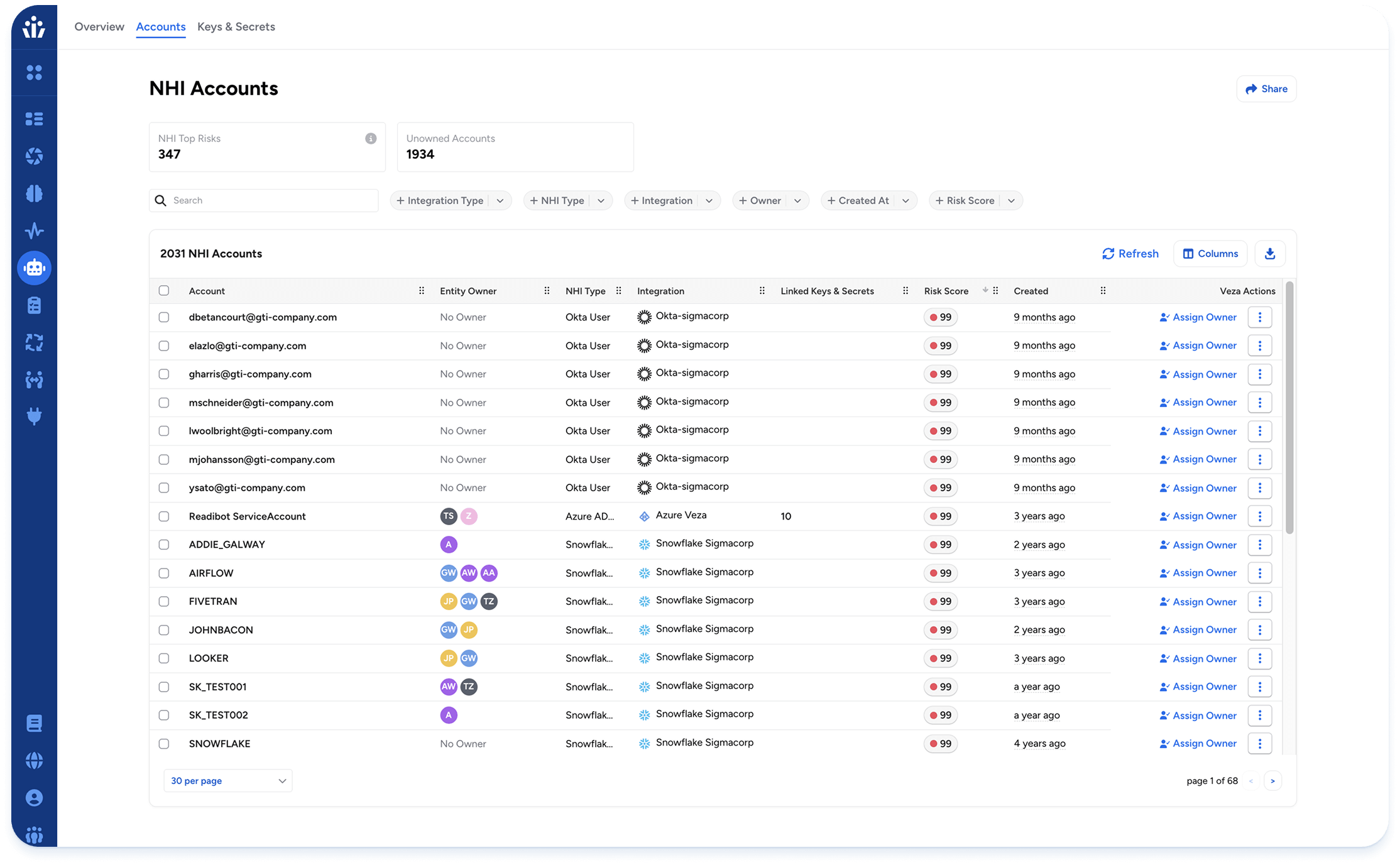
Veza's NHI Security product builds an inventory of non-human identities and calculates what each one can actually do. Coverage includes OS-level service accounts, cloud roles and workload identities, application registrations and service principals, API keys and tokens, CI/CD bots, robotic process automations, and headless SaaS users, secured on the same platform used for human identities.
Every non-human identity is assigned an owner linked to the human identity lifecycle, so alerts fire when that owner leaves or moves within the organization. Detection can be tailored to the environment, and the platform reports on expired credentials and over-permissioned accounts. A companion AI Agent Security product applies the same access graph model to AI agents and MCP servers.
Key features include:
Discovery and inventory across 40+ integrations: Finds non-human identities such as AWS Lambdas, Databricks service principals, Azure AD enterprise apps, GitHub deploy keys, and local accounts using out-of-the-box rules across SaaS, cloud, on-premises, and custom apps.
Ownership tied to the human lifecycle: Owners are assigned to each non-human identity and linked to their human record, with alerts when an owner leaves or changes role.
Effective permission calculation: Normalizes identities, roles, groups, policies, ACLs, and data objects across directories, clouds, SaaS, and databases to compute what each machine identity can actually do.
Custom NHI detection rules: Detection can be tailored using naming conventions or attribute combinations across 300+ integrations, including support for custom applications.
Credential and permission risk reporting: Surfaces expired credentials and over-permissioned accounts, with more than 100 pre-built reports and customizable views.
Broad NHI entity coverage: Supports over 90 different types of non-human identity entity across its integrations.
AI agent and MCP server discovery: Discovers agents across AWS Bedrock, Azure AI Foundry, Copilot Studio, ServiceNow, Google Vertex AI, Salesforce Agentforce, the OpenAI Agent Platform, and Claude Code, plus connections to public MCP servers.
Blast radius analysis for agents: Visualizes end-to-end access paths from agents and their models to tools, functions, APIs, and sensitive data, and quantifies action-level blast radius.
Limitations (as reported by users on PeerSpot):
Cost and fit for smaller projects: Reviewers note that the pricing is high, making the platform a poor fit for smaller deployments.
Complex setup: Setup is described as complex and dependent on integrating a number of separate systems.
Visibility-led rather than enforcement-led: A reviewer notes the absence of enforcement tooling, with the product delivering visibility and insight that teams then act on elsewhere.
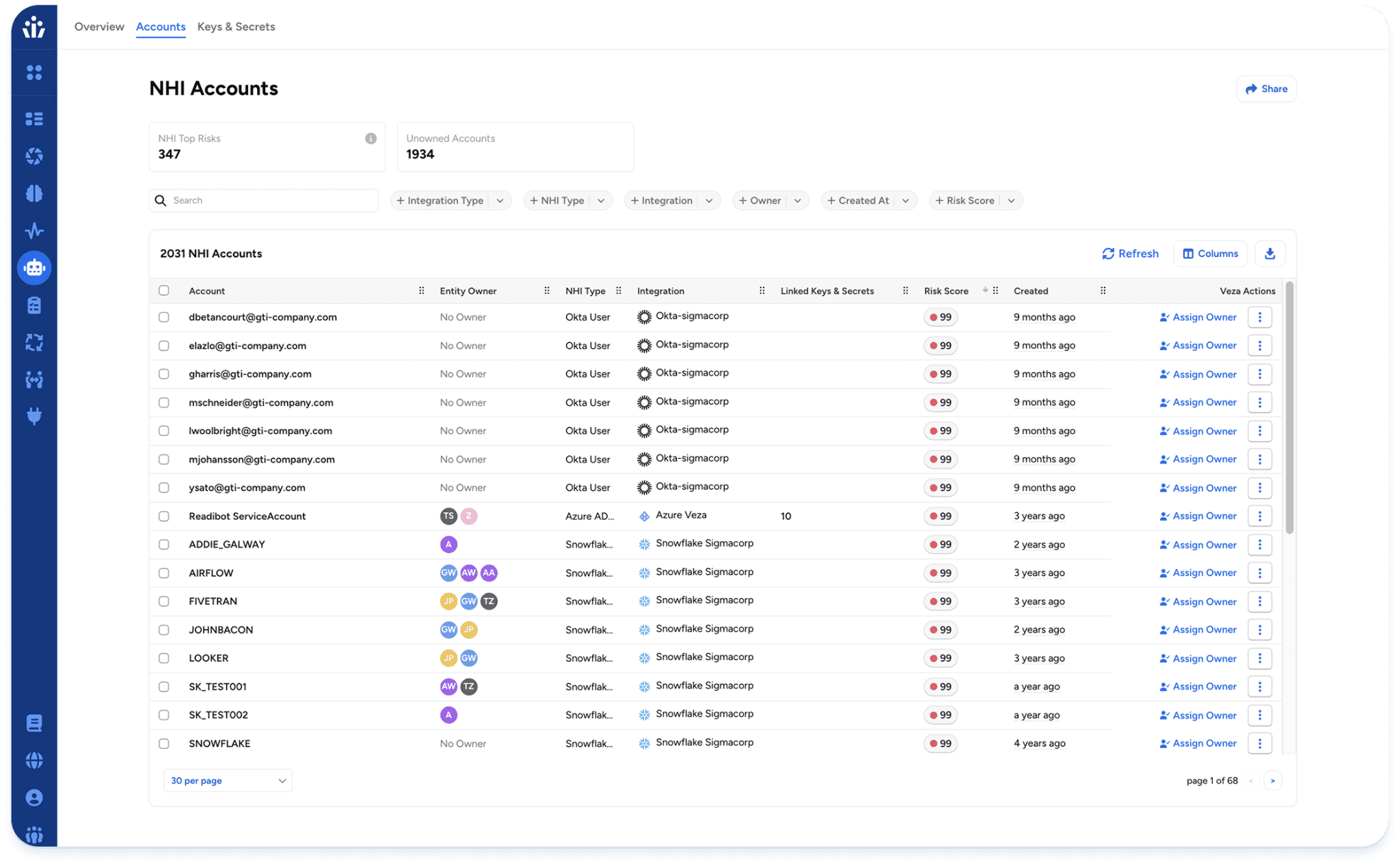
Source: Veza
Non-Human Identity and Machine Credential Security Platforms
5. Oasis Security

Best for: Dedicated lifecycle management for non-human identities
Strengths: Ownership inference, posture ranking, and safe secret rotation
Things to consider: Pending acquisition and limited public peer validation
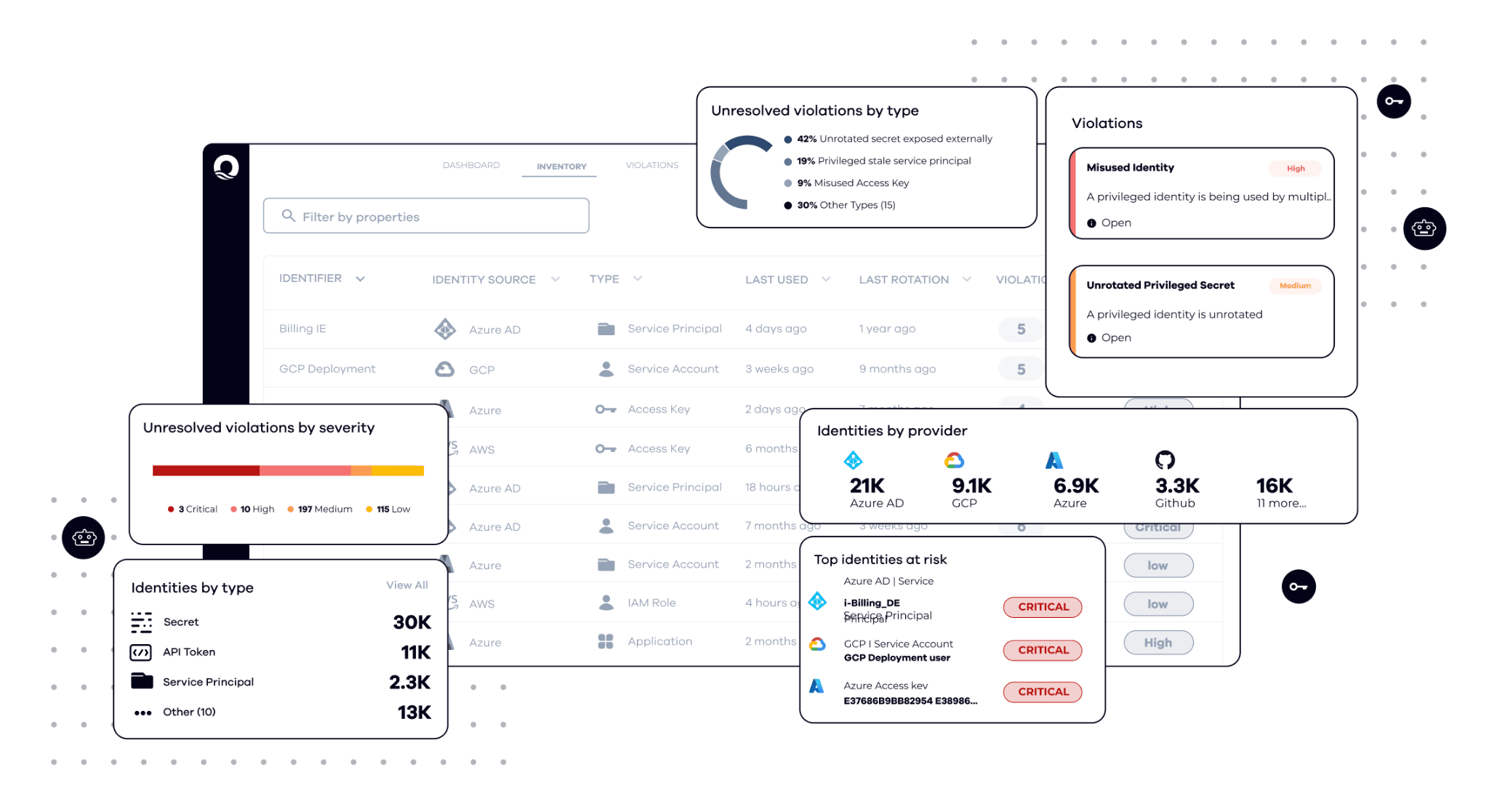
Oasis Security is a platform built specifically for non-human identity management across hybrid cloud environments. It connects to cloud, SaaS, and on-premises systems and automatically assembles an inventory of non-human identities in a consolidated view. Beyond raw discovery, it attaches context covering usage, consumers, resources accessed, and privileged status.
Ownership is resolved by combining CMDB data with heuristics and machine learning that suggest owners, identify gaps, and close them through certification campaigns. The platform assesses posture, ranks issues by severity, and supplies pre-configured remediation plans. Lifecycle coverage runs from provisioning and ownership assignment through vaulting, rotation, and decommissioning, and its Agentic Access Management capability evaluates agent intent and enforces time-bound access.
Key features include:
Automatic NHI inventory: Connects to the environment and builds a comprehensive inventory of all non-human identities within minutes, presented as a single pane of glass.
Contextual enrichment: Adds usage, consumers, resources, and privileged status to each identity rather than presenting raw data alone.
Ownership inventory and certification: Integrates cloud, SaaS, and on-premises environments enriched with CMDB data, uses heuristics and machine learning to suggest owners, and resolves gaps through certification campaigns.
Posture assessment and ranking: Automatically evaluates configuration and compliance, then ranks posture issues by severity so remediation can be prioritized.
Lifecycle orchestration: Automates provisioning, ownership assignment, vaulting, posture checks, rotation, monitoring, and decommissioning from initiation to retirement.
Safe secret rotation: Handles rotation with controls intended to make the process safe and efficient rather than disruptive.
Threat and anomaly detection: Oasis Scout monitors for leaked credentials, unauthorized access, and account takeover, with AuthPrint matching detected anomalies to known threat actor fingerprints.
Agentic intent and access control: Interprets what an agent is trying to do and enforces time-bound access accordingly.
AI security posture management: Checks AI agent configurations, permissions, and risk posture.
Out-of-the-box remediation plans: Supplies pre-configured, actionable remediation steps alongside the issues it identifies.
Limitations (based on publicly available sources):
Governance-focused scope: Independent reviewers position Oasis as an NHI governance platform that is typically paired with separate secrets tooling.
Ownership change ahead: Cyera signed a letter of intent in July 2026 to acquire Oasis, with the company set to operate as a unit inside Cyera, so roadmap and integration direction may shift.
Limited peer validation: Public coverage on established software review platforms is thin, leaving buyers with fewer independent data points than they would have for incumbent vendors.
Source: Oasis Security
6. Token Security

Best for: Machine-first governance of AI agents and their credentials
Strengths: Intent-based permissioning with broad integration coverage
Things to consider: Emerging vendor; verify coverage for your stack
Token Security is an identity security platform for AI agents and non-human identities. It discovers autonomous agents, copilots, custom GPTs, service-integrated agents and bots, agent frameworks and orchestration layers, and the non-human identities and tokens those agents use, across cloud environments, SaaS platforms, internal tools, and custom frameworks.
The platform analyzes identity logs and telemetry to establish who owns each agent, which APIs, services, and systems it can reach, which permissions and credentials it depends on, and how its behavior changes over time. Access is then aligned to a defined purpose rather than static roles, and policies govern agent creation, access, and operation with continuous compliance checks and immutable logging.
Key features include:
Agent and MCP server discovery: Automatically discovers AI agents and MCP servers, including autonomous agents, copilots, custom GPTs, bots, and orchestration layers, along with the non-human identities and tokens they rely on.
Contextual behavior and access mapping: Maps ownership, the APIs, services, and systems each agent can reach, the permissions and credentials in use, and behavior over time.
Intent-based permissioning: Defines permissions from an agent's purpose and expected actions, replaces over-scoped credentials, and enforces least privilege as behavior and intent evolve.
NHI lifecycle management: Covers continuous discovery, lifecycle management, posture management, threat detection and response, and remediation at scale for non-human identities.
Policy enforcement for agents: Defines approved services and data sources, allowed tools and integrations, access reviews with automated remediation, and environmental and runtime constraints.
Accountability and traceability: Logs AI actions comprehensively, correlates multi-agent sequences, alerts on suspicious activity, and maintains immutable logs.
Over 1,000 built-in integrations: Connects to AI platforms, cloud providers, CI/CD and DevOps tools, identity providers and PAM, AppSec, SIEM, CNAPP, and business systems.
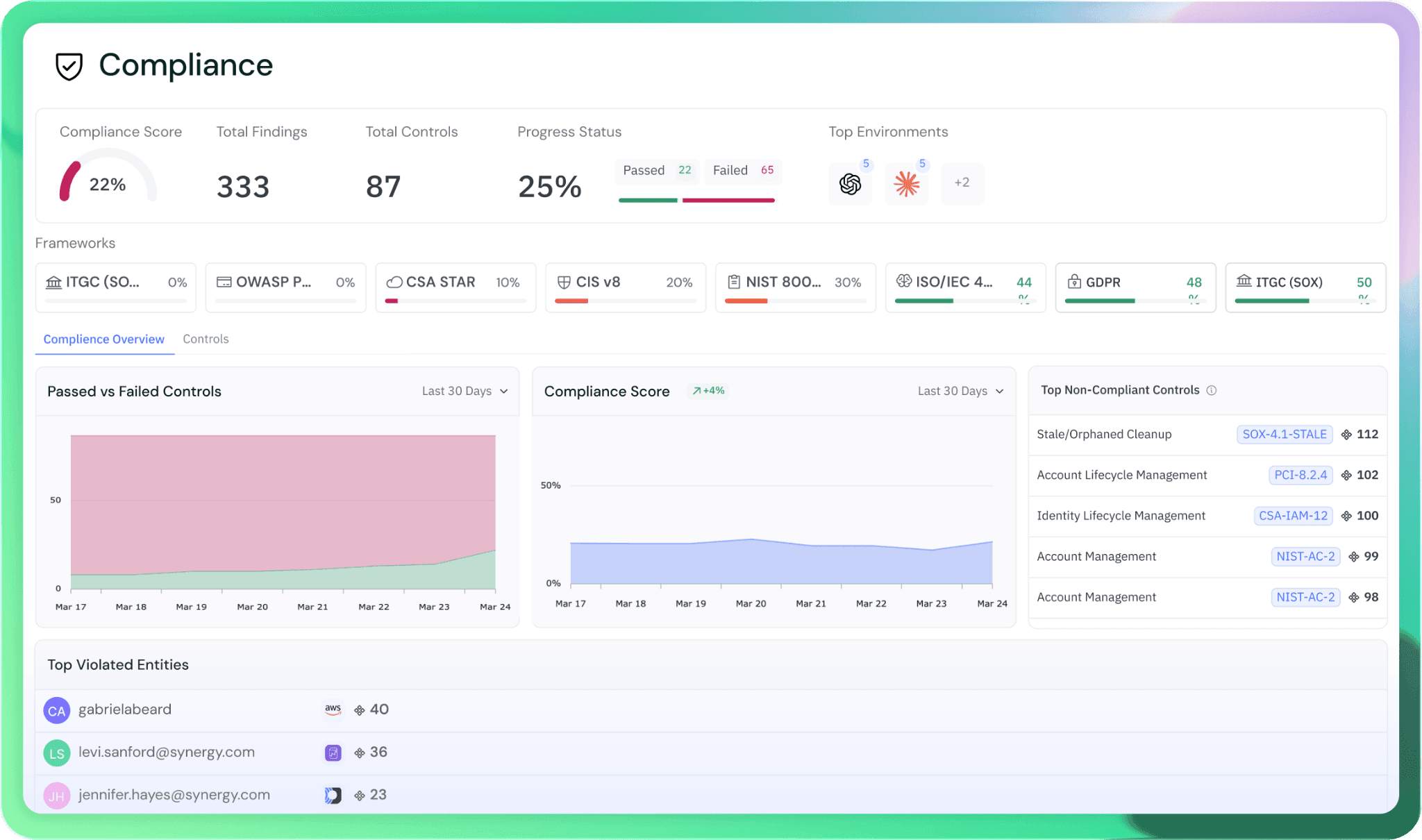
Compliance and auditability: Continuously evaluates agents against internal policies and external requirements, producing audit trails and forensic evidence for security and risk reviews.
Limitations (based on publicly available sources):
Emerging vendor: Independent reviewers advise confirming that the integrations a given environment depends on are supported before committing.
Agent-weighted positioning: Current platform messaging leads with AI agent security, so teams whose priority is traditional service account governance should validate depth in that area.
Category still consolidating: Analysts describe non-human identity security as a young market where standalone tools are being absorbed into larger platforms, which affects long-term product direction.
Source: Token Security
7. CyberArk Machine Identity Security

Best for: Broad machine identity coverage across secrets and certificates
Strengths: Covers secrets, certificates, workload identities, and SSH keys
Things to consider: Deployment complexity and administrative overhead
CyberArk's Machine Identity Security line manages secrets, certificates, workload identities, and SSH keys from a single platform. It is built around consolidated observability of machine identities across infrastructure, policy-driven automation for every machine identity type, and protection across the full lifecycle from discovery through privilege control and governance.
Secrets Management protects secrets and other machine identities used by applications, DevOps pipelines, and cloud workloads, and is available as SaaS, self-hosted, or through Secrets Hub and Credential Providers. Certificate Management delivers certificate visibility and lifecycle automation across data center, cloud, and network infrastructure. Workload Identity Security issues and authenticates workload identities just in time, including in Kubernetes and hybrid or multi-cloud environments.
Key features include:
Secrets management for applications and pipelines: Protects secrets and other machine identities used by applications, DevOps pipelines, and cloud workloads, with SaaS and self-hosted deployment options.
Secrets Hub and credential providers: Centralizes secrets across environments and delivers credentials to the applications that consume them.
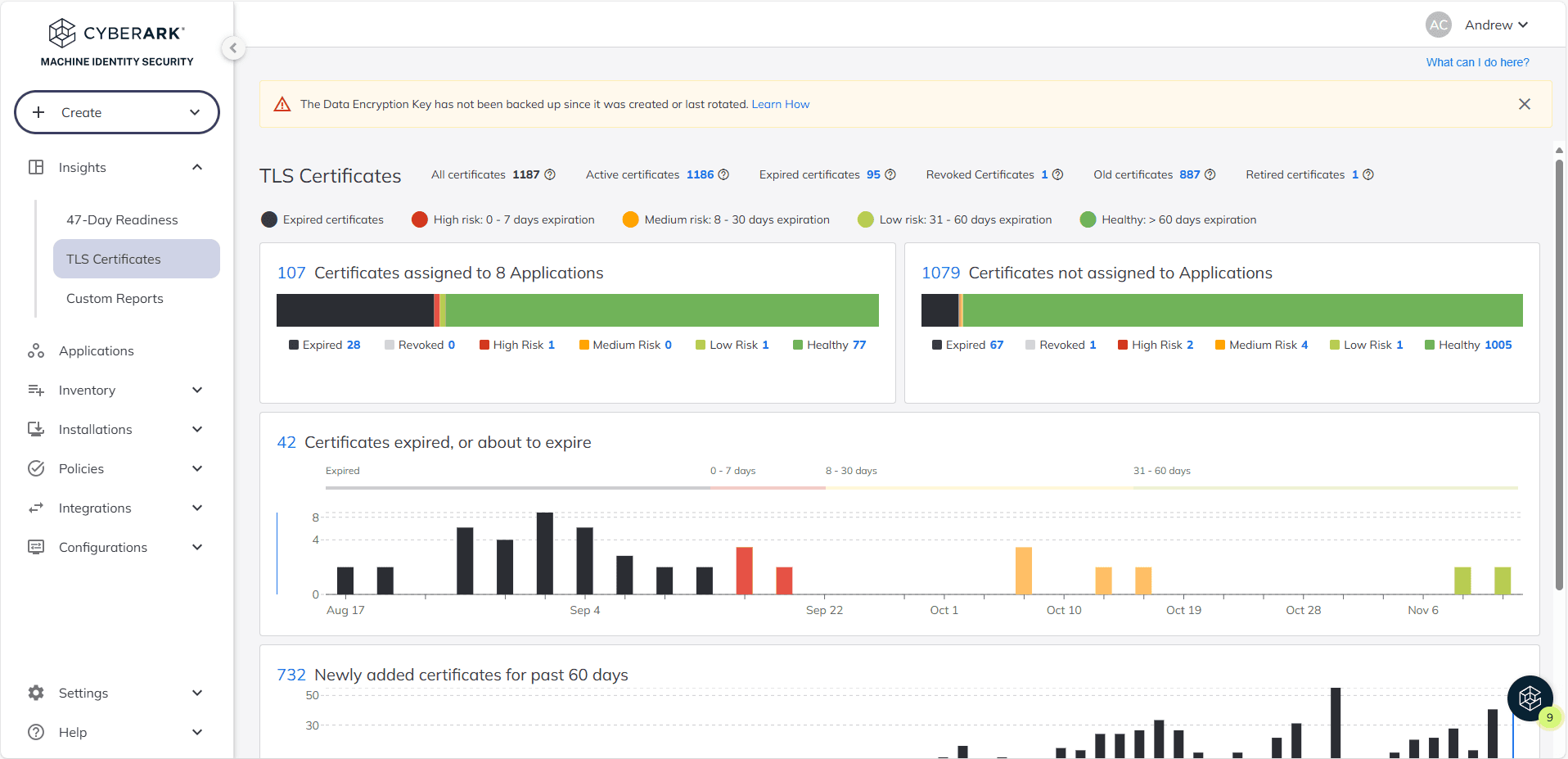
Certificate lifecycle automation: Provides certificate visibility and lifecycle automation across the data center, cloud, and network infrastructure, with dedicated capabilities for Kubernetes, code signing, and PKI.
Workload identity issuance: Issues and authenticates workload identities just in time, including in Kubernetes and complex hybrid and multi-cloud environments.
SSH key management for machines: Manages SSH keys as part of the wider machine identity estate rather than as a separate silo.
Consolidated observability: Maintains visibility of machine identities across infrastructure from a single platform.
Policy-driven automation: Applies scalable, policy-driven automation across the machine identity lifecycle for each identity type.
Discovery scans: Offers secrets and certificate scans that establish an initial picture of the machine identity estate before deployment.
Limitations (as reported by users on G2, covering the Conjur secrets management component):
Deployment complexity: Reviewers describe deployment as complex and the technology as difficult to manage in practice.
Navigation learning curve: Users report that the interface takes time to learn before it becomes straightforward to work with.
Synchronization gaps: One reported limitation is that deleting an account or safe from a synced source is not reflected in the secrets store.
Component overhead: Reviewers note that working across the product's various components requires patience and administrative effort.
Source: CyberArk
8. Aembit

Best for: Secretless, policy-based access for workloads and AI agents
Strengths: Short-lived credentials issued per task with full audit logs
Things to consider: Access-focused; pair with discovery and governance
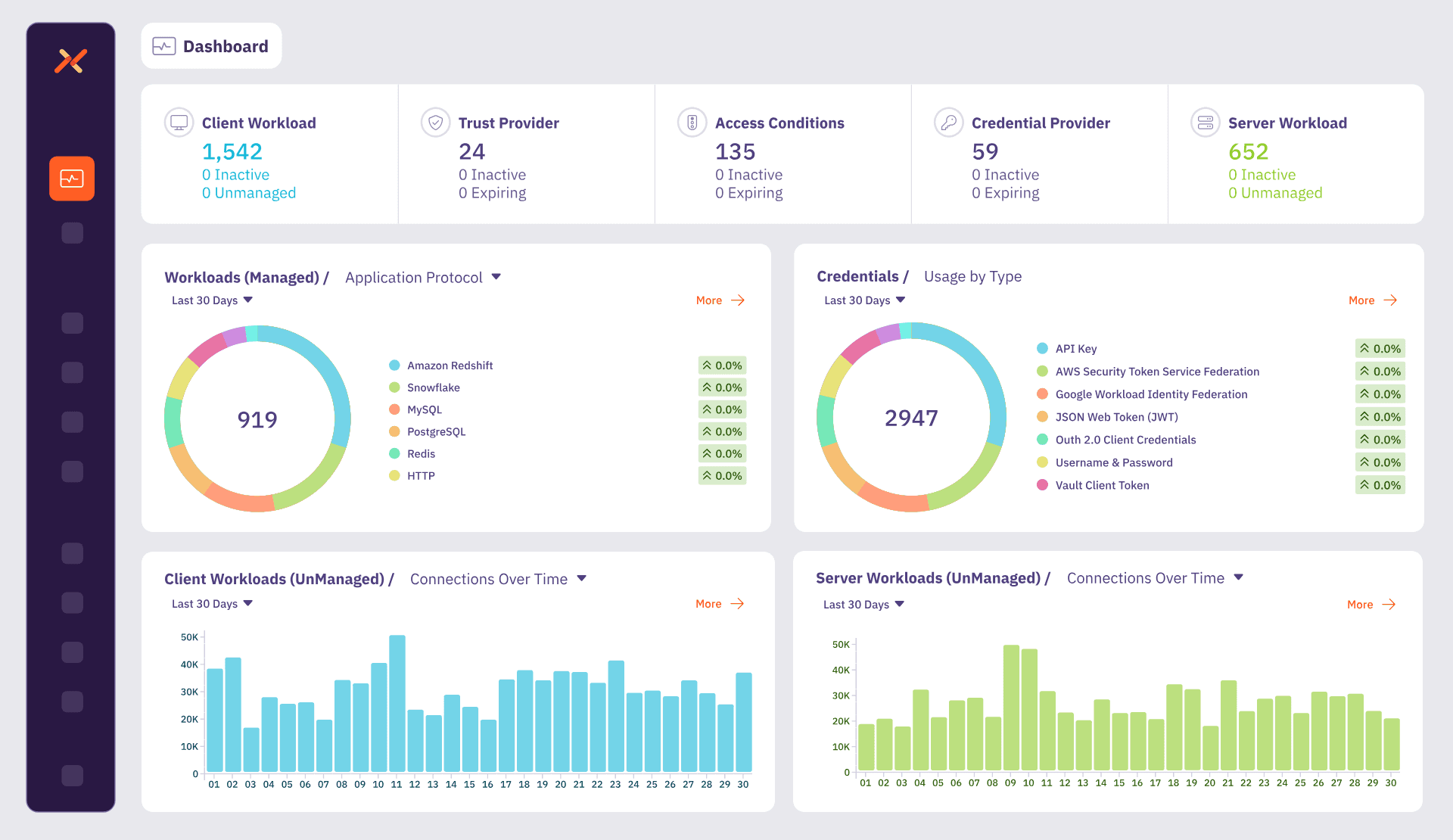
Aembit is an identity and access management platform for workloads and agentic AI. It acts as an independent identity broker that secures access for AI agents, MCP servers, and workloads across clouds, SaaS platforms, and on-premises data centers, giving teams one place to enforce and audit access from agents to sensitive resources.
Rather than storing or distributing secrets, Aembit issues short-lived credentials just in time and per task based on the workload's or agent's identity, whether that access is delegated, autonomous, or chained. Policies define what agents can reach, and conditional access evaluates posture, geography, time windows, and other behaviors at request time. Access can be cut off from the console.
Key features include:
Secretless authentication: Issues policy-based, short-lived credentials so workloads and agents authenticate without a bootstrap secret, stored secrets, or new certificates to rotate.
Central access control plane: Acts as an independent identity broker enforcing and auditing access for agents, MCP servers, and workloads across cloud, SaaS, and on-premises environments.
MCP gateway: Manages agentic access to MCP servers through a single auditable data plane, combining agent and user into a blended identity with real-time policy enforcement, token exchange, and credential isolation.
Conditional access using context: Evaluates AI agent security posture, geography, time windows, and other behaviors to determine access rights dynamically at each request.
Identity-based audit logging: Records what agents and workloads access under each agent's own identity rather than behind a user or parent agent, distinguishing human-initiated from agent-initiated access.
Immediate revocation: Agent access can be stopped from the console when needed.
Standards support: Works with MCP, A2A, and custom frameworks, and supports OAuth, OIDC, SPIFFE, and Kerberos across AWS, Azure, GCP, on-premises, and SaaS without deploying new identity systems.
Posture-driven integrations: Integrates with CrowdStrike and Wiz to tie security posture and intelligence to access policies, alongside a range of trust and credential providers.
Limitations (based on publicly available sources):
Access-focused scope: Independent reviewers position Aembit as an access enforcement layer that should be paired with separate discovery and governance tooling.
Not an inventory or discovery tool: Analyst commentary describes the platform as an identity-first control plane rather than a secrets manager or service account discovery tool, so a full NHI inventory requires another product alongside it.
Emerging category: Workload and agent identity brokering is a young category, so integration coverage for a specific stack should be validated during evaluation.
Source: Aembit
Conclusion
Access governance for non-human identities helps organizations maintain visibility and control as service accounts, workloads, APIs, and AI agents continue to grow across hybrid environments. By continuously discovering identities, assigning ownership, enforcing least privilege, governing the identity lifecycle, and monitoring access over time, these platforms reduce the risk of excessive permissions, orphaned accounts, compromised credentials, and unauthorized access while supporting security, compliance, and audit requirements.




.png)

