
TL;DR: AI access control platforms with real-time visibility discover AI apps, agents, and non-human identities, then monitor and govern what they reach as they act. Opti is best for unified human and AI access governance, Microsoft Entra Agent ID Microsoft-centric estates, Saviynt Zuma agent discovery, and Zenity runtime action control.
What Are AI Access Control Platforms with Real-Time Visibility?
AI access control platforms provide real-time visibility, discovery, and runtime governance for enterprise artificial intelligence applications, autonomous agents, and non-human identities (NHIs). They manage which users, service accounts, AI agents, and applications can access data, APIs, models, tools, and other digital resources, while continuously showing how that access is being used.
Why real-time visibility is important for AI access control:
Keeps pace with rapid AI growth: Continuously discovers new AI applications, agents, models, and integrations as they appear.
Reduces identity attack surface risk: Monitors human and machine identities to expose excessive privileges, misuse, and suspicious access.
Detects shadow AI: Identifies unapproved AI tools, unmanaged agents, and hidden access paths before they create larger governance gaps.
Tracks dynamic agent behavior: Shows how AI agents actually use permissions, tools, APIs, and data rather than relying only on static access reviews.
Improves incident response: Provides live activity and relationship data so teams can quickly investigate and contain risky or unauthorized behavior.
Supports least privilege: Reveals stale, excessive, or unused permissions so access can be reduced as agent roles and workflows change.
Strengthens governance and compliance: Maintains current access records, activity histories, and audit evidence for reviews and regulatory requirements.
Core real-time visibility capabilities in AI access control:
Continuous discovery of AI applications and agents: Automatically identifies new AI tools and agents as they appear across the environment.
Unified inventory of human and machine identities: Centralizes users, service accounts, bots, and AI agents with their permissions and ownership.
Live identity-to-resource relationship mapping: Maps which identities can access data, systems, APIs, and applications.
Real-time user and AI agent activity monitoring: Tracks identity behavior and agent actions to detect unusual or unauthorized activity.
AI agent tool and plugin usage visibility: Shows which tools, plugins, APIs, and connectors agents use and the actions they perform.
Shadow AI and unapproved application detection: Detects unauthorized AI services and applications operating outside established governance.
SIEM, SOAR, IAM, and ITDR integration: Shares AI identity and activity data with existing security, access, and response systems.
Separation of duties and toxic permission combination detection: Identifies conflicting permissions that give an identity excessive control over sensitive processes.
Continuous access reviews and certification for AI agents: Continuously validates agent permissions and triggers reviews when access or risk changes.
Compliance mapping and audit evidence: Maps access controls to compliance requirements and maintains evidence of reviews, activity, and remediation.
AI Access Control Platforms at a Glance
The table below summarizes the key differences between the platforms covered in this guide, including who each one suits and where the trade-offs sit. Each platform is explored in more detail in the sections that follow.
Category | Solution | Best For | Key Strengths | Things to Consider |
AI Identity and Access Governance | Opti | Governing human, non-human, and AI agent access in one place | Living access graph with real-time AI agent activity monitoring | Newer vendor with limited third-party review coverage |
AI Identity and Access Governance | Microsoft Entra Agent ID | Microsoft-centric estates assigning identities to AI agents | Conditional Access, governance, and risk detection for agents | Settings and licensing spread across admin portals |
AI Identity and Access Governance | Okta for AI Agents | Vendor-neutral agent discovery and lifecycle governance | Shadow agent discovery, short-lived credentials, kill switch | Advanced features add licensing cost and setup complexity |
AI Identity and Access Governance | SailPoint Agent Identity Security | Governing AI agents alongside human identities | Agent ownership, access reviews, indirect access detection | Complex implementation and steep administrative learning curve |
AI Identity and Access Governance | Saviynt Zuma | Discovering and governing AI agents and non-human identities | Access maps, activity timelines, runtime authorization | Setup can be lengthy and custom integrations need vendor help |
AI Usage Discovery and Runtime Governance | Palo Alto Networks AI Access Security | Discovering and controlling employee GenAI app usage | Real-time GenAI app discovery with inline data controls | Complex initial setup and cost tied to the wider platform |
AI Usage Discovery and Runtime Governance | Zenity | Governing agent actions before they execute | Live agent inventory, posture checks, exploitability testing | Agent-scoped, so it complements rather than replaces IAM |
AI Usage Discovery and Runtime Governance | WitnessAI | Network-level visibility into employee and agent AI activity | Shadow AI discovery, intent-based policy, runtime defense | Network deployment needs planning; red teaming sold separately |
Why Real-Time Visibility Is Important for AI Access Control
Rapid Growth of AI Applications and Agents
The adoption of AI technologies is accelerating across industries, leading to a proliferation of applications, agents, and models within enterprise environments. This rapid growth introduces significant complexity for security teams, who must track and manage an expanding array of AI-driven processes, each with its own access requirements and risk profiles. Manual inventory and oversight are no longer feasible, especially as organizations experiment with generative AI, autonomous agents, and custom AI workflows that evolve quickly over time.
This expansion also increases the likelihood of oversight and misconfiguration. Without automated, real-time discovery and monitoring, new AI agents or applications may be deployed without proper access controls, creating potential entry points for attackers. Continuous, real-time visibility is necessary to maintain an accurate picture of the AI ecosystem, ensuring that every new component is accounted for, governed, and secured from the moment it becomes operational.
Expanding Human and Machine Identity Attack Surfaces
The integration of AI into business processes introduces not only more machine identities—such as service accounts, bots, and agents—but also expands the number of human users interacting with these systems. Each new identity represents a potential attack vector, increasing the overall attack surface and complicating identity management. Attackers can exploit weak or misconfigured identities to gain unauthorized access to sensitive resources, making comprehensive visibility into all identities crucial.
Traditional identity and access management solutions often lack the granularity and speed needed to monitor these complex, dynamic environments. Real-time visibility platforms address this gap by continuously aggregating identity data across human and machine users, mapping their permissions, and highlighting anomalies as they occur. This approach allows organizations to quickly detect and mitigate identity-based threats, such as privilege escalation or credential misuse, before they can be exploited.
Related content: Read our article about the top causes of identity sprawl and how to prevent it.
Unapproved Use of Generative AI Tools
Business units may adopt generative AI tools without involving IT or security teams, creating a form of shadow AI similar to traditional shadow IT. Employees can connect these tools to corporate data, SaaS applications, APIs, or internal systems without centralized review. This can create unmanaged identities, unreviewed permissions, and access paths that security teams cannot see or govern.
Shadow AI also extends the broader non-human identity (NHI) and agentic identity governance problem. AI applications and agents may use service accounts, API keys, OAuth tokens, or delegated user permissions to act across multiple systems. Without real-time discovery and visibility, organizations may have no reliable process for reviewing this access, enforcing least privilege, or removing credentials and permissions when an AI tool or agent is retired.
Real-time visibility helps security teams discover unapproved AI applications, associated identities, and their access relationships as they appear. This makes it possible to bring shadow AI under existing governance processes, identify excessive or stale permissions, and establish an offboarding process for AI tools and agents that would otherwise retain access after their intended use ends.
Dynamic and Unpredictable AI Behavior
AI agents and applications often exhibit dynamic and sometimes unpredictable behavior, especially when they interact autonomously with systems or data. Unlike traditional software, AI-driven tools can adapt, learn, and change their actions based on new inputs or evolving objectives. This unpredictability complicates access control, as static rules or periodic reviews may not capture emerging risks or anomalous behavior in real time.
Real-time visibility enables organizations to monitor AI behavior as it unfolds, identifying deviations from expected patterns or unauthorized actions as soon as they occur. By correlating activity data with identity and resource information, security teams can quickly detect when an AI agent is accessing data it shouldn’t or performing actions outside its intended scope. This continuous oversight is essential for mitigating risks posed by the autonomous and evolving nature of AI systems.
Core Real-Time Visibility Capabilities of AI Access Control Platforms
1. Continuous Discovery of AI Applications and Agents
Continuous discovery is the automated process of identifying all AI applications and agents present within an organization’s environment. As new AI assets are deployed (either by IT teams, developers, or business units) the platform scans networks, cloud environments, and integrated systems to catalog them in real time. This ongoing process ensures that security teams are always aware of the current AI landscape, eliminating blind spots caused by manual inventory or delayed updates.
By maintaining an up-to-date inventory, organizations can:
Promptly apply access controls
Monitor usage
Assess risk for every AI asset, regardless of how quickly the environment changes
Continuous discovery also supports compliance efforts by providing auditable records of all AI tools and agents, making it easier to demonstrate control over sensitive systems and respond to regulatory inquiries.
2. Unified Inventory of Human and Machine Identities
A unified inventory brings together all human and machine identities (including employees, contractors, service accounts, bots, and AI agents) into a single view. It should capture roles, permissions, ownership, authentication methods, and resource relationships, while updating as identities are created, modified, or removed. This helps security teams identify:
Orphaned accounts
Excessive privileges
Unmanaged machine identities
The inventory should also include usage telemetry for each identity and entitlement. Last-used timestamps and access frequency show whether permissions are actively required or simply remain available. Without this data, access reviews can confirm that an entitlement exists but cannot determine whether it is still necessary. Usage context supports better certification decisions, removal of stale access, and right-sizing of human and AI agent privileges.
3. Live Identity-to-Resource Relationship Mapping
Live identity-to-resource relationship mapping visualizes and tracks the connections between identities (both human and machine) and the resources they can access. This capability provides an immediate, up-to-date map of which users or agents have access to specific:
Systems
Data
Applications
It also shows how those relationships change over time. Real-time mapping is crucial for detecting unauthorized access paths or privilege escalation attempts as soon as they occur. With live relationship mapping, security teams can quickly assess the blast radius of a compromised identity or misconfigured permission, enabling faster containment and remediation. This level of visibility also simplifies compliance reporting and audit processes by providing clear, defensible evidence of who has access to what at any given moment.
4. Real-Time User and AI Agent Activity Monitoring
Real-time activity monitoring tracks how human users and AI agents interact with systems, data, APIs, tools, and plugins. For agents, monitoring should cover:
Authentication events
Resource access
Tool calls
Data transfers
Configuration changes
Other autonomous actions
This provides the behavioral context needed to distinguish an agent's assigned permissions from how it actually uses them. AI-specific analytics can compare an agent with peer groups performing similar functions to identify behavioral outliers. Platforms can also detect anomalies in tool usage, such as an agent invoking an unusual connector, accessing a resource at abnormal frequency, or using tools in an unexpected sequence. High-risk agent entitlements can be automatically classified based on factors such as privilege level, resource sensitivity, and the actions those permissions enable.
5. AI Agent Tool and Plugin Usage Visibility
AI agents often rely on external tools, plugins, APIs, and connectors to complete tasks. These integrations may allow agents to:
Query databases
Send emails
Access cloud storage
Update business applications
Interact with internal systems
Real-time visibility into tool and plugin usage shows exactly which integrations an agent is using, what actions it performs, and which resources those actions affect. This visibility helps security teams identify unnecessary or risky integrations, detect unauthorized plugin usage, and verify that agents operate within approved boundaries. It also provides context during investigations by linking agent actions to the tools involved.
6. Shadow AI and Unapproved Application Detection
Shadow AI refers to AI applications, models, or services that employees or development teams use without formal approval from IT or security. These tools may process sensitive data, connect to enterprise systems, or create unmanaged identities outside established governance processes. Because they operate outside standard oversight, they can introduce compliance issues and increase the organization's attack surface.
Real-time detection continuously identifies new:
AI services
Browser-based AI tools
API connections
Locally deployed models
Security teams receive immediate visibility into unauthorized deployments and can assess the associated risks before sensitive data is exposed. This capability supports governance by helping organizations enforce approved AI usage policies while maintaining an accurate inventory of AI technologies.
7. SIEM, SOAR, IAM, and ITDR Integration
Real-time visibility becomes more valuable when it is integrated with existing security and identity platforms. AI access control platforms commonly:
Send events to security information and event management (SIEM) systems for centralized monitoring
Trigger automated response workflows through security orchestration, automation, and response (SOAR) platforms
Synchronize identity data with identity and access management (IAM) solutions
Share identity threat information with identity threat detection and response (ITDR) platforms
These integrations allow organizations to correlate AI-related activity with broader security telemetry, reducing investigation time and improving incident response. For example, suspicious AI agent behavior can automatically generate SIEM alerts, trigger SOAR playbooks to disable affected accounts, or enrich ITDR investigations with identity context. Connecting AI access control data to existing security operations creates a more complete view of identity and access risks across the enterprise.
Related content: Read our article about the top IAM security risks and the capabilities needed to address them.
8. Separation of Duties and Toxic Permission Combination Detection
Separation of duties (SoD) controls prevent a single identity from holding permissions that create excessive control over a sensitive process. For AI agents, this can include combinations such as creating a transaction and approving it, modifying financial data and changing audit records, or accessing sensitive data while also having permission to export it. Real-time analysis can identify these toxic combinations across:
Applications
APIs
Cloud services
Agent tools
Detecting these conflicts requires evaluating effective permissions rather than reviewing each entitlement in isolation. AI access control platforms can map inherited roles, delegated permissions, service accounts, and agent credentials to determine what an agent can actually do. Security teams can then remove conflicting privileges, introduce approval controls, or restrict agent actions before the access creates a material risk.
9. Continuous Access Reviews and Certification for AI Agents
Visibility alone does not ensure that AI agent access remains appropriate. Continuous access reviews evaluate agent permissions as roles, integrations, data sources, and business requirements change. Instead of relying only on periodic certification campaigns, organizations can trigger reviews when an agent:
Receives privileged access
Changes owners
Connects to a sensitive resource
Becomes inactive
Exceeds established risk thresholds
Access certification provides an accountable process for confirming whether each agent still requires its permissions. Application owners, security teams, or other designated reviewers can approve, modify, or revoke access based on current usage and risk. Automated remediation can then remove stale entitlements, disable unused credentials, and reduce excessive privileges identified during the review.
10. Compliance Mapping and Audit Evidence
Real-time identity and access visibility can support audit requirements under frameworks and regulations such as SOX, SOC 2, ISO 27001, HIPAA, PCI DSS, NYDFS cybersecurity requirements, NIS2, and GDPR. While obligations differ, many require organizations to demonstrate appropriate:
Access controls
Privileged-access oversight
Periodic reviews
Logging
Accountability
Timely removal of unnecessary access
AI access control platforms can map identity and agent governance data to relevant controls and retain evidence such as permission histories, access-review decisions, policy violations, remediation actions, and activity logs. This gives auditors a traceable record of who or what had access, why that access existed, how it was reviewed, and when it changed. Continuous evidence collection can also reduce reliance on point-in-time screenshots and manual audit preparation.
Notable AI Access Control Platforms
How we selected these platforms: We shortlisted AI access control platforms based on continuous discovery of AI applications and agents, unified visibility across human and non-human identities, real-time activity monitoring, runtime policy enforcement, and integration with existing identity and security tooling.
AI Identity and Access Governance Platforms
1. Opti

Best for: Governing human, non-human, and AI agent access in one place
Strengths: Living access graph with real-time AI agent activity monitoring
Things to consider: Newer vendor with limited third-party review coverage
Opti is an AI-native identity security platform that extends existing IAM policy to AI agents. Every access decision, tool invocation, and workflow an agent performs is tied to a verified identity and risk context, so agent activity is governed under the same model applied to human access.
The platform continuously consolidates identity, access, and entitlement data across connected systems and aligns it with policies, roles, and usage insights. That data feeds a living access graph covering human, non-human, and agentic identities, and supports on-demand access reviews and least-privilege evidence.
Key features include:
Real-time risk detection engine: Continuously analyzes agent behavior, flags over-privileged capabilities, and surfaces anomalies before they escalate.
AI activity risk monitoring: Tracks user and AI agent actions, prioritizes risks by severity, and surfaces anomalous behavior for rapid investigation and automated response.
Granular AI access visibility: Shows exactly what each AI agent can read, write, or manage across connected applications, supporting least-privilege enforcement and continuous compliance monitoring.
Agent supply chain controls: Discovers hidden agents, validates toolchain integrations, and enforces runtime guardrails across major AI platforms.
Living access graph: Unifies identities, entitlements, usage, and business context into a single view that stays current through continuous sync and flags policy violations early.
Natural language access queries: Answers questions such as who holds admin access to a given application without requiring query syntax or filters.
Graph-based remediation: Allows entitlement and permission changes to be made directly from the interactive access graph rather than in a separate console.
On-demand access reviews: Produces access reviews instantly and evidences least privilege using consolidated identity, policy, and usage data.
Limitations (based on publicly available sources):
Short market track record: The company emerged publicly with seed funding in late 2025, so it has less production history than long-established IAM suites.
Limited independent review coverage: Verified user reviews are not yet published on the major software review platforms, so buyers have less third-party feedback to compare.
No published pricing or self-service trial: Evaluation begins with a scheduled demo rather than listed plans or a sign-up path.
Book a demo to see how Opti governs AI agent access
2. Microsoft Entra Agent ID

Best for: Microsoft-centric estates assigning identities to AI agents
Strengths: Conditional Access, governance, and risk detection for agents
Things to consider: Settings and licensing spread across admin portals
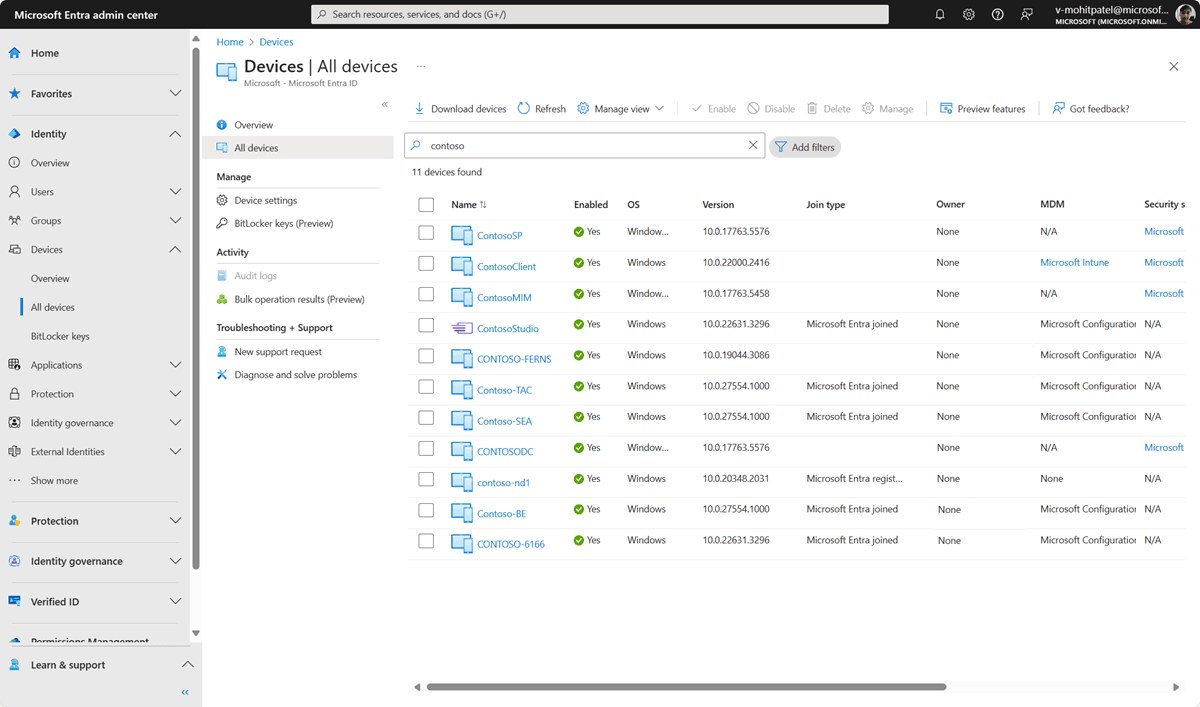
Microsoft Entra Agent ID extends Microsoft Entra identity and access management to AI agents. Agents are inventoried and provisioned with agent identities, which lets them authenticate, receive access assignments, and be managed using the same directory controls that already apply to employees and workloads.
The capabilities are delivered through Microsoft Agent 365, which acts as the control plane for agents and supplies a unified agent registry along with usage insights and visual mapping of agent activity and connections. Agent ID capabilities are included in Agent 365 and Microsoft 365 E7 plans.
Key features include:
Agent identity provisioning at scale: Assigns built-in identities to agents so authentication, policy enforcement, and existing organizational policies apply to each one.
Conditional Access for agents: Enforces real-time policies on agent access to resources, helps block risky agents, and supports granular access policies based on configured security attributes.
Identity governance for agents: Automates governance from deployment to expiration, keeps sponsors assigned and maintained, and makes access assignments intentional, auditable, and time bound.
Identity protection signals: Detects and flags unusual or unauthorized agent activity, traces agents with compromised tokens, and supports remediation of compromised agents.
Network controls and logging: Logs agent network activity for audit and threat detection, applies web categorization to APIs and MCP servers, restricts file uploads and downloads, and blocks malicious destinations.
Unified agent registry: Provides a fleet-wide inventory in the Microsoft admin center, covering agents from Microsoft AI platforms as well as synced and self-registered agents from other platforms.
Limitations (as reported by users on G2): G2 lists reviews for the parent Microsoft Entra ID platform rather than the Agent ID module specifically, so the points below reflect the wider platform experience.
Day-to-day navigation effort: Routine changes often require many clicks and movement between menus, which slows common administrative tasks.
Shifting portal layout and naming: Options that move or get renamed make troubleshooting harder to follow.
Settings split across portals: Important configuration lives in several different admin portals rather than one place.
Configuration complexity: Complex initial setup can lead to confusion and misconfiguration without experienced administrators.
Licensing tiers: Some advanced security and identity capabilities require higher-tier licenses, which can limit what an organization deploys.
Conditional Access troubleshooting: Diagnosing Conditional Access issues can be slow and complicated.
Source: Microsoft
3. Okta for AI Agents

Best for: Vendor-neutral agent discovery and lifecycle governance
Strengths: Shadow agent discovery, short-lived credentials, kill switch
Things to consider: Advanced features add licensing cost and setup complexity
Okta for AI Agents brings AI agents into Okta as first-class identities managed from a single control plane. The product is organized around three questions: where the agents are, what they can connect to, and what they are permitted to do. Agents are registered in Universal Directory alongside human and machine identities.
Okta is vendor-neutral, using open standards such as Cross App Access so agent connections can be governed consistently across platforms rather than inside one cloud. The core discover, onboard, protect, and govern capabilities are generally available, with a separate SKU for regulated environments.
Key features include:
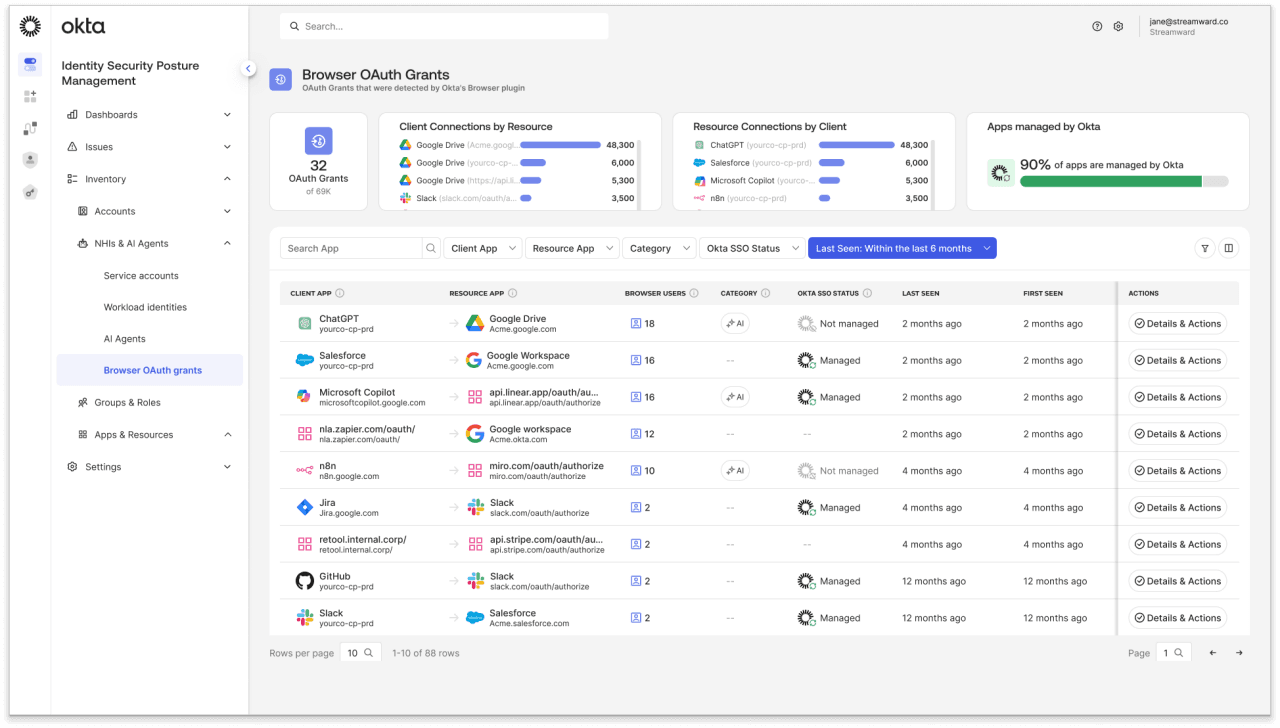
Continuous agent discovery: Finds known and unknown agents across the environment and shows what they can access and where they introduce risk.
Shadow AI detection through consent grants: Surfaces agents connecting directly to applications outside standard security review by detecting OAuth consent grants.
Centralized agent and MCP server registry: Registers agents and MCP servers wherever they were built and assigns a human owner for accountability.
Short-lived credentials: Replaces long-lived tokens with temporary credentials as agents connect to resources, with least-privilege policies applied to critical systems and data.
Agent Gateway for tool calls: Puts identity in the path of agent tool calls, verifying the agent, controlling what it can reach, holding the credentials, and logging each call without code changes to agents or tools.
Lifecycle governance and kill switch: Applies automated governance workflows and can revoke access for agents behaving unexpectedly, backed by a full audit trail.
Limitations (as reported by users on G2): G2 lists reviews for the wider Okta identity platform rather than the AI agent module specifically.
Pricing and add-on structure: Costs rise as users and capabilities are added, and several features are sold as separate modules rather than part of the core package.
Admin console learning curve: Advanced policy configuration and complex integrations require time and technical expertise before administrators are confident.
Troubleshooting visibility: Logs can be difficult to interpret, and diagnosing authentication or policy interactions is often time-consuming.
Custom and legacy integrations: Applications outside the prebuilt catalog frequently take more effort than expected to connect and maintain.
Governance depth: Some reviewers find governance capabilities lighter than dedicated IGA suites for highly complex, multi-condition access certifications.
Source: Okta
4. SailPoint Agent Identity Security

Best for: Governing AI agents alongside human identities
Strengths: Agent ownership, access reviews, indirect access detection
Things to consider: Complex implementation and steep administrative learning curve
SailPoint Agent Identity Security brings AI agents, the users behind them, and the tools they access into one governed view. Agents are onboarded automatically from AWS, Azure, Google Cloud, Salesforce, Microsoft Copilot Studio, and other platforms, and each is registered with a unique identity.
Each agent identity carries business and access context, which feeds certification decisions and access reviews. The capability sits inside SailPoint Identity Security Cloud, so agents are governed through the same workflows already used for human, non-employee, and machine identities.
Key features include:
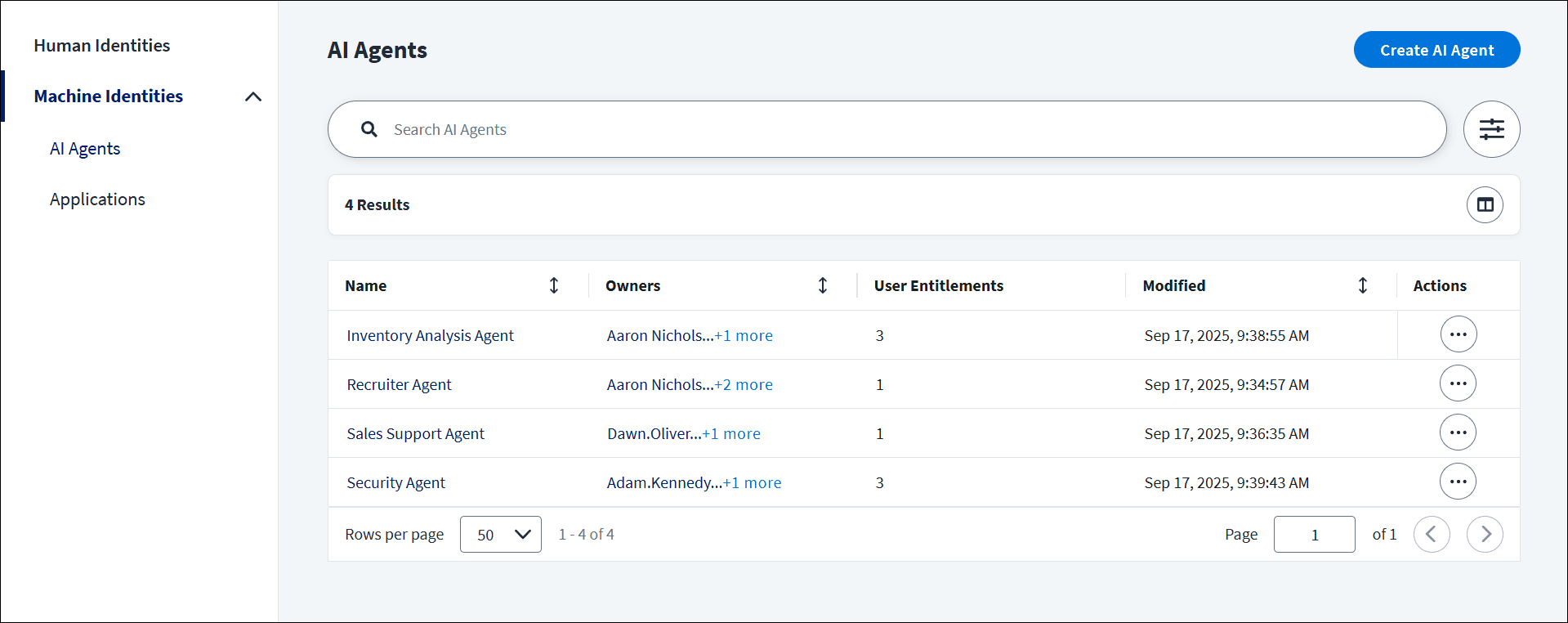
Automatic agent onboarding: Connects directly to cloud and agent platforms to aggregate AI agents into a single inventory enriched with business and access context.
Assigned agent ownership: Designates one or more human owners per agent, with automated updates and built-in succession planning so ownership survives role changes.
Agent access reviews: Reviews agent access against business need and security policy, then revokes inappropriate or excessive permissions.
Indirect access detection: Flags when human identities gain new entitlements or data access through an AI agent, covering both direct and indirect access pathways.
Shadow AI visibility: Surfaces unmonitored AI tool usage, supports remediation, and guides users toward approved alternatives.
Service account governance: Governs the service accounts each agent relies on, from creation through to retirement.
MCP server for the platform: Translates third-party agent requests into SailPoint API calls so AI-native environments operate under the same governance controls.
Limitations (as reported by users on G2):
Implementation complexity: Deployment and deep configuration have a steep learning curve and often require specialized technical expertise.
Total cost: Licensing sits at the higher end of the IGA market, and implementation, consulting, and add-on modules add further cost.
Support responsiveness: Reviewers report slow response times and frequent redirection toward paid expert services.
Customization debt: Heavy tailoring introduces technical debt that complicates upgrades and long-term maintenance.
Reporting flexibility: Built-in reporting is described as difficult to work with when pulling detailed or statistical data.
Source: SailPoint
5. Saviynt Zuma

Best for: Discovering and governing AI agents and non-human identities
Strengths: Access maps, activity timelines, runtime authorization
Things to consider: Setup can be lengthy and custom integrations need vendor help
Saviynt Zuma is an enterprise AI identity security platform for AI agents and non-human identities. It is organized into Zuma Insights, Zuma Access, and Zuma Governance, covering discovery and posture, runtime access control, and lifecycle governance across the environments where agents are built and where they run.
Discovery extends to agents, tools, MCP servers, and non-human identities, and the platform maintains a single registry enriched with risk context. Saviynt states coverage of 95% of enterprise applications and data sources, with the AI identity capabilities sitting alongside its posture management, privileged access, and application access governance products.
Key features include:
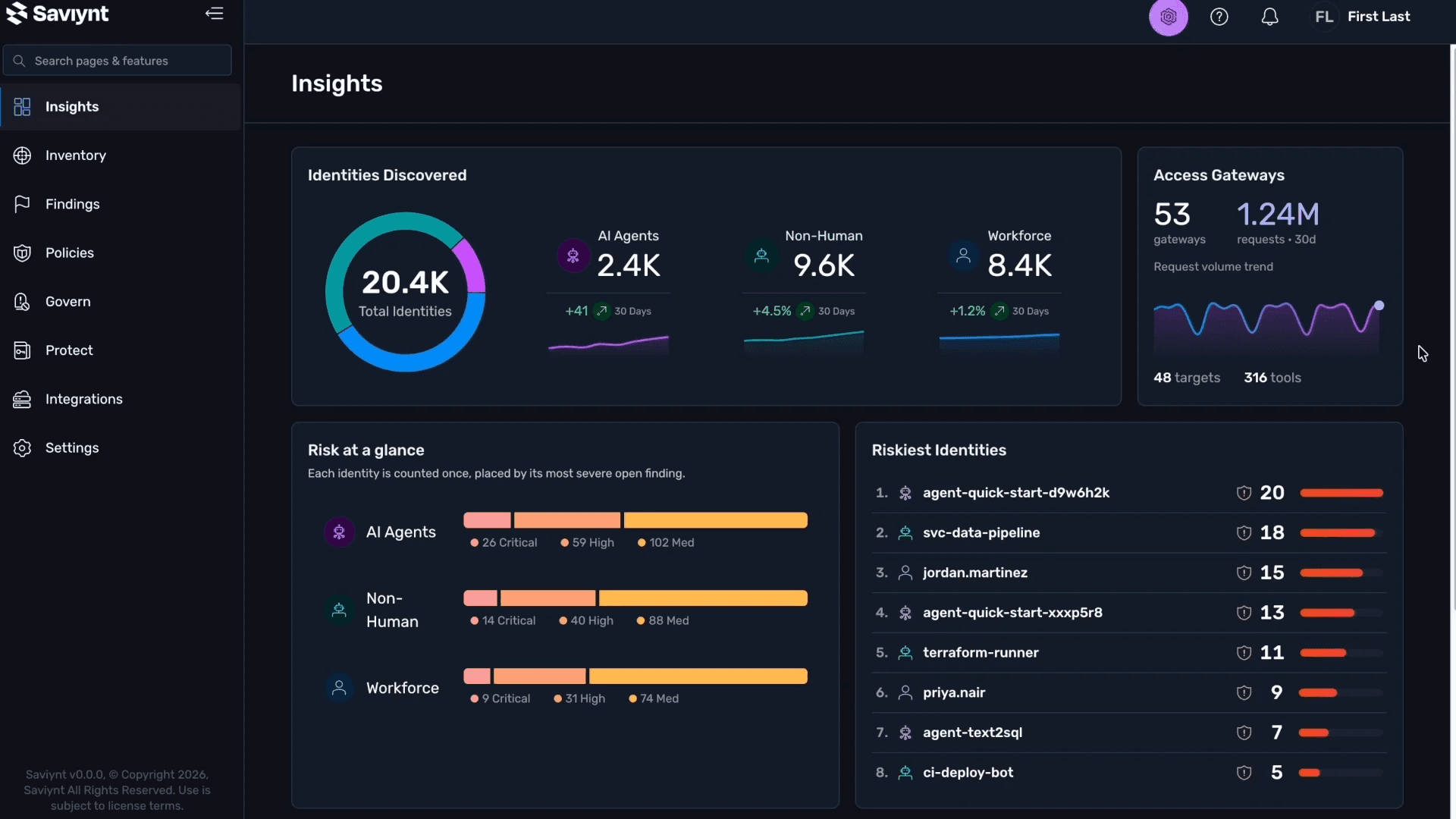
Automatic AI and NHI discovery: Finds every AI agent, tool, MCP server, and non-human identity across the ecosystem, including unsanctioned AI operating outside approval processes.
Prioritized risk insights: Continuously identifies and ranks security and governance risks by business impact so remediation work is ordered rather than arbitrary.
Access map: Traces the exact path an agent or non-human identity takes to reach critical applications, data, and tools, exposing high-risk access before it is exploited.
Timeline view: Maintains a record of every agent and non-human identity action, with a summary of each change for investigations and audit readiness.
Runtime access control: Governs what agents can touch in applications and data in real time, using intent-aware runtime authorization that evaluates the purpose behind a request rather than permission alone.
Ownership and lifecycle guardrails: Maintains continuous ownership, applies policy from registration through retirement, and offboards orphaned or inactive agents.
Limitations (as reported by users on G2): G2 lists reviews for the wider Saviynt platform rather than the Zuma product specifically.
Setup and implementation time: Initial deployment is described as complex and time-consuming.
Connector configuration: The ServiceNow connector for account and access requests is reported as difficult to configure and use.
Custom integration support: Support for custom integrations is limited, and additional plugins tend to add complexity.
Customization depth: Some reviewers describe custom capabilities as thinner than expected for intricate organizational setups.
Source: Saviynt
AI Usage Discovery and Runtime Governance Platforms
6. Palo Alto Networks AI Access Security

Best for: Discovering and controlling employee GenAI app usage
Strengths: Real-time GenAI app discovery with inline data controls
Things to consider: Complex initial setup and cost tied to the wider platform
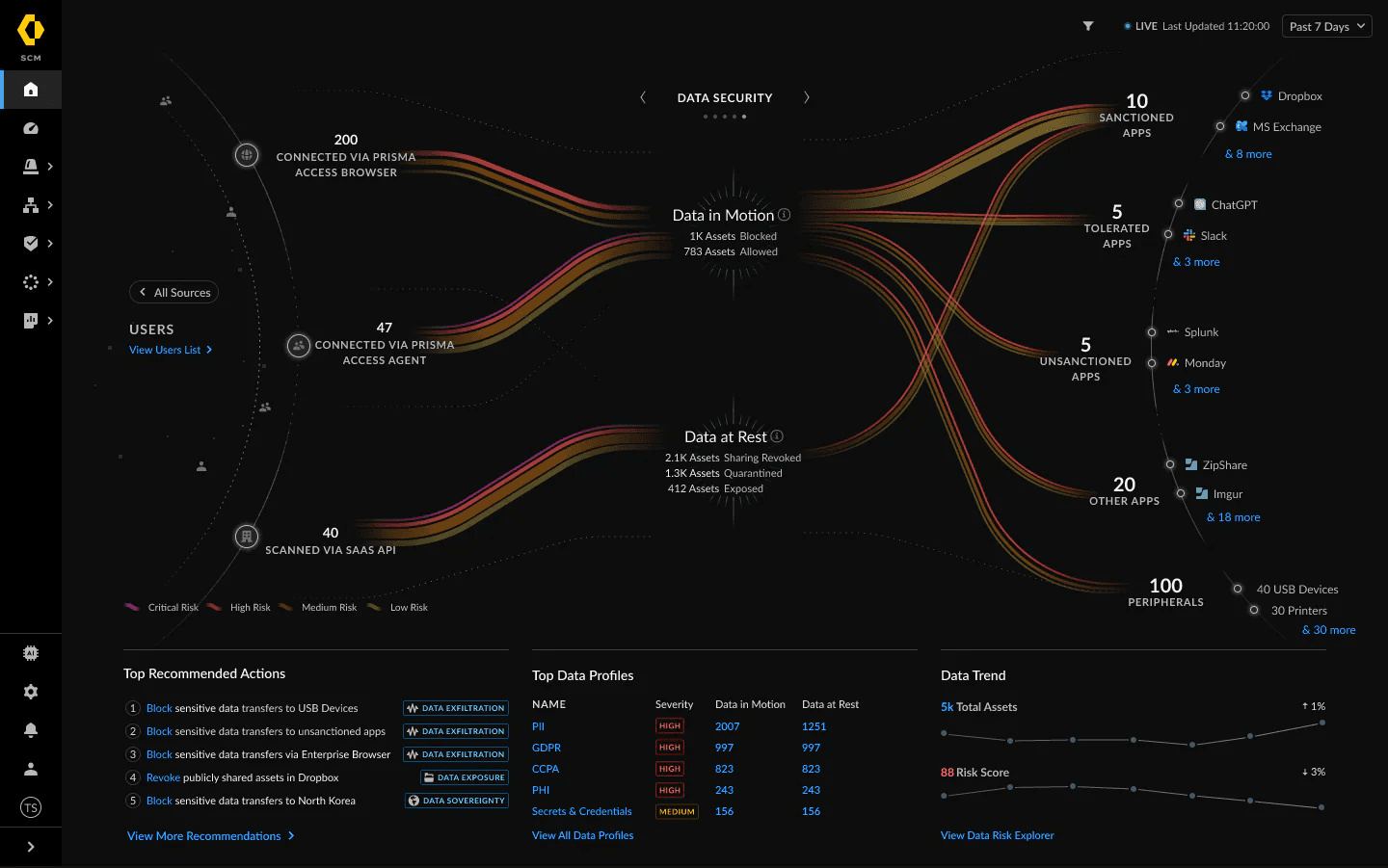
AI Access Security is the Palo Alto Networks control for employee use of generative AI applications, delivered as part of the Prisma SSE and SASE architecture. It discovers and categorizes GenAI applications, agents, and marketplace plugins, and reports in real time which apps are in use and by whom.
Palo Alto Networks cites coverage of more than 4,000 GenAI applications, over 80 GenAI-specific attributes, and more than 300 machine learning data classifiers. Policy is codified at the application category level rather than being handled app by app as new tools appear.
Key features include:
Real-time shadow AI visibility: Uses a maintained GenAI application dictionary to discover and categorize GenAI apps, agents, and marketplace plugins, then reports usage by user.
Sanctioned, tolerated, and unsanctioned classification: Groups applications into policy tiers and applies access controls, including revoking access based on privilege scope and risk factors.
Action-level controls: Applies fine-grained control over actions such as upload and download instead of allowing or blocking an application outright.
Policy recommendations from live traffic: Strata Copilot suggests access, data, and security policy changes based on observed traffic and security best practices.
In-line user coaching: Notifies employees when they attempt to reach unsanctioned GenAI apps or are about to breach AI usage policy.
Data controls for AI traffic: Combines LLM-powered classification and context-aware machine learning models with inline detection to block sensitive text and file transfers to GenAI apps.
Response inspection: Screens GenAI responses for malicious URLs and malware using Palo Alto Networks security services.
Limitations (as reported by users on G2): AI Access Security is a module of the Prisma platform, and G2 lists reviews for Prisma Access rather than the module on its own.
Complex initial setup: Onboarding and configuration are reported as time-consuming and often need specialist knowledge or vendor and partner assistance.
Learning curve: Teams unfamiliar with the Palo Alto Networks ecosystem take time to become productive.
Cost: Pricing is a recurring concern, particularly for smaller organizations.
Documentation and troubleshooting: Advanced use cases are not always covered clearly, and diagnosing issues is not always straightforward.
Source: Palo Alto Networks
7. Zenity

Best for: Governing agent actions before they execute
Strengths: Live agent inventory, posture checks, exploitability testing
Things to consider: Agent-scoped, so it complements rather than replaces IAM
Zenity is an AI agent security and governance platform built around the agent's decision rather than its prompts. The platform is organized in three layers, Surface, Enforce, and Protect, on the basis that what an agent can reach, who it acts for, and what it is trying to do never appear in a single view.
Coverage spans agentic SaaS such as Salesforce Agentforce and Copilot Studio, cloud and homegrown agents on platforms including AWS Bedrock and Google Vertex AI, and personal and coding agents running on endpoints. This compares to traditional tooling such as DLP, EDR, and CNAPP, which govern infrastructure and data flows rather than agent decision-making.
Key features include:
AI observability: Builds a live inventory of agents across SaaS, custom, and endpoint deployments and tracks the data each one touches.
AI security posture management: Evaluates agent configuration and permissions against policy before an agent goes live.
Exposure management: Validates which of an agent's attack paths are actually exploitable, scores each one, and produces a fix ready to apply in Runtime Boundaries.
Runtime boundaries: Enforces controls at the point where an agent makes a decision, so actions are evaluated before they become enterprise actions.
Agentic identity and MCP security: Covers the identity an agent acts under and the MCP servers and tools it invokes as part of the same control set.
AI detection and response: Provides detection and response for agent activity across SaaS, cloud, and endpoint environments.
Limitations (based on publicly available sources):
Enterprise-only commercial model: Pricing is not published, and evaluation starts with a demo request rather than a self-service trial.
Recently added capabilities: Exposure Management and Runtime Boundaries were introduced in mid-2026, so they have a short deployment history compared with the rest of the platform.
Agent-scoped remit: The platform is purpose-built for AI agents, so human entitlement governance and access certification still require separate identity tooling.
Platform-dependent coverage: Visibility and enforcement depend on the supported agent platforms and environments listed by the vendor.
8. WitnessAI

Best for: Network-level visibility into employee and agent AI activity
Strengths: Shadow AI discovery, intent-based policy, runtime defense
Things to consider: Network deployment needs planning; red teaming sold separately
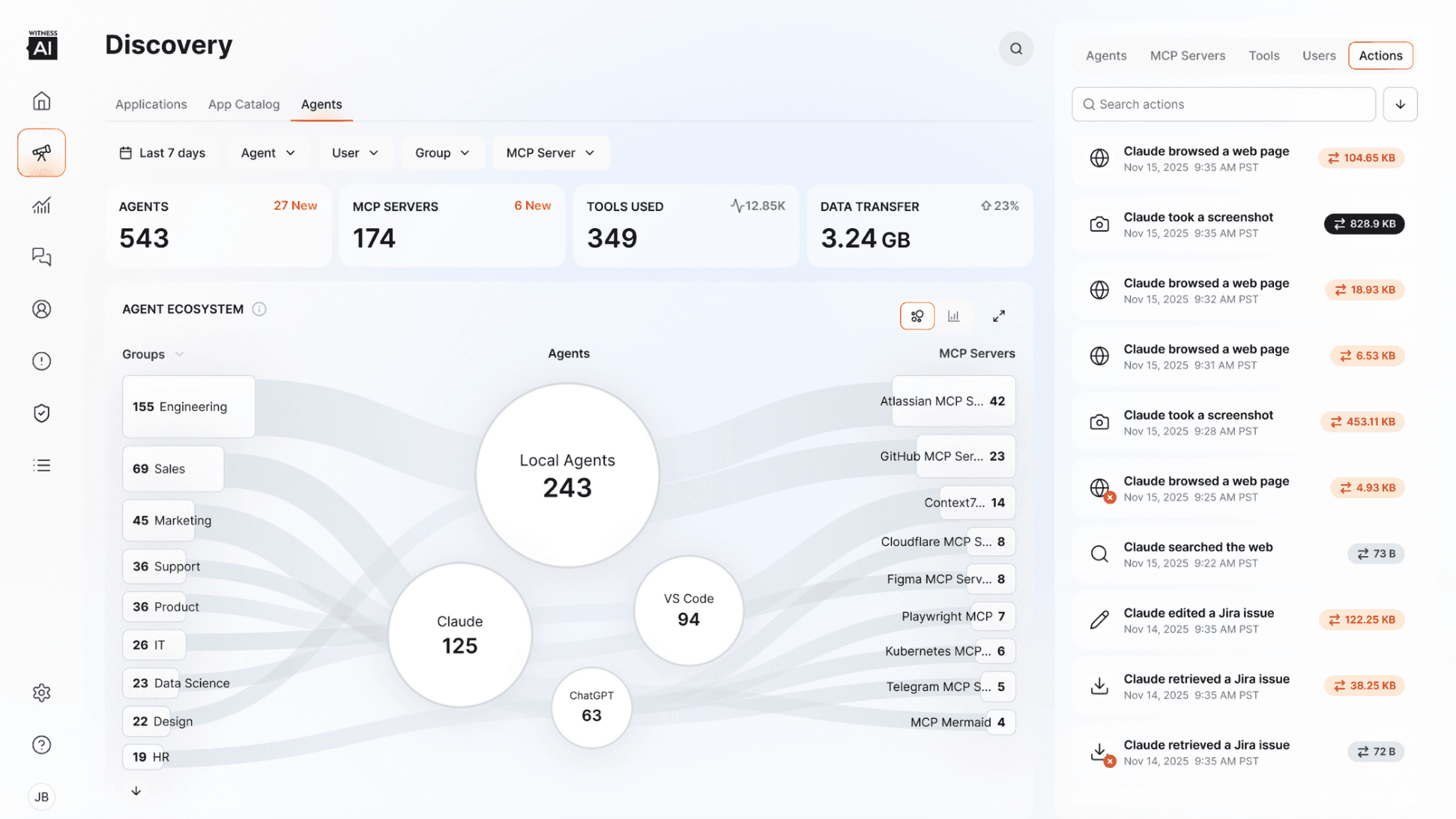
WitnessAI is an AI security and governance platform that sits at the network layer between users and AI systems. It governs human employees and AI agents through three modules, Observe, Control, and Protect, using intent-based machine learning engines that classify meaning and context rather than matching keywords.
Because it operates in the data flow rather than on endpoints, it captures AI activity without browser extensions or endpoint agents. The platform runs on a single-tenant architecture intended to keep customer data within a defined jurisdiction and under the customer's control.
Key features include:
Shadow AI discovery and inventory: Finds and catalogs AI applications, agents, and MCP servers in use, and shows which agents are running and what they connect to.
Real-time interaction visibility: Displays AI conversations, including prompts and responses, as they occur, and classifies interactions by type and intent across employees and agents.
Human-to-agent attribution: Traces autonomous agent actions back to the human identity that originated them, supporting audit and investigation.
Context-based policy enforcement: Applies policies by department, role, intent, or workforce type, and enforces the same rules consistently across employees and agents.
MCP and tool control: Restricts agents, IDEs, and agentic applications to approved MCP servers and tools.
Runtime defense: Blocks prompt injection and jailbreak attempts in both directions and filters harmful responses before users see them or agents act on them.
Real-time redaction: Detects and masks sensitive data in AI traffic and maintains granular audit trails for compliance reporting.
Limitations (based on publicly available sources):
Network deployment planning: Organizations with complex distributed network environments may need additional architectural work before rollout.
Red teaming sold separately: Automated AI red teaming is offered as a separate product rather than a built-in core module.
Breadth beyond narrow needs: Teams that only require basic shadow AI discovery may find the full Observe, Control, and Protect platform broader than necessary.
Custom enterprise pricing: Pricing is quote-based and procurement requires direct sales engagement.
Thin independent review base: Verified reviews across the main software review platforms remain limited, so third-party feedback is sparse.
Source: WitnessAI
Conclusion
AI access control increasingly requires continuous visibility into both identities and behavior. Organizations need to know which AI applications and agents exist, what identities and permissions they use, which resources they can reach, and how they act at runtime. Platforms that combine discovery, identity mapping, activity monitoring, access reviews, policy enforcement, and audit evidence can help reduce shadow AI, excessive privilege, toxic access combinations, and unmanaged agent activity as enterprise AI adoption grows.