What is Identity and Access Management (IAM)?
Identity and Access Management (IAM) is an IT discipline focused on managing digital identities and controlling user access to resources. IAM systems ensure that only authorized individuals and entities can access specific systems, data, and applications, using mechanisms such as authentication, authorization, and auditing.
Identity and Access Management (IAM) best practices focus on minimizing access scope, enforcing strong authentication, and maintaining visibility. Core strategies include enforcing the principle of least privilege, making Multi-Factor Authentication (MFA) universal, and regularly auditing permissions.
IAM best practices at a glance:
The following table summarizes IAM security best practices. We explore each best practice in more detail below.
Category | Best Practice | Why It Matters | Action Items |
IAM Foundation & Governance | Establish IAM governance and policies | Creates accountability and consistent identity management | Define IAM ownership, policies, and review processes |
IAM Foundation & Governance | Build a complete identity inventory | Improves visibility across human and non-human identities | Discover, document, and continuously update all identities |
IAM Foundation & Governance | Improve compliance and audit readiness | Supports regulatory compliance and reduces audit effort | Perform access reviews, enforce SoD, maintain audit trails |
Access Control & Authorization | Enforce least privilege | Reduces attack surface and limits excessive access | Default to minimal access, review and remove unused permissions |
Access Control & Authorization | Use RBAC and ABAC | Simplifies administration while enabling context-aware access | Define roles and enforce attribute-based policies |
Access Control & Authorization | Automate access reviews | Improves review quality and prioritizes risky access | Use analytics, usage data, and risk-based certifications |
Authentication & Identity Risk | Strengthen authentication | Protects against credential theft and phishing | Enforce MFA and deploy phishing-resistant authentication |
Authentication & Identity Risk | Adopt Zero Trust | Continuously validates users and devices before granting access | Verify identity, device health, and risk for every request |
Authentication & Identity Risk | Monitor identity risk continuously | Detects excessive privileges and suspicious activity earlier | Continuously monitor, prioritize, and remediate identity risks |
Identity Lifecycle & Privileged Access | Automate provisioning and deprovisioning | Keeps access aligned with workforce changes | Integrate HRIS with IAM and automate JML processes |
Identity Lifecycle & Privileged Access | Secure privileged access | Limits the impact of compromised administrator accounts | Use PAM, MFA, just-in-time access, and session monitoring |
Identity Lifecycle & Privileged Access | Govern non-human identities | Reduces risk from service accounts, APIs, and AI agents | Apply lifecycle management, least privilege, and credential rotation |
Identity Lifecycle & Privileged Access | Manage cloud IAM and workloads | Controls permissions across cloud environments | Enforce least privilege, monitor permissions, and use CIEM/CSPM |
Why IAM Best Practices Matter
IAM best practices provide a structured approach to managing identities and access rights in a secure and consistent way. As organizations adopt cloud services, remote work, and interconnected applications, the number of identities and access points grows significantly. Following established IAM practices helps reduce security risks, improve visibility, and ensure users have the appropriate level of access throughout their lifecycle.
Reduce the risk of unauthorized access: Implementing strong authentication, least privilege access, and regular access reviews helps prevent unauthorized users from accessing sensitive systems and data.
Support regulatory compliance: Many regulations require organizations to control and monitor access to protected information. IAM best practices help meet requirements for auditing, reporting, and access governance.
Improve identity lifecycle management: Automated provisioning and deprovisioning ensure that user accounts are created, updated, and removed as employees, contractors, and partners change roles or leave the organization.
Strengthen security across hybrid environments: Consistent IAM controls can be applied across on-premises systems, cloud platforms, and software-as-a-service (SaaS) applications, reducing security gaps between environments.
Enhance user experience: Features such as single sign-on (SSO) and self-service password management simplify access for users while maintaining security requirements.
Limit the impact of insider threats: Role-based access controls, segregation of duties, and continuous monitoring help reduce the risk of misuse of privileged access.
Increase operational efficiency: Automating access requests, approvals, and reviews reduces administrative workload and minimizes errors associated with manual processes.
Provide better visibility and auditability: Centralized identity management allows organizations to track who accessed specific resources, when access occurred, and whether access aligns with established policies.
Enable scalable access management: As organizations grow, IAM best practices provide a framework for managing increasing numbers of users, applications, devices, and service accounts without losing control over access permissions.
Why Traditional IAM Approaches Are Breaking Down
Many organizations built their identity and access management programs around centralized directories, manual approval processes, and periodic access reviews. While these approaches worked in relatively stable IT environments, they struggled to keep pace with today's cloud-first, highly distributed infrastructure. As identities, applications, and machine accounts multiply, traditional IAM models often create security gaps, operational bottlenecks, and governance challenges.
Manual processes do not scale across SaaS and cloud environments: Organizations may manage hundreds or thousands of applications across multiple cloud providers and SaaS platforms. Manual provisioning, access approvals, and permission updates become difficult to maintain at this scale, increasing the likelihood of delays, inconsistencies, and human error.
Static role-based access control (RBAC) struggles in dynamic environments: Traditional RBAC models rely on predefined roles that often fail to reflect rapidly changing business needs. Users frequently accumulate additional permissions over time, creating role sprawl and making it difficult to enforce least-privilege access.
Non-human identities are growing faster than governance programs: Service accounts, API keys, bots, workloads, and machine identities now outnumber human users in many organizations. Traditional IAM programs were designed primarily for employees and contractors, leaving many non-human identities with excessive privileges, poor visibility, or weak lifecycle management.
Periodic reviews leave long security gaps between audits: Many organizations still perform access certifications quarterly or annually. In modern environments, permissions can change daily. Risky access combinations, dormant accounts, and excessive privileges may remain undetected for months between review cycles.
Cloud and hybrid environments increase complexity: Users often require access across on-premises systems, cloud platforms, SaaS applications, and third-party services. Managing identities and permissions across disconnected systems creates inconsistencies and makes centralized governance more difficult.
Privilege accumulation creates long-term risk: As employees change roles, access rights are frequently added but not removed. Over time, users may accumulate permissions that exceed their current responsibilities, expanding the potential impact of compromised accounts or insider threats.
These challenges are driving organizations toward more automated, continuous, and risk-aware IAM approaches that can adapt to modern identity ecosystems and provide stronger control over both human and non-human access.
Related content: Learn how an identity fabric can unify identity data across disconnected systems.
Top Identity and Access Management Best Practices
IAM Foundation and Governance
1. Identity and Access Management Best Practices
Establishing a strong IAM foundation starts with clear governance, policies, and ownership. Organizations must define roles and responsibilities for IAM management, ensuring accountability at every level. A centralized IAM policy should outline acceptable use, authentication requirements, access approval workflows, and incident response procedures. Regular policy reviews help keep IAM aligned with business needs and regulatory changes.
Organizations should ensure executive sponsorship and cross-functional collaboration, bringing together IT, security, HR, and compliance teams. This governance structure supports consistent implementation and adherence to standards. Clear documentation of IAM processes and controls supports audits and helps address gaps. Training ensures stakeholders understand their roles and can respond to identity-related incidents.
2. Build a Complete Identity Inventory
A complete identity inventory is the foundation of effective IAM. Organizations cannot govern, secure, or audit identities they do not know exist. The inventory should include all human and non-human identities (NHIs) across the environment, including employees, contractors, partners, service accounts, API keys, OAuth tokens, applications, workloads, bots, and AI agents. Every identity should have a documented owner, defined purpose, associated permissions, and lifecycle status.
Many organizations significantly underestimate the number of non-human identities in their environments. Industry experience shows that NHIs often outnumber human identities by a factor of three to five, yet many IAM programs remain focused primarily on workforce users. As cloud services, automation platforms, microservices, and AI systems expand, unmanaged machine identities can become one of the largest sources of access risk.
The inventory should be continuously updated rather than treated as a periodic audit exercise. Automated discovery tools can identify new accounts, credentials, service principals, API integrations, and AI agents as they are created. Integrating identity data from directories, cloud platforms, SaaS applications, and infrastructure systems helps maintain a centralized and accurate view of the identity ecosystem.
3. Improve IAM Compliance and Audit Readiness
Effective IAM programs play a central role in meeting regulatory and audit requirements. Organizations must be able to demonstrate that access to systems and data is appropriately controlled, reviewed, and monitored. IAM controls support compliance with regulations and frameworks such as SOX, HIPAA, PCI DSS, GDPR, ISO 27001, and NIST by providing evidence of who has access, why access was granted, and how access is governed throughout its lifecycle.
Regular access reviews and certifications help validate that users maintain only the permissions required for their current responsibilities. Organizations should document approval workflows, access changes, and deprovisioning activities to create a clear audit trail. Centralized reporting simplifies the process of demonstrating compliance and responding to auditor requests.
Segregation of duties (SoD) controls should be implemented to prevent individuals from accumulating conflicting permissions that could enable fraud, unauthorized transactions, or policy violations. Organizations should continuously monitor for toxic access combinations, such as the ability to both create and approve financial transactions or modify and audit security controls. Automated SoD analysis helps identify violations early and supports remediation before they become compliance issues.
Access Control and Authorization
4. Enforce Least Privilege Access
Least privilege is one of the most important principles in IAM. Users, applications, service accounts, and AI agents should receive only the minimum access required to perform authorized tasks. Organizations should treat access as an exception rather than a birthright, defaulting to zero standing access whenever possible. Additional permissions should be granted only upon request, with appropriate business context, approval, and, where practical, automatic expiration dates.
Role-based provisioning should be driven by authoritative workforce data. Human resources information systems (HRIS) should serve as the source of truth for joiner events, job roles, and organizational structure, enabling IAM platforms to automatically assign baseline access during onboarding. This improves consistency, reduces manual effort, and helps ensure users receive appropriate access from day one.
Least privilege must be continuously maintained, not just established at onboarding. Regular access reviews, combined with usage telemetry such as last-used and access frequency data, help identify dormant, excessive, or unnecessary permissions. Removing unused access reduces risk, strengthens compliance, and limits the impact of compromised accounts across both human and non-human identities.
5. Use Role-Based and Attribute-Based Access Controls
Role-based access control (RBAC) simplifies access management by assigning permissions based on job roles, ensuring consistency and reducing administrative overhead. Roles should be well-defined, regularly reviewed, and mapped to organizational functions. Attribute-based access control (ABAC) uses contextual attributes such as location, device type, or time of day to refine access decisions and support dynamic security policies.
Combining RBAC and ABAC enables organizations to address complex access requirements, particularly in environments with diverse users and resources. Automated policy engines can evaluate attributes in real time, granting or denying access based on policy logic. This approach maintains control over sensitive data and systems.
6. Automate Access Reviews and Certifications
Traditional access reviews often require managers and application owners to manually certify long lists of permissions on a quarterly or annual basis. This approach is time-consuming, produces inconsistent results, and frequently leads to rubber-stamp approvals. Modern IAM programs should automate access reviews and focus reviewer attention on the permissions that present the greatest risk.
Reviews should be driven by peer-group analytics, anomaly detection, and usage data rather than static access lists alone. Comparing a user's entitlements to others with similar roles can help identify outliers, while last-used and access frequency data provide evidence of whether permissions remain necessary. Access that has not been used for extended periods, falls outside normal peer-group patterns, or creates elevated risk should be flagged for review and remediation.
Organizations should prioritize high-risk entitlements such as privileged access, sensitive data access, segregation-of-duties violations, and critical system permissions. Low-risk, commonly assigned, and well-governed access can often be automatically approved, renewed, or removed based on predefined policies. This risk-based approach reduces review fatigue, improves decision quality, and enables faster remediation of the access that matters most.
Authentication, Zero Trust, and Identity Risk
7. Strengthen Authentication with MFA and Phishing-Resistant Controls
Multi-factor authentication (MFA) protects accounts from credential theft and unauthorized access. Implementing MFA adds a layer of security by requiring users to verify their identity through additional factors such as biometrics, hardware tokens, or mobile push notifications. MFA should be enforced for all users, especially those with privileged access or remote connectivity.
Phishing-resistant authentication methods, such as FIDO2 security keys or certificate-based authentication, offer stronger protection against common attack vectors. These methods reduce reliance on passwords, which are often targeted in phishing campaigns. Organizations should prioritize deploying phishing-resistant controls for high-risk users and applications.
8. Adopt Zero Trust Access Principles
Zero trust is a security model that assumes no user or device is inherently trusted, regardless of location or network segment. Adopting zero trust principles requires continuous verification of identity, device health, and user context before granting access to resources. Access decisions are dynamic and risk-aware, based on real-time signals and policy enforcement.
Zero trust frameworks integrate with IAM solutions to enforce strong authentication, least privilege, and micro-segmentation. Organizations should implement network and application segmentation, monitor user behavior, and apply adaptive policies that respond to changing risk levels. This approach limits lateral movement within networks and reduces the impact of breaches.
9. Monitor Identity Risk Continuously
Continuous monitoring helps organizations identify risky access before it leads to security incidents or compliance violations. Because permissions, roles, and identity relationships change constantly, point-in-time reviews are no longer sufficient. Organizations should continuously evaluate both human and non-human identities for excessive privileges, dormant access, segregation-of-duties violations, credential exposure, and unusual behavior across cloud, SaaS, on-premises, and AI-driven environments.
Modern identity risk programs should use peer-group analytics to identify outlier access that differs significantly from users with similar roles and responsibilities. Anomaly detection can help uncover unusual authentication activity, privilege use, access patterns, and behavioral changes that may indicate compromised accounts, insider threats, or misconfigured permissions. High-risk entitlements should be automatically classified and prioritized based on factors such as privilege level, data sensitivity, business criticality, and toxic access combinations.
Continuous monitoring only delivers value when it is connected to remediation. Organizations should adopt a closed-loop approach in which detected risks trigger corrective actions such as access reviews, approval workflows, privilege reductions, credential rotation, or automatic access removal. By linking risk detection directly to remediation, security teams can reduce exposure more quickly and ensure that identity risks are not simply identified and reported, but actively resolved.
Identity Lifecycle, Privileged Access, and Machine Identities
10. Automate User Provisioning and Deprovisioning
Automating provisioning and deprovisioning helps ensure that access rights remain aligned with workforce changes while reducing administrative effort and security risk. Organizations should use their human resources information system (HRIS) as the authoritative source for joiner, mover, and leaver (JML) events. When integrated with IAM platforms, HRIS data can automatically trigger account creation, role-based access assignments, permission updates, and access removal based on changes in employment status, job function, or organizational structure.
Automated provisioning improves onboarding by ensuring users receive the appropriate baseline access on their first day, while automated mover processes help prevent privilege accumulation as employees change roles. Access decisions should be based on approved role models, business rules, and governance policies rather than manual requests whenever possible.
Deprovisioning is particularly critical because former employees, contractors, and third parties often retain access longer than intended. Mean time to deprovision (MTTD) should be tracked as a key IAM risk metric, as standing access after offboarding remains one of the most common audit findings and a frequent source of security exposure. Organizations should automatically disable accounts, revoke application access, terminate active sessions, remove group memberships, and rotate or revoke associated credentials as soon as a termination event is received. Continuous monitoring can help identify orphaned accounts and residual access that may persist after the deprovisioning process is complete.
11. Secure Privileged Access
Privileged accounts pose a significant risk if compromised, as they can provide broad access to critical systems. Securing privileged access starts with minimizing the number of privileged accounts and enforcing strong authentication, such as MFA or hardware tokens. Privileged access management (PAM) solutions can vault credentials, enforce session recording, and provide just-in-time access to sensitive resources.
Regular monitoring and auditing of privileged activity are necessary for detecting misuse and ensuring accountability. Organizations should implement granular controls to restrict privileged actions, use approval workflows for high-risk tasks, and rotate credentials frequently.
12. Govern Non-Human Identities
Non-human identities (NHIs) have become one of the fastest-growing areas of IAM. Service accounts, API keys, OAuth tokens, applications, workloads, automation tools, and AI agents now perform many business and operational functions. In many organizations, these identities outnumber human users by several times, making them a critical part of the identity security program.
Organizations should govern NHIs with the same lifecycle controls applied to human identities. Every non-human identity should have a documented owner, a defined business purpose, approved access scope, and clear creation and retirement processes. AI agents should be treated as a distinct identity category, with assigned ownership, documented permissions, and oversight of the systems and data they can access.
Least privilege principles should apply equally to machine identities. Service accounts, API credentials, and AI agents should receive only the permissions required to perform their intended functions. Credentials should be centrally managed, securely stored, and regularly rotated, with a preference for short-lived credentials where possible.
13. Manage Cloud IAM and Workload Permissions
Cloud environments introduce dynamic resources, distributed workloads, and multiple identity providers, making access management more complex. Organizations should implement centralized cloud IAM policies that govern users, service accounts, containers, serverless functions, and other workloads across cloud platforms. Permissions should be assigned using predefined roles and least privilege principles, avoiding overly broad administrative access. Regular reviews of cloud roles, policies, and trust relationships help identify excessive permissions and reduce the risk of unauthorized access.
Workload identities should be managed separately from human identities and protected through strong authentication mechanisms, short-lived credentials, and automated secret rotation. Organizations should monitor cloud activity logs and permission changes to detect misconfigurations or suspicious behavior. Cloud security posture management (CSPM) and cloud infrastructure entitlement management (CIEM) tools can help identify permission risks, enforce governance policies, and maintain visibility into access across multi-cloud and hybrid environments. Applying consistent IAM controls to cloud resources and workloads reduces attack surfaces and improves overall security.
How Opti Helps You Put IAM Best Practices Into Action
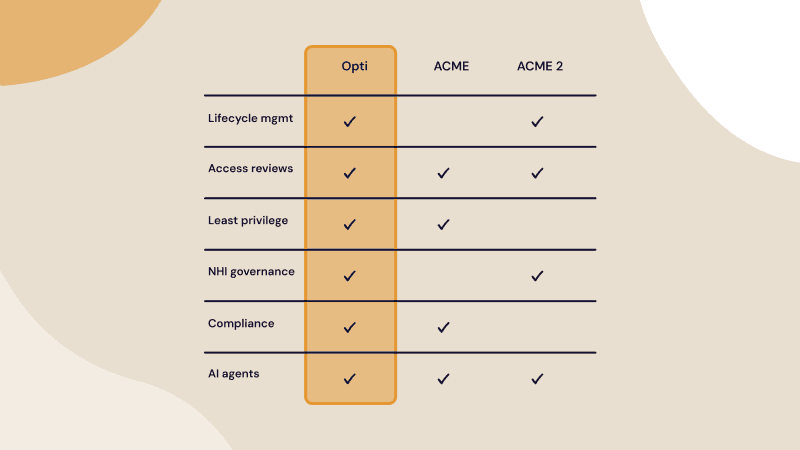
Opti is an AI-native identity security platform that revolutionizes how modern teams define, protect, and govern identities. Rather than relying on manual processes, rubber-stamped access, and periodic reviews, Opti applies AI models purpose-built for IAM through a context-aware engine that continuously analyzes access behavior and risk across every identity and application. This gives security teams the speed and intelligence to enforce the best practices above, from least privilege and continuous monitoring to lifecycle automation and audit readiness, without adding operational overhead.
Key capabilities of Opti:
Complete identity visibility: Opti's AI-powered identity fabric ingests, normalizes, and analyzes all identities, human, non-human, and agentic, across every application, giving teams the unprecedented visibility needed to build and maintain a complete identity inventory.
Risk detection and remediation: Specialized entitlement models understand and analyze the wide context to discover risky access and excessive privileges, while an identity workflow engine builds tailored, automated policies and remediation plans that transform identity risks into resolved outcomes, rather than just flagging them.
Smarter lifecycle and governance: Rich analytics fuse intelligence into lifecycle and governance processes and enhance joiner-mover-leaver (JML) workflows, replacing guesswork and rubber-stamping with AI-driven recommendations and automation, with or without an existing IGA.
Streamlined compliance and audit readiness: Opti continuously aggregates identity, access, and entitlement data and maps it to roles, policies, and usage, so audits become more streamlined and actionable instead of a fire drill.
Broad integration and fast deployment: Opti deploys in hours and integrates with over 250 tools, from IdP to IGA and everything in between, and its AI engine can even understand and support homegrown applications for consistent controls across the environment.
Ready to operationalize these IAM best practices with AI? Discover the Opti AI-native IAM platform.