What Is Access Management?
Access management is a security practice that focuses on controlling and monitoring access to data, resources, and systems within an organization. It helps make sure that only explicitly authorized individuals have appropriate permissions to access specific information or perform certain tasks.
Access management typically involves user authentication, role-based access control, and the enforcement of access policies. By implementing an effective access management system, organizations can reduce unauthorized access risks, data breaches.
Here is how access management works:
Authentication: Verifies a user's identity using passwords, biometrics, passkeys, or multi-factor authentication before granting access.
Authorization: Determines which applications, data, and resources an authenticated user is permitted to access.
Access control: Enforces authorization decisions by granting or denying access based on policies, roles, or attributes.
User management: Creates, updates, and removes user accounts while maintaining roles, permissions, and account policies.
Preventing unauthorized access: Uses measures such as MFA, monitoring, and behavioral analysis to detect and block suspicious activity.
Common access management methods and protocols include:
Role-based access control (RBAC): Grants permissions based on predefined job roles to simplify access management.
Attribute-based access control (ABAC): Makes access decisions using user, resource, and environmental attributes for fine-grained control.
Policy-based access control (PBAC): Evaluates organizational policies to determine whether access requests should be approved.
Single sign-on (SSO): Lets users access multiple applications with one authenticated login session.
OAuth: Delegates limited access to third-party applications without exposing user credentials.
OpenID Connect (OIDC): Adds user authentication and identity verification on top of the OAuth 2.0 framework.
Lightweight Directory Access Protocol (LDAP): Authenticates users and retrieves identity information from directory services.
Security Assertion Markup Language (SAML): Exchanges authentication and authorization data to enable enterprise single sign-on.
Web Authentication API (WebAuthn): Supports passwordless authentication using public-key cryptography and trusted authenticators.
Why Is Access Management Important?
Access management is important for several reasons. Here are a few:
Security: Access management is critical for maintaining the security and integrity of an organization’s resources and information. By controlling access to resources and information, organizations can minimize data breach risks, protect confidential and sensitive information, and ensure that resources are being used appropriately.
Operational efficiency: Access management helps organizations manage user accounts and permissions more efficiently, while also reducing the risk of errors or inconsistencies that can arise from manual processes. This can help organizations save time and resources, and minimize the risk of data breaches caused by human error.
Collaboration: Access management can help organizations facilitate collaboration and information sharing between users, while still maintaining appropriate access controls. By managing user accounts and permissions, organizations can ensure that users have access to the resources they need to perform their jobs, without compromising security or data privacy.
Compliance: Many industries and organizations are subject to regulatory requirements, such as HIPAA or GDPR, that mandate strict access controls and data protection. Access management helps organizations comply with these regulations and avoid potential legal or financial penalties.
Access Management Security Risks
Here are the main risks associated with improper access management.
Misconfiguration Issues
Misconfigurations are improper settings or incorrect configurations within systems, applications, or network devices, often resulting from human error or a lack of understanding of best practices. They pose a significant problem for security controls because they can create vulnerabilities, allowing attackers to bypass security measures, gain unauthorized access, and compromise sensitive data.
Misconfigurations can lead to data breaches, system downtime, and reputational damage. Regular security audits, automated configuration management, and employee training help mitigate the risks associated with misconfigurations.
Learn more in our detailed guide to security misconfiguration
External Data Sharing
Sharing data externally through the cloud presents a security risk because it increases potential exposure to cyber threats. Storing data on remote servers operated by third-party providers can make it more susceptible to unauthorized access, data breaches, and cyberattacks.
Additionally, data transmitted between users and cloud services might be intercepted or tampered with during transit. To mitigate these risks, organizations must implement robust security measures like encryption, access control, and continuous monitoring of cloud-based resources.
Excessive Access Permissions
Excessive access permissions refer to granting users more access rights to systems, resources, or data than they actually need to perform their job duties. These overly permissive access rights can increase security risks and insider threats. To minimize risks, organizations should follow the principle of least privilege, which limits user permissions to the minimum necessary for their specific roles and responsibilities.
Inadequate Visibility
Insufficient visibility over access is a problem because it makes it difficult for organizations to effectively monitor and control user access to resources, systems, and data. Without proper visibility, detecting unauthorized access, policy violations, and potential security threats becomes challenging.
This can lead to increased risks of data breaches, insider threats, and compliance issues. Adequate visibility in access management is crucial for implementing proactive security measures, ensuring policy adherence, and maintaining a strong security posture.
Non-Human Identities (NHI)
Non-human identities (NHIs) include service accounts, application identities, API keys, machine identities, containers, workloads, bots, and IoT devices that authenticate to systems without direct human involvement. In many organizations, NHIs outnumber human users by a large margin and often have broad, persistent permissions. Because they frequently operate in the background and are not tied to an individual employee, they can be difficult to inventory, monitor, and govern. Unused service accounts, long-lived secrets, and unmanaged machine credentials can provide attackers with an effective path to sensitive systems.
Managing NHIs requires the same level of governance applied to human identities. Organizations should maintain an inventory of machine identities, rotate secrets and certificates regularly, eliminate unused accounts, and grant only the minimum permissions required for each workload. Using short-lived credentials, workload identities, centralized secret management, and continuous monitoring helps reduce the risk of credential theft, privilege escalation, and unauthorized access while improving visibility into machine-to-machine activity.
Agentic Identities
Agentic identities are identities used by AI agents that can independently perform tasks, make decisions, and interact with applications, APIs, and infrastructure on behalf of users or organizations. Unlike traditional service accounts, AI agents often access multiple systems, retrieve sensitive data, invoke tools, and execute workflows with limited human involvement. As organizations deploy more autonomous AI systems, the number of agentic identities is expected to grow rapidly, creating new challenges for access management. If these identities receive excessive privileges or are not properly monitored, they can become a high-value target for attackers.
Organizations should manage agentic identities using the same security principles applied to privileged human and machine identities. AI agents should be assigned unique identities, granted least-privilege access, and authenticated using short-lived credentials rather than long-lived secrets whenever possible. Their actions should be continuously logged, monitored, and audited to detect misuse or unexpected behavior.
Employee Offboarding
Offboarding employees can present a security threat if their access to systems, resources, and data is not properly revoked or managed. Inadequate offboarding processes may leave dormant accounts and access privileges, which can be exploited by malicious actors or former employees with malicious intent.
These security risks can lead to data breaches, unauthorized access, or intellectual property theft. Proper offboarding procedures, including timely deactivation of accounts and access removal, are essential for maintaining a secure environment.
Third Party Risk Management
Third-party vendors, contractors, and partners often require access to an organization’s systems, data, or networks. However, their security practices may not align with the organization’s standards, creating potential vulnerabilities. If a third party is compromised, attackers can exploit their access to infiltrate the organization’s systems, leading to data breaches or operational disruptions.
Additionally, organizations may have limited visibility into third-party access and activities, making it difficult to detect unauthorized use or policy violations. Weak security controls among third parties can also expose sensitive information, increasing the risk of compliance failures and regulatory penalties.
Learn more about third party risk management.
Account Takeover
Account takeover occurs when attackers gain unauthorized access to a user’s account, often through stolen credentials, phishing, or brute-force attacks. Once inside, they can manipulate data, access sensitive information, or escalate privileges to further infiltrate systems.
This type of attack is difficult to detect because threat actors often mimic legitimate user behavior, allowing them to operate unnoticed for extended periods. Account takeovers can lead to data breaches, financial fraud, and disruption of business operations, posing significant security and compliance risks.
Privileged Access
Privileged access can pose significant risks for access management in an organization:
Increased risk of data breaches: Privileged users often have access to sensitive information, systems, and applications, and therefore pose a greater risk of data breaches if their access is not properly managed. If a privileged user’s account is compromised, the attacker can gain access to sensitive information and systems, potentially leading to data loss, financial loss, and reputational damage.
Insider threats: Privileged users may be more likely to engage in malicious activity because of their access to sensitive resources. This could include stealing confidential information, altering data, or causing damage to systems. Proper access management is necessary to prevent such insider threats.
Difficulty in managing access: Managing privileged access can be challenging, as there are often multiple users with varying levels of access, and access controls may need to be frequently updated. It can be difficult to track who has access to what resources and to manage access changes effectively.
Improper Role Design
Improper role design can create significant risks for access management in an organization. Here are a few examples:
Over-privileged access: Improper role design can lead to over-privileged access, where users have more access than they need to perform their job duties. This can create a significant risk of data breaches, as users with excessive access may be able to access sensitive information or systems that they should not have access to.
Under-privileged access: On the other hand, improper provisioning can lead to under-privileged access, where users do not have the access they need to perform their job duties. This can lead to a lack of productivity, frustration among employees, and delays in critical business processes.
Compliance violations: Improper role design or provisioning can lead to compliance violations, where access controls don’t meet regulatory requirements, such as GDPR, CCPA, and HIPAA. Compliance violations can lead to legal and financial consequences for the organization.
How an Access Management System Works
Access management is a process that involves several key steps:
Authentication
Authentication is the process of verifying the identity of a user, typically through a username and password, or through more advanced methods such as biometrics or multi-factor authentication. The goal of authentication is to ensure that the users are who they claim to be, and to prevent unauthorized access.
Authorization
Authorization is the process of determining what resources and information a user is authorized to access, based on their role, permissions, and access levels. This involves checking the user’s credentials against a database of authorized users, and verifying that the user has the necessary permissions to access the requested resources.
Access Control
Access control is the process of granting or denying access to resources and information based on the user’s authorization. Access control mechanisms may include access control lists (ACLs), role-based access control (RBAC), or attribute-based access control (ABAC). Access control ensures that users are only granted access to resources that they are authorized to access.
User Management
User management involves creating, modifying, and deleting user accounts, and managing user attributes such as roles, permissions, and access levels. User management also involves enforcing policies for password management, account lockout, and user account maintenance.
Preventing Unauthorized Access
There are several ways to prevent unwanted access to valuable resources and information, such as implementing multi-factor authentication (MFA), maintaining physical security measures, monitoring user access, and conducting periodic behavioral analysis. Monitoring user access and conducting behavioral analysis can also help detect and prevent unauthorized access, as suspicious behavior can be flagged and investigated.
Access Management Methods and Protocols
Here’s a breakdown of the main methods used in access management, followed by popular authentication protocols.
RBAC
Role-based access control (RBAC) is a method of restricting access within the network, based on the roles of each user within an enterprise.
RBAC ensures employees access only information they need to do their jobs and prevents them from accessing information that doesn’t pertain to them.
In the role-based access control data model, roles are based on several factors, including authorization, responsibility and job competency. As such, companies can designate whether a user is an end user, an administrator or a specialist user. In addition, access to computer resources can be limited to specific tasks, such as the ability to view, create or modify files.
ABAC
Attribute-based access control (ABAC) is a more flexible and dynamic access control model that grants access rights based on user attributes, resource attributes, environmental factors, and access policies. Attributes can include user characteristics (e.g., department, job title), resource properties (e.g., data classification), and contextual information (e.g., time, location). In ABAC, access decisions are determined by evaluating policies that define the relationships between attributes, often using Boolean logic and other operators.
While RBAC relies on static, predefined roles, ABAC provides more fine-grained control, allowing for complex access scenarios and dynamic permission changes. ABAC can accommodate a wide range of use cases and adapt to changing business requirements, making it suitable for organizations with diverse and evolving access needs. However, ABAC can be more complex to implement and manage due to the need for comprehensive attribute and policy management.
PBAC
Policy-based access control determines access rights by evaluating policies governing user actions on resources. PBAC provides a more flexible and dynamic approach to access management by allowing administrators to define access rules based on a variety of factors, including user attributes, resource properties, and contextual information.
Mandatory access control (MAC) is an access control model where access decisions are enforced by a central authority, based on predefined security policies. Discretionary access control (DAC) is a more flexible access control model where resource owners have discretion to grant or deny access permissions to other users.
PBAC can encompass elements of both MAC and DAC, enabling organizations to define access policies that strike a balance between the rigidity of mandatory access control and the flexibility of discretionary access control.
Single Sign-On (SSO)
Single sign-on (SSO) is a user authentication method that allows users to access multiple applications or systems with a single set of login credentials. SSO simplifies the user experience by eliminating the need for multiple passwords, reducing the risk of password fatigue and forgotten credentials. It also streamlines access management and enhances security by centralizing authentication and providing better control over user access.
Open Authorization (OAuth)
OAuth is an open standard for access delegation, allowing users to grant third-party applications limited access to their resources without sharing their credentials. OAuth 2.0, the most widely used version, is a framework that specifies a process for resource owners (e.g., end-users) to authorize third-party applications by providing them with access tokens.
These tokens, typically short-lived, are used by applications to access resources on behalf of the user from a resource server, with the authorization being granted by an authorization server. OAuth is commonly used for API access control and social media login integrations, enabling seamless user experiences and reducing the need for additional authentication steps.
OpenID Connect (OIDC)
OIDC is an identity layer built on top of the OAuth 2.0 protocol. It enables clients to verify users’ identities based on the authentication performed by an authorization server. OIDC uses JSON Web Tokens (JWT) to encode user information (called claims) and provide an ID token to the client application upon successful authentication.
This ID token allows the client to obtain basic user profile information in a standardized and secure manner. OIDC is widely used for SSO solutions and modern web applications, simplifying authentication and reducing the need for multiple account registrations.
Lightweight Directory Access Protocol (LDAP)
LDAP is a client-server protocol for accessing and managing directory information services over an IP network. It is primarily used for organizing and querying user, group, and device information within an organization’s directory service, such as Microsoft Active Directory (learn more about Microsoft security solutions) or Novell eDirectory.
LDAP allows applications to authenticate and authorize users by checking their credentials against the directory and retrieving their associated attributes, roles, or group memberships. LDAP is known for its speed, flexibility, and scalability, making it a popular choice for managing large directories and integrating with various SaaS applications and services.
Security Assertion Markup Language (SAML)
SAML is an XML-based standard for exchanging data about authentication and authorization between parties, specifically between an identity provider (IdP) and a service provider (SP). SAML enables single sign-on (SSO) by allowing users to authenticate with an IdP and subsequently access multiple service providers without re-authenticating.
In a SAML process, the identity provider generates a SAML assertion containing the user’s identity and authorization information, which is then passed to the service provider. The service provider validates the assertion and grants the user access to its resources based on the provided information. SAML is widely used in enterprise settings, enabling seamless access to web applications and services across organizational boundaries.
Web Authentication API (WebAuthn)
WebAuthn is a web standard for passwordless and multi-factor authentication, aiming to make authentication more secure and user-friendly. Developed by the World Wide Web Consortium (W3C) and the FIDO (Fast Identity Online) Alliance, WebAuthn enables users to authenticate to web applications using public-key cryptography and external authenticators, such as biometrics, security keys, or mobile devices.
In WebAuthn, the user’s private key is securely stored on the authenticator, while the public key is registered with the web application. During authentication, the authenticator signs a challenge from the web application, proving possession of the private key without revealing it. WebAuthn provides strong resistance to phishing, credential theft, and other common attacks, enhancing the security of user authentication on the web.
Types of Access Management Solutions
Identity and Access Management (IAM)
IAM is a comprehensive approach to managing and securing user identities, access rights, and authentication within an organization. It encompasses a wide range of processes and technologies that ensure only authorized users have access to systems, applications, and data. IAM solutions typically include:
User provisioning and deprovisioning: Creating, updating, and deleting user accounts and access permissions based on job roles and responsibilities.
SSO: Allowing users to access multiple systems or applications with a single set of credentials.
Audit and reporting: Monitoring, logging, and reporting on user access and activities to ensure compliance with internal policies and external regulations.
Learn more in the detailed guide to Identity and Access Management
Privileged Access Management (PAM)
PAM focuses specifically on securing and controlling access to highly sensitive systems, resources, and data that require elevated permissions, often referred to as “privileged” access. Privileged users, such as system administrators, IT staff, and other high-level personnel, have the potential to cause significant harm if their accounts are compromised or misused. PAM solutions typically provide:
Privileged account discovery: Identifying and inventorying privileged accounts across an organization’s eco-system.
Session management: Granting, revoking, and monitoring privileged access, often including real-time session monitoring and recording for auditing purposes.
Credential management: Securely storing, rotating, and managing privileged account passwords and access keys to reduce the risk of credential theft or misuse.
Activity monitoring and auditing: Tracking and analyzing privileged user activities to detect potential security threats and policy violations.
Customer Identity and Access Management (CIAM)
CIAM is a specialized IAM solution designed to manage and secure the digital identities, access rights, and customer data of external users, such as customers, partners, or clients. CIAM solutions are tailored to address the unique challenges of customer-facing applications, including scalability, user experience, and data privacy. Key features of CIAM solutions include:
Registration and authentication: Simplifying and securing customer account creation and login processes, often with support for social media logins or SSO.
Self-service account management: Enabling customers to manage their own account information, preferences, and consent settings.
Consent and privacy management: Ensuring compliance with data protection regulations and managing customer consent for data processing and sharing.
Customer profiling and analytics: Collecting and analyzing customer data to enable personalized experiences and targeted marketing efforts.
Identity Governance and Administration (IGA)
IGA solutions focus on the management, governance, and compliance aspects of access management. They provide a centralized framework for defining, implementing, and enforcing access policies and processes across an organization’s systems and applications. Key components of IGA solutions include:
Role management: Defining and managing roles, permissions, and access policies to ensure a consistent and compliant approach to access control.
Access request and approval workflows: Streamlining the process for users to request, approve, or deny access to resources based on established policies and procedures.
Access certification and attestation: Periodically reviewing and confirming user access rights to ensure adherence to the principle of least privilege and compliance with regulations.
Compliance and risk management: Identifying and mitigating access-related risks and ensuring compliance with internal policies and external regulations through monitoring, reporting, and auditing capabilities.
Learn more in the detailed guide to Identity Governance and Administration
Examples of Access Management Solutions
Opti
Access Management with Opti
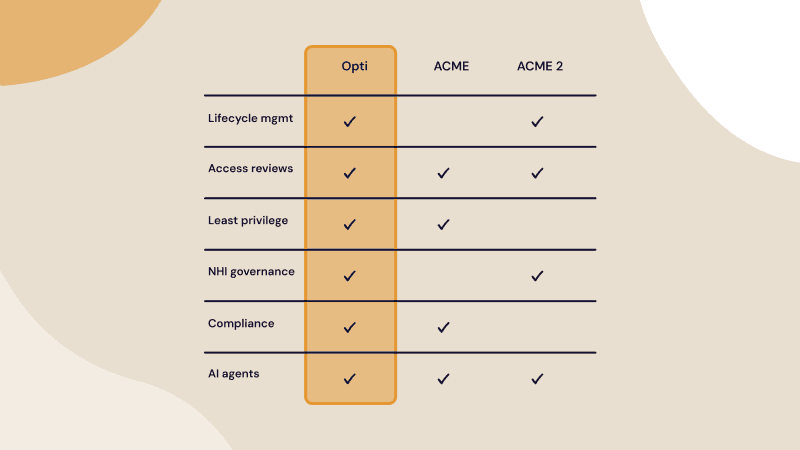
As enterprise environments grow more complex, governing access has outgrown manual processes and legacy tools. The bottleneck has shifted from having the data to being able to act on it, across human users, non-human identities, and AI agents operating across hundreds of applications.
Opti is an AI-native identity security platform that turns access management from a periodic, reactive process into a continuous operation. Purpose-built AI models power three core capabilities: risk visibility and remediation, automated access reviews, and intelligent access administration. Opti continuously analyzes identities, entitlements, and usage patterns across the environment, surfacing excessive access, SoD violations, and dormant permissions, and connects detection directly to remediation rather than leaving findings in a queue.
Risk visibility and remediation
Continuously identifies over-permissioned accounts, orphaned identities, toxic access combinations, and NHI exposure across cloud, SaaS, and on-premises environments. Automated workflows resolve findings rather than flagging them for manual follow-up.
Automated access reviews
Replaces periodic, manual certification with continuous, risk-based reviews driven by peer-group analytics, last-used data, and anomaly detection. High-risk access is prioritized; low-risk is auto-handled. The audit trail maintains itself.
Intelligent access administration
Automates joiner, mover, and leaver workflows using HRIS as the source of truth, ensuring every identity has the right access from day one and throughout its lifecycle. Access requests are handled through context-rich approval workflows, not blanket grants.
Human, NHI, and agentic identity coverage
Governs service accounts, API keys, machine identities, and AI agents with the same rigor applied to human users, including scoped permissions, lifecycle controls, and continuous review.
Opti deploys in hours across 250+ integrations, works alongside existing identity solutions, and is recognized by Gartner as a next-generation identity governance platform. It is the exclusive emerging IAM partner for AWS Security Hub Extended.
Microsoft Azure Active Directory
Azure Active Directory (Azure AD) is Microsoft’s cloud-based identity and access management (IAM) service, providing a comprehensive solution for managing and securing user identities, access rights, and authentication in the Azure ecosystem and other connected applications. Azure AD supports a wide range of applications, including both on-premises and cloud-based applications.
Key features of Azure AD include single sign-on (SSO), multi-factor authentication (MFA), conditional access, allowing administrators to define and enforce granular access policies, and identity protection, using machine learning algorithms to detect and block suspicious activities.
AWS IAM
AWS IAM is Amazon Web Services’ access management solution, designed to control and secure access to AWS resources and services. AWS IAM allows administrators to create and manage users, groups, and permissions, ensuring that only authorized users have access to the necessary AWS resources. Key features of AWS IAM include fine-grained access control, policy-based permissions, temporary security credentials, and integration with AWS services.
Key features of AWS IAM include multi-factor authentication (MFA), the ability to create and apply permissions to users, groups, or roles at a granular level, controlling access to specific resources and actions within AWS services, and the ability to define policies that define permissions for users, groups, and roles.
AWS Cognito
AWS Cognito is Amazon’s identity management service designed to authenticate and authorize users for web and mobile applications. It provides scalable authentication and access control with built-in support for social identity providers (Google, Facebook, Apple), enterprise identity providers (SAML, OIDC), and traditional username-password authentication.
Key features of AWS Cognito include user pools for user authentication, identity pools for granting temporary access to AWS resources, MFA, adaptive authentication based on risk analysis, and built-in security features like token-based authentication and automatic scaling. It also integrates with AWS Lambda for custom authentication flows.
Auth0
Auth0 is an identity-as-a-service (IDaaS) platform that provides authentication and authorization for applications through a flexible and developer-friendly approach. It supports various authentication methods, including social logins, enterprise identity providers, and passwordless authentication.
Key features of Auth0 include single sign-on (SSO), MFA, RBAC, and extensible authentication workflows using rules and hooks. It also offers robust API security, developer SDKs for various platforms, and compliance with security standards such as GDPR and SOC 2. Auth0’s adaptability makes it a popular choice for organizations needing secure and scalable identity management.
Technologies and Tools to Support Access Management
In a modern IT environment, there is a need for several different technologies to support access management. This includes solutions for segmenting the network to improve security and performance, remote access management, and security solutions that can help mitigate unauthorized access attempts.
Multi-Factor Authentication
Multi-factor authentication (MFA) is a security mechanism that requires users to provide multiple forms of verification before gaining access to a system or application. This approach enhances security by ensuring that even if one authentication factor is compromised, an attacker cannot gain access without the additional required factors.
MFA typically involves three categories of authentication factors:
Something You Know: a password or PIN
Something You Have: a hardware token, smart card, or mobile authentication app
Something You Are: biometric data such as fingerprints, facial recognition, or voice patterns
Modern MFA solutions integrate with identity providers, single sign-on (SSO) systems, and cloud applications, making them an essential component of access management. Organizations use MFA to secure user logins, protect sensitive data, and meet compliance requirements.
Access Reviews
Access reviews are a governance process used to verify that users have the appropriate level of access to systems, applications, and data. During an access review, managers, application owners, or data owners periodically examine user permissions and confirm whether access is still required. This helps organizations enforce the principle of least privilege and remove unnecessary or outdated permissions.
Access reviews are commonly performed on a scheduled basis, such as quarterly or annually, or after significant events like employee role changes or departures. Modern identity governance and administration (IGA) platforms automate much of the process by identifying accounts for review, notifying reviewers, tracking decisions, and recording audit evidence for compliance.
Regular access reviews reduce the risk of excessive privileges, orphaned accounts, and unauthorized access. They also help organizations meet regulatory and industry requirements, including ISO 27001, PCI DSS, HIPAA, and SOX, by demonstrating that user access is regularly validated and adjusted as business needs change.
Learn more in the detailed guide to Access Reviews
One-Time Password (OTP)
A One-Time Password (OTP) is a time-limited or single-use code generated to authenticate a user during a login or transaction. It adds a second factor beyond static passwords, reducing the risk of credential reuse and replay attacks. OTPs are typically valid for a short window or a single session, which limits their usefulness if intercepted.
There are two common OTP models:
HOTP (HMAC-Based One-Time Password): Generated using a shared secret and a counter that increments with each use.
TOTP (Time-Based One-Time Password): Generated using a shared secret and the current time, usually rotating every 30–60 seconds.
OTPs can be delivered through multiple channels:
SMS or Voice: Sent to a registered phone number; easy to deploy but vulnerable to SIM swap and interception.
Email: Delivered to a user’s inbox; dependent on email account security.
Authenticator Apps: Apps like Google Authenticator or Microsoft Authenticator generate TOTPs locally, avoiding network delivery risks.
Hardware Tokens: Dedicated devices that generate OTPs; provide strong security but add cost and management overhead.
In access management, OTPs are widely used for multi-factor authentication (MFA), step-up authentication for sensitive actions, and account recovery flows. They help mitigate password-based attacks such as credential stuffing and brute force attempts.
Learn more in the detailed guide to OTP
Related product offering: MessageWhiz OTP Protection | Secure OTP Verification for Account Protection
CAPTCHA
CAPTCHA (Completely Automated Public Turing test to tell Computers and Humans Apart) is a security feature designed to differentiate between human users and automated bots. It helps prevent automated attacks, such as credential stuffing, brute-force login attempts, and spam submissions.
Common types of CAPTCHA include:
Image-Based CAPTCHA: Users select images that match a given prompt (e.g., “select all traffic lights”).
Text-Based CAPTCHA: Users identify and enter distorted characters displayed on the screen.
ReCAPTCHA: A Google-powered solution that uses behavioral analysis and risk assessment to determine whether a user is human, often requiring no interaction.
hCaptcha: An alternative to reCAPTCHA that rewards website owners for solving security challenges.
CAPTCHAs are widely implemented on login pages, online forms, and eCommerce sites to prevent unauthorized or malicious activity. They must be balanced with user experience considerations to avoid excessive friction.
Learn more about CAPTCHA
Related product offering: Radware AI-Powered Bot Protection | Comprehensive Bot Management
Subscriber Identity Module (SIM)
A Subscriber Identity Module (SIM) is a secure hardware element, typically used in mobile devices, that stores unique identifiers and cryptographic keys used to authenticate a subscriber to a mobile network. Beyond cellular connectivity, SIM-based authentication has become an important component of access management across enterprise mobility, IoT ecosystems, and zero-trust architectures.
SIM authentication relies on challenge-response mechanisms defined in mobile network standards (e.g., GSM, UMTS, LTE), in which the SIM securely performs cryptographic operations without exposing its private keys. This provides a strong, hardware-backed “something you have” factor that is resistant to cloning and tampering.
Modern variants, such as eSIM (embedded SIM) and iSIM (integrated SIM), offer enhanced security and lifecycle management by enabling remote provisioning, over-the-air updates, and secure hardware isolation.
Key uses of SIM in access management include:
Device identity and verification: SIMs act as hardware-based identifiers for mobile devices, ensuring only authorized devices connect to enterprise networks or mobile services.
IoT access control: SIM and eSIM technology provide secure identity for IoT devices, enabling authenticated connections to cellular IoT networks, management platforms, and cloud services.
Enterprise mobility management (EMM): Organizations use SIM identity to enforce per-device access policies, manage BYOD environments, and tie network access to verified corporate devices.
Learn more in the detailed guide to Subscriber Identity Modules
Microsegmentation
Microsegmentation is a network security technique that divides a network into smaller, isolated segments (also called microsegments) to improve security and reduce the attack surface. By applying granular access controls and security policies to each microsegment, microsegmentation restricts communication between different parts of the network, limiting unauthorized access and lateral movement of potential attackers within the network.
Microsegmentation is particularly useful in modern, dynamic environments, such as cloud and virtualized infrastructures, where traditional perimeter-based security measures may be less effective. Implementing microsegmentation allows organizations to achieve better visibility and control over their network traffic, enabling them to detect and respond to threats more quickly.
Virtual Private Network (VPN)
A VPN is a technology that creates a secure, encrypted connection between a user’s device and a remote server over the public internet. VPNs are commonly used to protect user privacy, secure sensitive data transmissions, and bypass internet censorship or geographic restrictions.
When a user connects to a VPN, their internet traffic is routed through the VPN server, effectively masking their IP address and making it appear as if the traffic is originating from the server’s location. The encrypted tunnel established between the user’s device and the VPN server ensures that the data remains secure from eavesdropping, hacking, or interception.
VPNs are widely used by businesses to enable secure remote access to corporate networks, as well as by individuals seeking to maintain online privacy and security.
Zero Trust Network Access (ZTNA)
Zero trust is a security model that requires strict verification of user identities, devices, and contextual information before granting access to network resources, regardless of whether users are within or outside the organization’s perimeter. ZTNA operates under the principle of “never trust, always verify,” which assumes that potential threats exist both inside and outside the network.
ZTNA solutions typically employ technologies such as microsegmentation, multi-factor authentication (MFA), and least-privilege access to enforce granular access controls. This approach helps organizations minimize the attack surface, prevent unauthorized access, and mitigate the risk of lateral movement within the network. ZTNA is particularly relevant for modern, distributed workforces and cloud-based environments, where traditional perimeter-based security measures may be less effective.
Secure Access Service Edge (SASE)
SASE is a cybersecurity framework that converges network and security services into a single, cloud-native solution. It combines software-defined wide area networking (SD-WAN) and various security functions, such as secure web gateways, cloud access security brokers, firewall as a service, and zero trust network access (ZTNA), into a single, unified service. Delivered as a cloud-based, on-demand offering, SASE provides organizations with consistent security and network policies across all users, devices, and locations.
By integrating network and security services, SASE simplifies management, improves scalability, and enables more effective protection against evolving cyber threats for organizations with remote workforces and multi-cloud environments.
Endpoint Security
Endpoint security refers to the protection of devices, or endpoints, that connect to a network, such as laptops, smartphones, and tablets. It involves implementing security measures, including antivirus software, firewalls, and encryption, to defend these devices against cyber threats, unauthorized access, and data breaches.
Endpoint security helps safeguard an organization’s network by preventing malware infections, detecting vulnerabilities, and ensuring compliance with security policies, thereby reducing the overall risk to the network and its data.
Key Capabilities of Modern Access Management Platforms
Modern access management platforms go beyond authentication by helping organizations govern, monitor, and continuously validate who has access to which systems, applications, and data. These capabilities are especially important in complex environments with cloud applications, distributed teams, privileged users, and frequent organizational changes.
Key capabilities include:
Centralized identity visibility: Provides a unified view of users, roles, groups, permissions, and access relationships across applications, cloud environments, directories, and business systems.
Automated access reviews: Streamlines periodic access certification by assigning reviews to managers, application owners, or data owners, tracking decisions, and maintaining audit-ready evidence.
NHI governance: Discovers, inventories, and manages non-human identities such as service accounts, application identities, API keys, workloads, and machine identities.
Least-privilege enforcement: Helps identify excessive, outdated, or inappropriate access so organizations can reduce unnecessary permissions and limit the impact of compromised accounts.
Role and policy-based access controls: Supports access decisions based on job roles, departments, seniority, location, risk level, or business context, making permissions easier to manage at scale.
Joiner, mover, and leaver workflows: Automates access changes when employees join the organization, move to new roles, or leave, reducing manual work and preventing orphaned accounts.
Privileged access governance: Monitors and reviews high-risk permissions, admin accounts, and elevated privileges to ensure sensitive access is approved, justified, and regularly validated.
Risk-based prioritization: Highlights users, applications, or permissions that pose higher risk, allowing security and compliance teams to focus review efforts where they matter most.
Access request and approval workflows: Enables users to request access through structured workflows with business justification, manager approval, and policy checks before permissions are granted.
Separation of duties controls: Detects conflicting permissions that could create fraud, compliance, or operational risks, especially in finance, HR, ERP, and business-critical applications.
Audit trails and compliance reporting: Records access decisions, approval history, reviewer actions, and remediation steps to support frameworks such as SOX, ISO 27001, PCI DSS, HIPAA, and GDPR.
8 Access Management and Security Best Practices
The following best practices can help you create a strong access management strategy.
1. Mapping the Workforce and Assigning Privileges
To effectively manage access within an organization, it’s crucial to map the entire workforce, including employees, contractors, and partners. This process involves identifying each user’s job role, responsibilities, and required access levels to perform their tasks.
Assigning privileges based on the principle of least privilege helps make sure that users have access only to the resources necessary for their job, reducing the risk of unauthorized access and data breaches. Regularly reviewing and updating access permissions, especially during role changes or employee offboarding, is essential for maintaining a secure and compliant access management environment.
2. Creating Individual User Profiles with Clear Role Definitions
Implementing role-based access control (RBAC) or attribute-based access control (ABAC) helps streamline access management by associating users with predefined roles or attributes that determine their access permissions. When creating individual user profiles, it’s important to define roles and attributes intelligently, taking into account factors such as job responsibilities, department, seniority, and location.
This approach enables efficient, granular access management while minimizing the risk of excessive access permissions. Regularly reviewing and updating role definitions can be cumbersome but it ensures that they remain aligned with the organization’s evolving needs and security policies.
3. Enabling Passwordless Login
Traditional password-based authentication has several drawbacks, including susceptibility to brute-force attacks, phishing, and user error. Passwordless login methods, such as email, SMS, social media account, and biometrics, can improve security and enhance the user experience by replacing or augmenting passwords with more secure and convenient authentication options. Some passwordless login methods include:
Email: Users receive a unique, time-limited login link via email, eliminating the need to remember and enter a password.
SMS: Users receive a one-time passcode (OTP) via SMS, which they enter alongside their username to authenticate.
Social: Users can authenticate using their existing social media accounts, such as Facebook or Google, leveraging the platform’s built-in security features.
Biometrics: Users authenticate using unique biological characteristics, such as fingerprint, facial recognition, or iris scanning, which are difficult to forge or steal.
Adopting passwordless login methods can help reduce the risk of account compromise, simplify user onboarding, and improve overall security. However, it’s essential to carefully evaluate the security implications and potential trade-offs of each method before implementation, considering factors such as user privacy, device security, and regulatory compliance.
4. Identifying and Securing High-Value Data
High-value data, such as intellectual property, customer information, and financial records, are attractive targets for cybercriminals. It’s essential to identify and secure these sensitive assets by implementing strict access controls and security measures.
Data classification, encryption, and secure storage solutions can help protect high-value data from unauthorized access and breaches. Regularly monitoring and auditing access to sensitive data, as well as employing data loss prevention (DLP) solutions, can further enhance data security and ensure compliance with relevant regulations.
5. Conducting Third-Party Risk Management
Third-party risk management involves assessing and managing the risks associated with the use of third-party vendors and suppliers, including risks related to data privacy, security, and compliance. Third-party vendors and suppliers often require access to an organization’s resources and information in order to perform their services. Therefore, access management plays a key role in third-party risk management by ensuring that third-party vendors and suppliers are granted appropriate access to resources, based on their roles and responsibilities.
To manage third-party risk effectively, organizations must have a clear understanding of the access requirements for each third-party vendor and supplier, and ensure that access is granted and monitored in accordance with organizational policies and industry best practices. This involves implementing strong access management practices, such as identity and access management (IAM), single sign-on (SSO), and multi-factor authentication (MFA), and ensuring that these practices are extended to third-party vendors and suppliers.
Additionally, organizations must conduct regular assessments of third-party vendors and suppliers to ensure that they are meeting their contractual obligations and complying with applicable regulations and industry standards. These assessments should include a review of third-party vendors’ access controls, as well as their policies and procedures for managing access to organizational resources and information.
6. Use Just-in-Time Access for Privileged Roles
Privileged accounts present a higher security risk because they provide broad access to critical systems, sensitive data, and administrative functions. Instead of granting permanent administrative privileges, organizations should adopt just-in-time (JIT) access, which provides elevated permissions only when they are needed and automatically removes them when the approved task is complete. This reduces the attack surface and limits the impact of compromised privileged accounts.
JIT access is typically implemented through privileged access management (PAM) platforms that require users to request elevated access, provide a business justification, and obtain approval before privileges are granted. Access can be limited by time, application, device, or specific administrative tasks, and all privileged sessions should be logged and monitored. Combining JIT access with MFA, session recording, and regular access reviews helps organizations strengthen privileged access governance and meet compliance requirements.
7. Test Access Controls and Identify Gaps
Access controls should be tested regularly to verify that policies are working as intended and that users can access only the resources appropriate for their roles. Testing helps identify excessive permissions, misconfigured policies, orphaned accounts, broken approval workflows, and other weaknesses that could lead to unauthorized access or operational issues.
Organizations can validate access controls through periodic audits, access reviews, penetration testing, identity security assessments, and automated policy analysis. Monitoring authentication logs and access events also helps detect unusual behavior, such as repeated failed login attempts, privilege escalation, or access from unexpected locations or devices. Findings should be documented, prioritized based on risk, and remediated promptly to maintain a secure and compliant access management program.
8. Ensure Governance for NHIs and Agentic Identities
Organizations should apply the same governance standards to non-human identities (NHIs) and agentic identities as they do to human users. Service accounts, application identities, workloads, AI agents, API keys, and machine identities often operate with elevated privileges and can persist long after they are needed, making them attractive targets for attackers. Maintaining a complete inventory of these identities helps security teams understand where they exist, what they can access, and whether they are still required.
Permissions should be narrowly scoped according to the principle of least privilege, with each identity receiving only the access necessary to perform its specific function. Long-lived credentials should be replaced with short-lived tokens or workload identities where possible, while secrets, certificates, and API keys should be rotated regularly and stored in centralized secret management systems. Organizations should also establish lifecycle processes to create, update, and retire machine and AI identities as applications and services change. Continuous monitoring and periodic access reviews are essential to detect unused identities, excessive permissions, suspicious machine-to-machine activity, and unauthorized changes.
Access Management with Opti
Access Management with Opti
As enterprise environments grow more complex, governing access has outgrown manual processes and legacy tools. The bottleneck has shifted from having the data to being able to act on it, across human users, non-human identities, and AI agents operating across hundreds of applications.
Opti is an AI-native identity security platform that turns access management from a periodic, reactive process into a continuous operation. Purpose-built AI models power three core capabilities: risk visibility and remediation, automated access reviews, and intelligent access administration. Opti continuously analyzes identities, entitlements, and usage patterns across the environment, surfacing excessive access, SoD violations, and dormant permissions, and connects detection directly to remediation rather than leaving findings in a queue.
Risk visibility and remediation
Continuously identifies over-permissioned accounts, orphaned identities, toxic access combinations, and NHI exposure across cloud, SaaS, and on-premises environments. Automated workflows resolve findings rather than flagging them for manual follow-up.
Automated access reviews
Replaces periodic, manual certification with continuous, risk-based reviews driven by peer-group analytics, last-used data, and anomaly detection. High-risk access is prioritized; low-risk is auto-handled. The audit trail maintains itself.
Intelligent access administration
Automates joiner, mover, and leaver workflows using HRIS as the source of truth, ensuring every identity has the right access from day one and throughout its lifecycle. Access requests are handled through context-rich approval workflows, not blanket grants.
Human, NHI, and agentic identity coverage
Governs service accounts, API keys, machine identities, and AI agents with the same rigor applied to human users, including scoped permissions, lifecycle controls, and continuous review.
Opti deploys in hours across 250+ integrations, works alongside existing identity solutions, and is recognized by Gartner as a next-generation identity governance platform. It is the exclusive emerging IAM partner for AWS Security Hub Extended.
See Additional Guides on Access Management Topics
Access Reviews
Related guides
Authored by Opti
Identity and Access Management
Related guides
Authored by Opti
Identity Governance and Administration
Related guides
Authored by Opti
Complete Guide to Identity Governance and Administration (IGA)
Identity Governance: 7 Key Components, Challenges & Best Practices
IGA Solutions: Key Features, Evolution of IGA & Top 6 Platforms -
Unauthorized Access
Related guides
Authored by Bright Security
Unauthorized Access: Risks, Examples, and 6 Defensive Measures
Broken Access Control: Attack Examples and 4 Defensive Measures
OTP
Related guides
Authored by MessageWhiz
One-Time Password (OTP): How it Works, Delivery, and Top Use Cases
How OTP Messages Work, Use Cases, Risks, and Critical Best Practices
Related product offering: MessageWhiz OTP Protection | Secure OTP Verification for Account Protection
CAPTCHA
Related guides
Authored by Radware
Related product offering: Radware AI-Powered Bot Protection | Comprehensive Bot Management
Related technology updates:
[Blog] DragonForce Malaysia - #OpsBedil
[Case Study] How a 2-Second Improvement in Page Load Time More Than Doubled Conversions
Subscriber Identity Module
Related guides
Authored by floLIVE
Multi-Network Connectivity: 4 Technical Approaches, Pros & Cons
What Is Subscriber Identity Module (SIM)? Ultimate Guide [2025]
Complete Guide to IoT SIM Cards: Types, Form Factors & Connectivity
Endpoint Security
Related guides
Authored by BlueVoyant
Complete Guide to Endpoint Security: Solutions and Best Practices
EDR Security: How EDR Supports an Endpoint Security Strategy
Microsoft Security
Related guides
Authored by BlueVoyant
Third Party Risk Management
Related guides
Authored by BlueVoyant
Security Misconfiguration
Related guides
Authored by Bright Security